


















Lesson 10 of 43 · The Mind as Information Processor
Chapter 2 review: The mind as information processor
Review stages and reaction time, attention models and working memory with a one-page recap, a worked example about driving and a ten-question quiz.
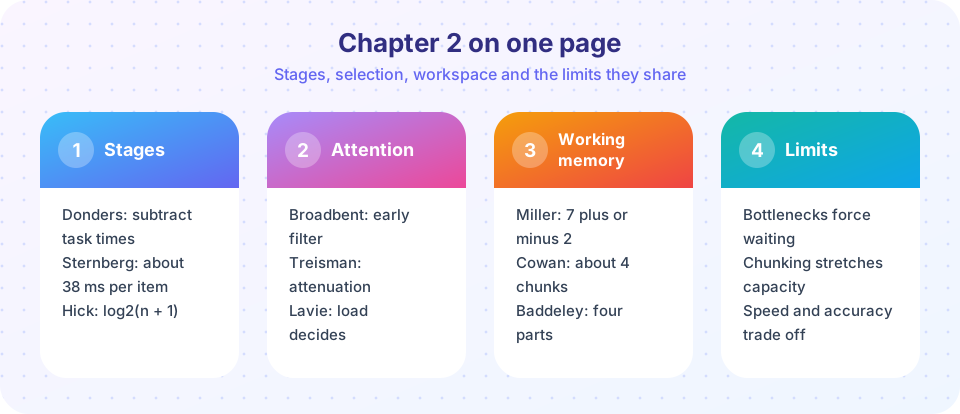
Chapter 2 treated the mind as a system with stages, bottlenecks and limited capacity. This review collects the main findings, applies them to one everyday problem, and tests you with a longer quiz.
What you will learn
- How the three lessons connect into one view of cognitive limits.
- How to reason about a practical problem (driving while using a phone) with these ideas.
- Which names, dates and results you should recall.
Recap table
| Topic | Core idea | Evidence and names |
|---|---|---|
| Reaction time and stages | Time differences between tasks reveal hidden stages | Donders 1868; Sternberg 1966 (about 38 ms per item); Hick's law (RT grows with log2(n + 1)) |
| Attention and filtering | Selection protects a limited-capacity system | Cherry 1953; Broadbent 1958; Treisman 1964; Deutsch and Deutsch 1963; Lavie 1995; Stroop 1935 |
| Working memory and capacity | A small workspace with several components | Miller 1956; Baddeley and Hitch 1974; Cowan 2001 (about 4 chunks); Chase and Simon 1973 |
Key terms
Bottleneck: a limited stage that makes information wait.
Attenuation: weakening rather than blocking unattended input.
Chunk: a meaningful unit stored as one item.
Speed-accuracy trade-off: faster responses tend to be less accurate.
A worked example: talking while driving
How would an information-processing psychologist analyze a driver on a phone call?
- Stages. The driver must perceive the road, identify hazards, select a response and execute it. A conversation requires its own perception, comprehension and response selection stages. If response selection is a shared bottleneck, the two tasks queue, so braking is delayed when a hazard appears during a conversation.
- Attention. Attenuation models say the unattended road is weakened, not blocked, but a weak signal may not reach the threshold for noticing an unexpected pedestrian. Load theory says a demanding conversation uses capacity, so irrelevant-looking road events are filtered out earlier. Inattentional blindness can occur even when the driver is looking at the hazard.
- Working memory. Following a conversation holds names, numbers and plans in the phonological loop. Driving uses the visuospatial sketchpad for the layout of surrounding cars. Because the loop and the sketchpad are somewhat separate, the combination is easier than two verbal tasks, but the central executive still has to switch and coordinate.
- Prediction. Reaction time to sudden events should be longer on a call, and the cost should not depend on holding the phone, since the bottleneck is in thinking, not in the hands. Controlled studies using driving simulators and real-road data generally report this pattern for both handheld and hands-free calls, though the size of the effect depends on conversation difficulty and traffic.
This example shows the pattern: map the task to stages, identify the limit, and make a prediction that can be checked.
Common misconceptions
"Capacity limits are a flaw of the brain." Limits force selection and protect processing, and chunking shows how knowledge can overcome them.
"Attention is a single thing." Attention involves selection, control, vigilance and orienting. Different tasks tap different aspects.
Try it
A chunking calculator. Given a string, it splits it into chunks of a chosen size and reports the number of chunks. Use it to see how grouping changes the load on a roughly four-chunk workspace. This is a simple illustration, not a model of the brain.
Press Run (or Ctrl + Enter) to see the result here.
Program input · what you'd type while the program runs
Type the answers before you press Run, one per line. Each time the program reads a line (with input()), it gets the next line from this box.
A sorter for the three classic models. Read each finding and decide which model best fits it. Compare your answers with the key.
Press Run (or Ctrl + Enter) to see the console output here.
No output.
Check your understanding
Quick check · 10 questions
of 10 answered You scored / 10 · perfect!
-
1. Which pair of tasks does Donders' subtraction method compare to estimate discrimination time?
Go/no-go adds a discrimination stage to simple reaction. -
2. In Sternberg's task, what did the straight-line increase of RT with set size suggest?
About 38 ms per item suggested serial scanning, though parallel models can mimic the pattern. -
3. Hick's law says choice RT grows with
RT = a + b log2(n + 1). -
4. Which model explains breakthrough of the listener's own name best?
Weakened signals can still cross a low threshold. -
5. According to load theory, distractors are least processed when
High perceptual load uses up capacity. -
6. Which finding supports the phonological loop?
The phonological similarity effect shows that verbal storage is sound-based. -
7. Chase and Simon's chess experiment shows that expert memory depends on
The advantage vanished for random boards. -
8. Cowan's revision of Miller's limit is about
With rehearsal and chunking limited, capacity is around four chunks. -
9. Why might a hands-free phone call still slow reactions while driving?
Shared central resources create interference regardless of how the call is held. -
10. What does the Stroop effect demonstrate?
Interference on incongruent trials reveals automatic processing and the effort of control.
Summary
- Stage models, attention models and working memory all describe limits on how much a mind can process at once.
- Timing methods (Donders, Sternberg, Hick) give indirect evidence about stages.
- Attention models differ on where and how selection happens, and load theory links them.
- Working memory holds about four chunks, with separate stores for sound and space plus a controller.
- Applying these ideas to a real problem means mapping stages, finding the bottleneck and predicting a testable cost.
Track your progress
Create a free account to tick off lessons and pick up where you left off on any device.
of Cognitive Science lessons completed