


















Lesson 7 of 43 · The Mind as Information Processor
Reaction time and stages
See how Donders' subtraction method and Sternberg's memory-scanning task use reaction times to estimate hidden mental stages, and where those methods break down.
How long does it take to think? Until the middle of the nineteenth century most people assumed thought was instantaneous. Then physiologists measured how fast nerves conduct signals, and a Dutch scientist named Franciscus Donders asked a bolder question: could you time a mental act itself? His answer launched a tradition, called mental chronometry, that is still one of the most productive tools in cognitive science.
What you will learn
- How Donders' subtraction method estimates the duration of a stage.
- What Sternberg's memory-scanning task showed about searching short-term memory.
- Hick's law and the speed-accuracy trade-off.
- Why timing logic can fail, and how researchers guard against that.
Key terms
Reaction time (RT): the time between a stimulus and the response.
Mental chronometry: using timing to infer the structure of mental processes.
Subtraction method: comparing two tasks that differ by one assumed stage and treating the RT difference as that stage's duration.
Speed-accuracy trade-off: responding faster usually means making more errors.
Donders' subtraction method
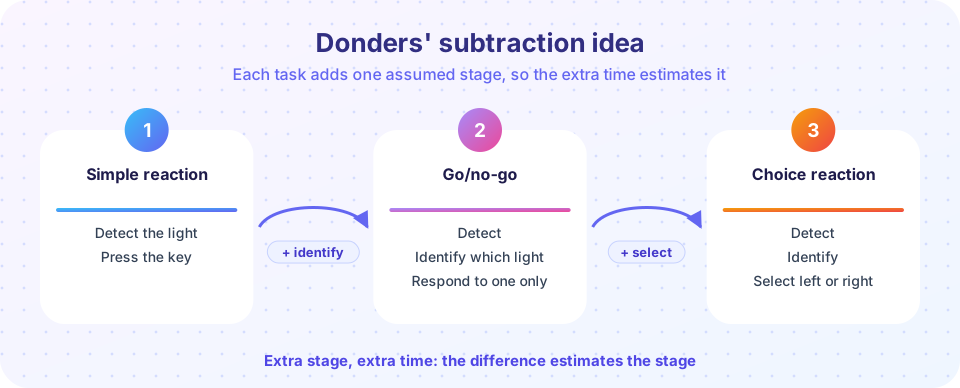
In 1868 Donders compared three tasks, which later authors labeled a, b and c reactions.
- Simple reaction (a): respond to a single, known signal. For example, press a key whenever a light appears. Required stages: detect the signal, execute the response.
- Go/no-go reaction (c in his scheme): respond to one signal but withhold the response to another. This adds discrimination: you must identify which signal appeared.
- Choice reaction (b): press the left key for one signal and the right key for another. This adds response selection: you must pick which response to make.
If each step adds one stage and nothing else changes, then:
discrimination time      = RT(go/no-go) - RT(simple)
response selection time  = RT(choice)   - RT(go/no-go)
The logic is appealingly simple: a hidden mental process is measured by a difference between two things you can measure. Reaction times for simple responses to a light are typically in the neighborhood of a couple of hundred milliseconds, and choice responses take longer, but the exact numbers depend on the person, the stimulus and the equipment.
The weakness: pure insertion
The method assumes pure insertion: adding a stage changes nothing else. That might be false. Maybe in the choice task, the earlier stages run differently because the person has to hold two rules in mind. If so, the subtraction mixes together the added stage and the side effects. Donders' successors found that the method gives sensible estimates for some tasks and misleading ones for others, and that it needs independent checks.
Sternberg's memory-scanning task
In 1966 Saul Sternberg asked: when you hold a short list in mind and a probe appears, how do you decide whether the probe was on the list? Participants memorized a set of digits (one to six), then saw a single probe digit and pressed "yes" or "no". The striking result was that reaction time rose in a straight line with the size of the memory set, at roughly 38 ms per item, and the slope was about the same for "yes" and "no" answers.
Sternberg interpreted this as serial exhaustive scanning: you compare the probe with each item one after another, and you keep going through the whole list even after finding a match. The idea of exhaustive search felt odd at first (why continue after finding it?), and later work offered alternatives, including parallel models that can mimic the same pattern. This is a general lesson: the same RT data can be consistent with several mechanisms, so researchers look for experiments that separate them.
Sternberg also developed the additive-factors method. If two experimental manipulations affect different stages, their effects on RT add up. If they affect the same stage, they interact. Seeing additivity or interaction thus gives evidence about which stages are shared.
Hick's law
Choosing among more alternatives takes longer, but not in proportion. W. E. Hick (1952) and Ray Hyman (1953) found that choice reaction time grows with the logarithm of the number of equally likely alternatives:
RT = a + b * log2(n + 1)
Here n is the number of alternatives and a and b are constants fitted to data. This fits nicely with Shannon's information theory from the previous chapter: each doubling of choices adds roughly one bit and a fixed increment of time. Hick's law describes many menus, dashboards and controls, though it holds best for simple, practiced mappings.
Speed and accuracy
If you rush you make more errors, if you are careful you slow down. This speed-accuracy trade-off means RT must be interpreted along with accuracy. Researchers instruct participants to be both fast and accurate, analyze errors, or use models (such as drift-diffusion models, which treat a decision as noisy evidence accumulating toward a threshold) that explain both together.
Why timing data are useful and why they need care
RT is cheap, precise and sensitive. But it measures the whole chain, including how fast the finger moves and how cautious the person is. Good practice involves many trials, careful control of the timing hardware (the browser demos in this course are rough), outlier handling and, importantly, a theory that says what the numbers should do.
Common misconceptions
"A faster reaction time means higher intelligence." Simple RT shows modest relationships with some measures in research, but it is influenced by age, fatigue, practice, strategy and the apparatus. It is not an IQ score.
"Stages have been proven to exist in the brain." Stage models are theories that fit timing data. Alternative accounts, including overlapping or parallel processing, are also tested.
"The Sternberg task shows people search memory one item at a time." It shows a linear RT pattern that serial scanning explains well, but other models can produce similar patterns.
Try it
A simulation of Donders' method. The simulated person has fixed true stage durations plus random noise; we estimate the stages from the averages. These are invented parameters, shown to illustrate the logic.
Press Run (or Ctrl + Enter) to see the result here.
Program input · what you'd type while the program runs
Type the answers before you press Run, one per line. Each time the program reads a line (with input()), it gets the next line from this box.
A simulation of Sternberg's task. We generate noisy RTs that rise 38 ms per list item and fit a line. The data are simulated from that assumption.
Press Run (or Ctrl + Enter) to see the result here.
Program input · what you'd type while the program runs
Type the answers before you press Run, one per line. Each time the program reads a line (with input()), it gets the next line from this box.
Check your understanding
Quick check · 5 questions
of 5 answered You scored / 5 · perfect!
-
1. In Donders' scheme, which difference estimates the time for response selection?
The choice task adds response selection to the go/no-go task, so their difference estimates it. -
2. What is the pure insertion assumption?
Subtraction only works if the added stage leaves the others unchanged. -
3. Sternberg found that RT in the memory-scanning task
The slope was about 38 ms per item, similar for yes and no answers. -
4. According to Hick's law, doubling the number of equally likely choices
RT grows with log2(n + 1), so each doubling adds about one bit and a constant amount of time. -
5. Why must RT be read together with accuracy?
People can trade speed for accuracy, so faster RTs may simply mean more errors.
Summary
- Mental chronometry infers hidden stages from reaction times.
- Donders' subtraction method estimates a stage by comparing tasks that differ by one stage, assuming pure insertion.
- Sternberg's task showed a linear increase in RT with memory set size, about 38 ms per item, and the additive-factors method.
- Hick's law relates choice RT to the logarithm of the number of alternatives.
- Always consider speed-accuracy trade-offs and alternative mechanisms.
Next: Attention and filtering
Track your progress
Create a free account to tick off lessons and pick up where you left off on any device.
of Cognitive Science lessons completed