


















Lesson 13 of 43 · Philosophy of Mind
Functionalism and computation
Understand functionalism, multiple realizability, Turing machines and the computational theory of mind, with objections such as the China brain and absent qualia.
Suppose you meet a being from another planet whose body is made of something other than carbon chemistry. It shrieks and pulls away when injured, tries to avoid injury, learns from it and reports distress. Is it in pain? If you say yes, you have implicitly accepted the idea behind functionalism: what makes something a pain is not what it is made of, but what it does. This view turned philosophy of mind toward the information-processing picture of cognitive science.
What you will learn
- The functionalist definition of a mental state and the idea of multiple realizability.
- What a Turing machine is and why it matters for the computational theory of mind.
- Machine functionalism and its link to Marr's levels.
- The main objections: the China brain, absent qualia and the inverted spectrum.
Key terms
Functionalism: a mental state is defined by its causal role: what causes it, what it causes, and how it interacts with other mental states.
Multiple realizability: the same mental state can be realized by different physical systems.
Turing machine: an abstract machine that reads and writes symbols on a tape according to a table of rules.
Computational theory of mind: the view that mental processes are computations.
Substrate independence: the idea that what matters is the organization, not the material.
What functionalism says
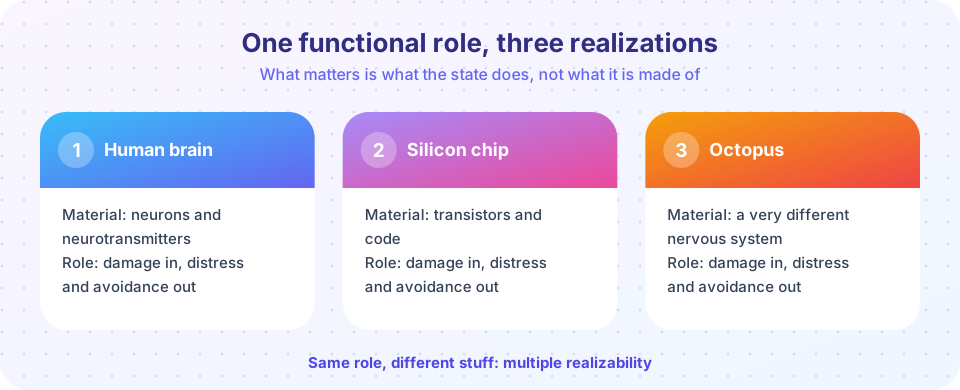
A thermostat is defined by its function: it senses temperature and switches heating on or off. You can build one from a bimetallic strip, a digital chip or a mechanical lever. The same, said Hilary Putnam in the 1960s, holds for mental states. Pain is the state that is typically caused by bodily damage, tends to cause distress and avoidance, and interacts with beliefs and desires. Whatever occupies that role is pain.
Notice how this answers the objection that sank identity theory: octopuses, humans and possibly robots can all be in pain, because pain is the role, not the particular neurons. It also respects the behaviorist insight that mental states are tied to behavior, while allowing internal states to cause it, which Ryle's view could not.
The causal role of a mental state includes other mental states. Believing it will rain leads you to take an umbrella if you want to stay dry. Functionalists accept this holism: the whole system of mental states is defined together, by the network of causal relations among inputs, internal states and outputs.
Turing machines and computation
A Turing machine, described by Alan Turing in 1936, consists of an endless tape of cells, a head that reads and writes symbols, and a finite table of rules: "in state S, reading symbol X, write Y, move left or right, and switch to state T". Despite its simplicity, it can carry out any procedure that can be described step by step. The Church-Turing thesis says that this captures what we mean by computation. It is a thesis, not a theorem, because "what we mean" is informal.
Machine functionalism (an early version championed by Putnam) said that the mind is, in effect, the machine table of a very complex Turing machine, and mental states are its internal states. Jerry Fodor and Zenon Pylyshyn later developed the computational theory of mind: thinking is the manipulation of mental representations according to rules, which links directly to the symbolic tradition from the history lesson.
Connection to Marr's levels from what is cognitive science: functionalism lives at the computational and algorithmic levels, and is deliberately neutral about the implementational level. That is why the same cognitive model can be tested on people and on programs.
Why functionalism is attractive
- It explains how minds can be studied without knowing everything about neurons.
- It makes cognitive science's use of computer models principled.
- It gives a physicalist answer: every mental state is realized by some physical state, so nothing non-physical is needed.
- It opens the door to artificial minds, which is the subject of chapter 7.
Objections
The China brain
Ned Block (1978) imagined the population of China, each person with a two-way radio, following instructions that reproduce the functional organization of a brain for an hour. If functionalism is right, the whole nation would have a mind, but that seems absurd. Defenders reply that our intuition about the nation is unreliable (the "system" is enormous and slow), while critics say the example shows that function alone cannot be enough.
Absent and inverted qualia
A functional duplicate of you might lack conscious experience (absent qualia), or have experiences with different feel, such as seeing what you see as red as what you call green (inverted spectrum), while behaving identically. If such cases are possible, experience is not exhausted by function. Whether they are really conceivable, and whether conceivability implies possibility, is highly contested.
Too liberal or too narrow?
Functionalism can seem too liberal: a system might match the roles and still lack mentality (as Searle's argument in the next lesson claims). It can seem too narrow if the roles are described too finely: then a creature with a slightly different psychology would count as lacking pain. Finding the right level of description for the roles is a hard problem.
Common misconceptions
"Functionalism says brains are computers." It says mental states are defined by roles, which computers could in principle share. It does not claim that current computers are minded.
"Multiple realizability proves minds are not physical." It shows that mental kinds are not the same as physical kinds, but each instance can still be physical.
"The Turing machine is a blueprint for brains." It is a mathematical idealization of computation, not a model of neural hardware.
Try it
Multiple realizability in miniature. The function XOR (true when exactly one input is true) is built three ways: from NAND gates, from a lookup table, and from arithmetic. Their internal workings differ, but they play the same role.
Press Run (or Ctrl + Enter) to see the result here.
Program input · what you'd type while the program runs
Type the answers before you press Run, one per line. Each time the program reads a line (with input()), it gets the next line from this box.
A tiny Turing machine. The rule table below adds one to a binary number on the tape. It is a teaching simulation of the idea described above.
Press Run (or Ctrl + Enter) to see the result here.
Program input · what you'd type while the program runs
Type the answers before you press Run, one per line. Each time the program reads a line (with input()), it gets the next line from this box.
Check your understanding
Quick check · 5 questions
of 5 answered You scored / 5 · perfect!
-
1. According to functionalism, what makes a state a pain?
Functionalism defines mental states by causal role, not material. -
2. Multiple realizability supports functionalism over type identity theory because
If pain can be realized in octopuses and humans, it cannot be identical to one type of brain state. -
3. A Turing machine consists of
That abstract design is enough for any step-by-step procedure. -
4. What does Block's China brain thought experiment challenge?
It suggests an implausible case where function is present but a mind seems absent. -
5. Where does functionalism sit in Marr's scheme?
It is deliberately neutral about the material that realizes the roles.
Summary
- Functionalism defines mental states by their causal roles, so the same state can be realized in different materials.
- Turing machines formalize computation; the computational theory of mind treats thinking as computation over representations.
- Functionalism fits cognitive science's use of models and allows artificial minds in principle.
- Objections include the China brain, absent qualia, inverted spectra and the worry that function may be too liberal or too narrow.
Track your progress
Create a free account to tick off lessons and pick up where you left off on any device.
of Cognitive Science lessons completed