


















Lesson 28 of 43 · Language, Vision and Embodiment
Visual Perception: From Light to Objects
Follow vision from retina to cortex: edge detectors, the ventral and dorsal streams, Gestalt grouping, illusions as unconscious inference, and change blindness.
Vision feels like looking through a window. You open your eyes and the world is simply there: stable, colorful, full of objects. But the eye is more like a camera with a few odd features. It has a small high-resolution center, a blind spot, and it jerks around several times a second. The picture on the retina is flat, upside down and constantly changing. Everything you see as a stable 3D scene is built by the brain.
This lesson follows that construction: the first stages that find edges, the two routes that carry information to different jobs, the rules that group parts into wholes, and the surprising things we fail to see.
What you will learn
- What the retina, thalamus and primary visual cortex do.
- What Hubel and Wiesel found and why it mattered.
- The difference between the ventral and dorsal streams.
- Gestalt grouping principles and what illusions reveal.
- Why unattended things can go unseen.
Key terms
Receptive field: the region of the visual field in which a stimulus changes a neuron's firing.
V1: the primary visual cortex, the first cortical stage for vision, at the back of the brain.
Ventral stream: the route toward the temporal lobe, associated with recognizing what things are.
Dorsal stream: the route toward the parietal lobe, associated with guiding action in space.
Change blindness: failure to notice large changes in a scene when attention is elsewhere.
Retina to cortex
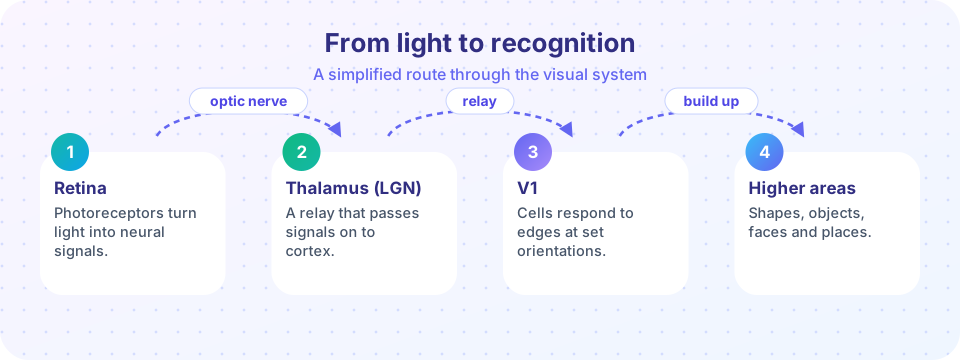
Light is absorbed by photoreceptors: rods for dim light and cones for color and detail. Retinal cells begin comparing neighboring points, responding to contrast rather than absolute brightness. Signals travel along the optic nerve to a relay in the thalamus called the lateral geniculate nucleus (LGN) and then to V1.
In the late 1950s and 1960s David Hubel and Torsten Wiesel recorded from single neurons in cat visual cortex. They found that many cells in V1 respond best to an oriented edge or bar at a particular position and angle. They called these simple cells; complex cells respond to the same orientation regardless of exact position. Hubel and Wiesel shared a 1981 Nobel Prize for this work. The result suggests that vision builds complexity in stages: edges first, then combinations of edges, then shapes.
Two streams
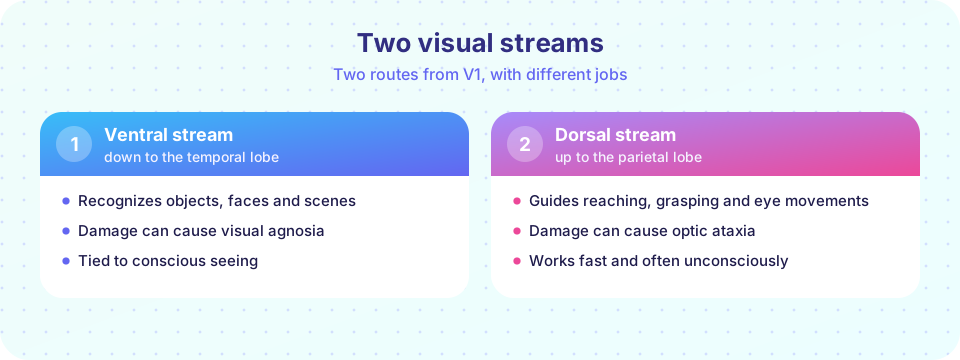
In 1982 Leslie Ungerleider and Mortimer Mishkin proposed that visual information splits into a ventral stream for "what" and a dorsal stream for "where". Later David Milner and Melvyn Goodale (1992) refined the dorsal idea to "how": guiding action. Their evidence came from a patient known as DF, who had brain damage after carbon monoxide poisoning. DF could not report the orientation of a slot, yet she could post a card through it correctly. Seeing for recognition and seeing for action could be pulled apart.
This is not a rigid division, since the streams interact constantly, but it is a useful map of damage patterns. Damage to ventral areas can cause visual agnosia, failure to recognize objects despite intact basic vision. Damage to parts of the dorsal stream can cause optic ataxia, trouble reaching accurately for objects you can see.
Grouping: the whole before the parts
The Gestalt psychologists, led by Max Wertheimer in the 1920s, argued the mind organizes input into wholes by simple principles:
- Proximity: nearby items group together.
- Similarity: items that look alike group.
- Closure: we fill gaps to see complete shapes.
- Good continuation: we prefer smooth lines to abrupt turns.
- Common fate: things that move together group together.
These principles are rules of thumb, and modern work tests them quantitatively, but they capture how perception makes sense of clutter.
Perception as inference
Hermann von Helmholtz proposed in the nineteenth century that perception is unconscious inference: the brain guesses the most likely cause of its sensory input. That fits the Bayesian view of the last chapter. Illusions are what such inference looks like when the guess is wrong. In the Müller-Lyer illusion (1889), two lines of identical length look unequal because of the arrowheads at their ends. A common explanation is that the figure resembles corners in the 3D world, which triggers size-adjustment processes that usually help us, though researchers still debate the exact cause.
Marr's framework, from the last chapter, applies here too. He described a progression from an initial primal sketch of edges, to a 2.5D sketch of surfaces and depth seen from your viewpoint, to a viewer-independent 3D model.
Seeing is selective
You do not take in the whole scene equally. In a well-known 1999 experiment Daniel Simons and Christopher Chabris asked people to count basketball passes while a person in a gorilla suit walked through the scene. About half of observers did not notice the gorilla. This is inattentional blindness. In related change blindness studies, such as work by Ronald Rensink and colleagues in 1997, people miss large changes if the change happens during a brief flicker or an eye movement. Attention, not just the eye, determines what reaches awareness.
Common misconceptions
"The eye is like a camera, and vision is a recording." The brain actively constructs perception from partial, noisy samples and prior knowledge.
"Illusions show the brain is broken." They show a system optimized for the real world revealing its assumptions in unusual stimuli.
Try it
Press Run (or Ctrl + Enter) to see the result here.
Program input · what you'd type while the program runs
Type the answers before you press Run, one per line. Each time the program reads a line (with input()), it gets the next line from this box.
Press Run (or Ctrl + Enter) to see the result here.
Program input · what you'd type while the program runs
Type the answers before you press Run, one per line. Each time the program reads a line (with input()), it gets the next line from this box.
Check your understanding
Quick check · 5 questions
of 5 answered You scored / 5 · perfect!
-
1. What did Hubel and Wiesel find in cat V1?
Many V1 cells prefer a bar or edge at a particular orientation and location. -
2. Patient DF could post a card through a slot but not report its orientation. This supports:
It suggested distinct ventral (perception) and dorsal (action) processing. -
3. Which Gestalt principle explains seeing a circle with small gaps as a whole circle?
Closure is the tendency to fill gaps to perceive complete forms. -
4. In the Simons and Chabris gorilla study, about how many viewers missed the gorilla?
About half of the observers who were counting passes did not notice it. -
5. Helmholtz described perception as:
He proposed that the brain unconsciously infers the likeliest causes of sensory input.
Summary
- Vision is constructed: retina, LGN and V1 extract edges, and higher areas build shapes and objects.
- A ventral stream supports recognition and a dorsal stream supports action.
- Gestalt principles describe how the mind groups elements into wholes.
- Illusions and inattentional blindness reveal the inferences and selectivity of perception.
Next: Embodied cognition
Track your progress
Create a free account to tick off lessons and pick up where you left off on any device.
of Cognitive Science lessons completed