


















Lesson 37 of 43 · Consciousness and Frontiers
Measuring Consciousness and Its Frontiers
How researchers catch consciousness: blindsight, masking, signal detection, no-report paradigms, patients and anesthesia, animal consciousness and machines.
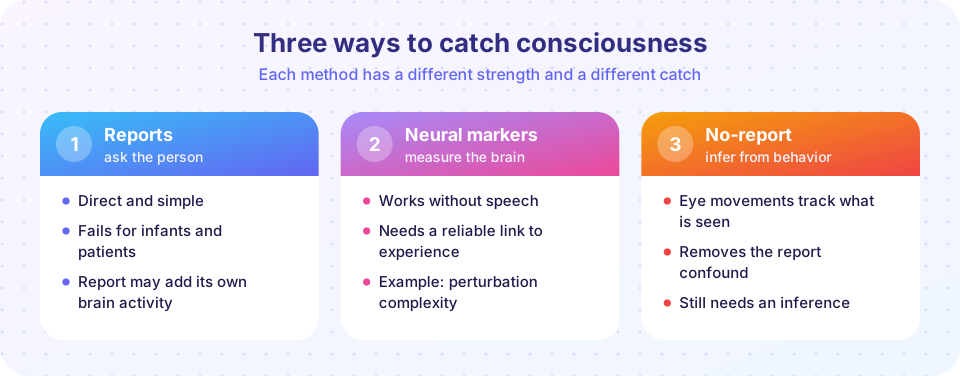
How do you measure something that only the person having it can directly observe? That is the central methodological problem of consciousness science. The standard answer is indirect: arrange for the same stimulus to be sometimes consciously seen and sometimes not, then compare brain activity and behavior across the two conditions. Any difference is a candidate for what consciousness adds.
This lesson explains that strategy, its pitfalls, and how the same questions extend to patients, animals and machines.
This lesson is educational information about research. It is not medical advice and cannot be used to assess any person's condition.
What you will learn
- The contrastive method and how blindsight and masking support it.
- How signal detection theory separates sensitivity from willingness to say yes.
- Why report itself can confuse results and what no-report designs do.
- What research on patients, anesthesia, animals and AI says, and its limits.
Key terms
Contrastive analysis: comparing conscious with unconscious processing of matched stimuli.
Blindsight: above-chance guessing about stimuli in a visual field region where the person reports seeing nothing, after damage to V1.
d-prime (d'): a signal detection measure of sensitivity, independent of response bias.
Metacognition: knowing about one's own mental states, such as how confident you are.
No-report paradigm: an experiment that infers experience without asking for a report during the measured period.
Seen versus unseen
Several laboratory tricks make a stimulus sometimes visible and sometimes not, while the physical input stays nearly the same.
- Masking: a brief image is flashed and followed quickly by another image that hides it.
- Binocular rivalry: different images are shown to the two eyes, and your experience alternates between them while the input is constant. Nikos Logothetis and colleagues recorded in monkeys during rivalry and found neurons whose activity followed what the animal perceived.
- Blindsight: after damage to V1, some people report no vision in part of their visual field but can still point to or guess the location or type of objects above chance. Lawrence Weiskrantz and colleagues studied such patients, notably DB, from the 1970s. This shows that some visual processing can guide behavior without reported experience, though researchers debate whether the experience is truly absent or just very weak and uncertain.
Signal detection theory
When you decide whether a faint stimulus was present, two things matter: how well your senses separate signal from noise (sensitivity) and how readily you say yes (criterion or bias). Signal detection theory, developed by David Green and John Swets in 1966, separates them. Sensitivity is measured by d', computed from the hit rate H and false-alarm rate F as d' = z(H) - z(F), where z is the inverse of the standard normal cumulative distribution.
Why does this matter for consciousness? A cautious person who says "I saw nothing" may still carry information about the stimulus. If forced to guess, they perform above chance. Researchers therefore ask for a confidence or awareness rating as well, such as the four-point Perceptual Awareness Scale, and compare accuracy at different awareness levels. Whether a person "saw" depends on where they set their criterion, which complicates simple claims about unconscious perception.
The problem of report
Asking people to report affects what the brain does. Activity might reflect decision, attention, memory or motor preparation, not experience itself. A seminal case is Benjamin Libet's 1983 work on voluntary movement: a slowly building brain signal, the readiness potential, began hundreds of milliseconds before people reported their conscious urge to move. It was widely read as showing free will is illusory. Later work, including a 2012 study by Aaron Schurger, Jacobo Sitt and Stanislas Dehaene, suggested that the signal may reflect random fluctuations in neural activity that cross a threshold, so its meaning is disputed.
No-report paradigms try to avoid the problem. In rivalry experiments, researchers can infer which image is seen from involuntary eye movements, so the participant need not press buttons. Early results suggested that some brain signals that look like consciousness in report tasks, for instance late frontal activity, may reflect the act of reporting, which is important for adjudicating between workspace and recurrent theories.
Patients and anesthesia
In 2006 Adrian Owen and colleagues used fMRI with a woman who met the criteria for the vegetative state. When asked to imagine playing tennis or walking around her house, her brain showed activity patterns like those of healthy volunteers doing the same. This suggested some patients diagnosed as unresponsive might be aware, and has led to methods for detecting covert awareness.
Another line of work probes the brain with a magnetic pulse and records the EEG response. The perturbational complexity index, introduced by Marcello Massimini, Adenauer Casali and colleagues in 2013, was high in awake people and low in deep sleep and under anesthesia. It is an example of a theory-neutral marker that works without speech, though its use in clinical decisions remains the subject of ongoing research.
Animals
Consciousness probably does not depend on language, but language was our usual way to tell. In 2012 a group of neuroscientists signed the Cambridge Declaration on Consciousness, stating that many non-human animals, including mammals and birds, have the neurological substrates that generate conscious states, and mentioning the octopus. A 2024 New York Declaration on Animal Consciousness, signed by many researchers, argued that there is at least a realistic possibility of consciousness in all vertebrates and many invertebrates. These statements are consensus positions of groups, not proofs, and they spark debates about which evidence counts: behavior, brain structures or both.
Machines
Could an artificial system be conscious? In 2023 a team led by Patrick Butlin and Robert Long reviewed several scientific theories and extracted a list of indicator properties for an AI system, such as recurrent processing, a global workspace and self-monitoring. They concluded that no current system was a strong candidate for consciousness, while seeing no obvious technical barrier to building systems that satisfy the indicators. The answer depends on which theory is right: IIT would deny digital computers any consciousness, while workspace theory would allow it in a suitable architecture.
Common misconceptions
"Blindsight proves unconscious perception is the same as conscious perception minus a switch." The interpretation is debated, and patients differ.
"If a brain scan shows activity, the person is conscious." Activity can occur without awareness, and the link depends on the theory and the signal.
Try it
Press Run (or Ctrl + Enter) to see the result here.
Program input · what you'd type while the program runs
Type the answers before you press Run, one per line. Each time the program reads a line (with input()), it gets the next line from this box.
Check your understanding
Quick check · 5 questions
of 5 answered You scored / 5 · perfect!
-
1. What is the contrastive method?
Researchers use masking, rivalry and similar tricks to keep the input similar while experience differs. -
2. d-prime measures:
It is computed from hit and false-alarm rates and does not depend on the criterion. -
3. What problem do no-report paradigms try to avoid?
Report involves decision and motor processes that can contaminate signals linked to experience. -
4. Owen and colleagues' 2006 fMRI study of a patient in a vegetative state suggested that:
The patient's brain showed tennis and navigation imagery patterns on command. -
5. The 2023 Butlin, Long and colleagues report concluded that:
They used indicator properties derived from theories and found current systems lacking.
Summary
- Consciousness is studied by contrasting seen with unseen stimuli and by finding correlates, with the report problem always in the background.
- Signal detection theory separates sensitivity from criterion, which matters when interpreting "I saw nothing".
- Patient and anesthesia research aim for report-free markers.
- Claims about animals and machines depend on which theory of consciousness one adopts.
Next: Chapter review
Track your progress
Create a free account to tick off lessons and pick up where you left off on any device.
of Cognitive Science lessons completed