


















Lesson 42 of 43 · Projects and Practice
Cheat Sheet: Cognitive Science in Two Pages
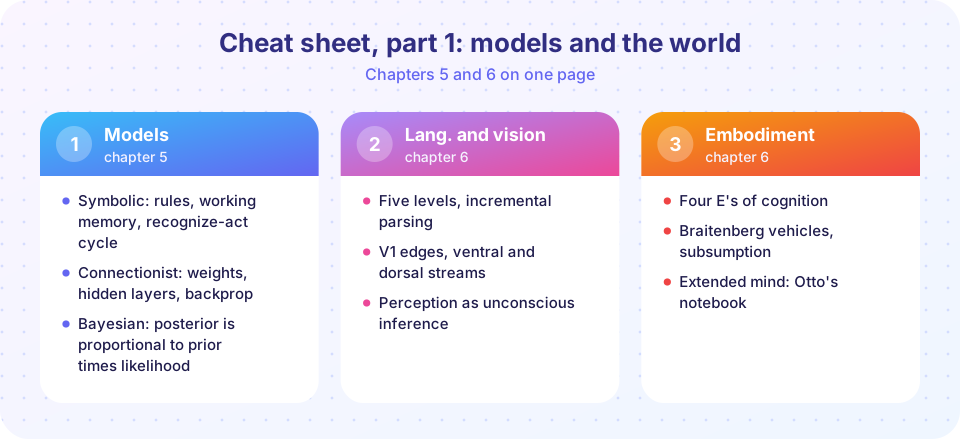
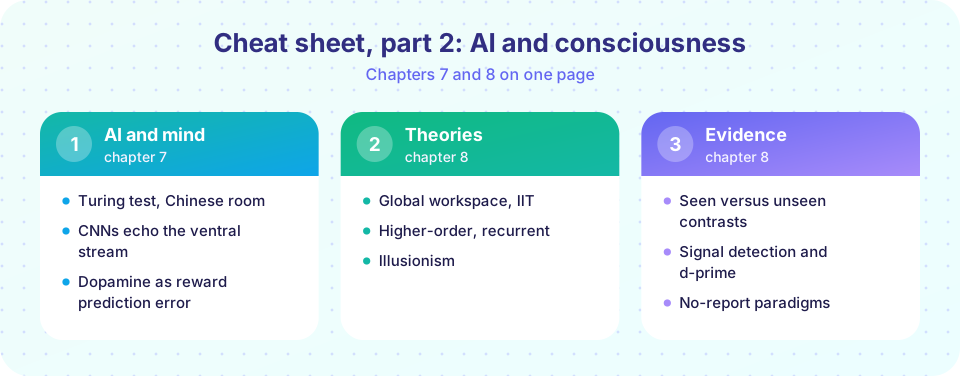
A two-picture recap of models of cognition, language, vision, embodiment, AI and consciousness, plus the key formulas and a table of landmark names and findings.
This is the revision page for the second half of the course. Two summary pictures cover chapters 5 to 8, a short table collects the formulas that appear in the lessons, and a final table lists landmark names with what they found.
What you will learn
- The one-line version of every major idea in chapters 5 to 8.
- The formulas worth remembering.
- Which name belongs to which result.
Formulas worth remembering
| Idea | Formula | Plain reading |
|---|---|---|
| Bayes' rule | P(H given D) = P(D given H) * P(H) / P(D) |
Posterior from prior and likelihood |
| Perceptron update | w = w + rate * (target - output) * x |
Nudge weights toward fewer errors |
| Cue combination | weight_i = precision_i / sum of precisions |
Trust the reliable cue more |
| Precision | precision = 1 / variance |
Reliability of a signal |
| TD error | error = reward + V(next) - V(now) |
Reward received versus expected |
| d-prime | d' = z(hit rate) - z(false-alarm rate) |
Sensitivity apart from bias |
| Hopfield weights | w[i][j] = (1/N) * sum of patterns' x[i] * x[j] |
Hebbian storage |
| Hopfield capacity | about 0.14 * N random patterns |
Beyond this recall collapses |
Landmark names and findings
| Name and year | Finding or idea |
|---|---|
| Newell and Simon, 1976 | Physical symbol system hypothesis |
| Marr, 1982 | Three levels of explanation |
| Rumelhart, Hinton, Williams, 1986 | Backpropagation popularized |
| Fodor and Pylyshyn, 1988 | Systematicity objection to connectionism |
| Ernst and Banks, 2002 | Humans combine sight and touch near-optimally |
| Meyer and Schvaneveldt, 1971 | Semantic priming in word recognition |
| Hubel and Wiesel, 1959 to 1962 | Orientation-tuned cells in V1 |
| Milner and Goodale, 1992 | Vision for perception versus action (patient DF) |
| Simons and Chabris, 1999 | Inattentional blindness (gorilla) |
| Braitenberg, 1984; Brooks, 1991 | Behavior from sensor-motor coupling and layers |
| Clark and Chalmers, 1998 | Extended mind |
| Turing, 1950; Searle, 1980 | Imitation game; Chinese room |
| Schultz, Dayan, Montague, 1997 | Dopamine as reward prediction error |
| Nagel, 1974; Chalmers, 1995 | What it is like; the hard problem |
| Baars, 1988; Dehaene | Global workspace |
| Tononi, 2004 onward | Integrated information theory |
| Green and Swets, 1966 | Signal detection theory |
| Owen et al., 2006 | Covert awareness in a vegetative-state patient |
Five habits of a good cognitive scientist
- Ask what is stored, how it is used, how it is learned and where the model fails.
- State which level of explanation a claim is at.
- Distinguish similar behavior from similar mechanism.
- Prefer replicated results and be skeptical of small surprising effects.
- Keep first-person reports and third-person data in view together.
Check your understanding
Quick check · 3 questions
of 3 answered You scored / 3 · perfect!
-
1. In cue combination, a cue's weight is proportional to its:
Reliable cues, those with high precision, get more weight. -
2. Which formula gives the temporal-difference error?
The error compares reward plus the next state's value to the current estimate. -
3. Who is paired correctly with the hard problem?
Chalmers introduced the easy versus hard problem distinction in 1995.
Summary
- Models differ in what they take knowledge to be; perception and action rely on inference and context.
- AI sharpens questions about understanding, and consciousness science struggles to measure experience.
- A handful of formulas recur: Bayes, the perceptron rule, precision weighting, TD error, d-prime.
- Good habits matter as much as facts.
Next: Further study
Track your progress
Create a free account to tick off lessons and pick up where you left off on any device.
of Cognitive Science lessons completed