


















Lesson 30 of 43 · Language, Vision and Embodiment
Language, Vision and Embodiment: Chapter Review
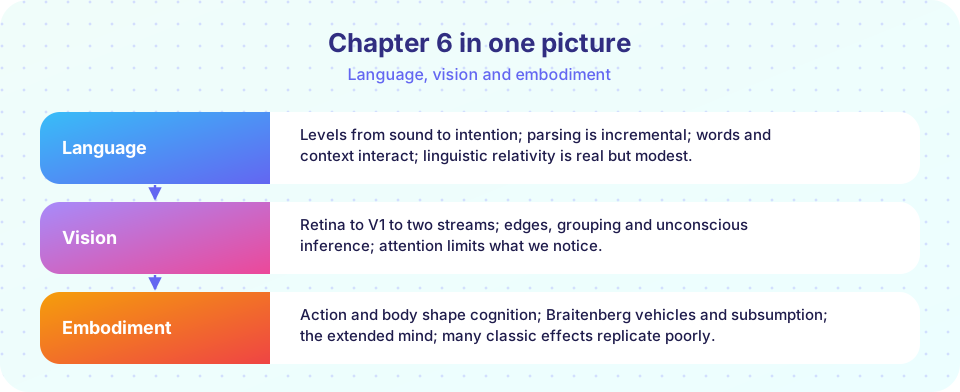
Review chapter 6 with a one-picture summary, a recap table of key names and findings, and a ten-question quiz covering language, vision and embodied cognition.
Chapter 6 covered three big arenas of cognition. Language, vision and bodily action all turn noisy, ambiguous input into useful interpretations. This review gathers the key ideas, so you can check what has stuck before moving on to artificial intelligence.
What you will learn
- How to recall the key findings and names of the chapter.
- How the three topics share a common logic.
- Where the evidence is strong and where it is shaky.
Recap table
| Topic | Key idea | Names and findings | Caution |
|---|---|---|---|
| Language levels | Phonology, morphology, syntax, semantics, pragmatics | Broca 1861, Wernicke 1874 | Brain "centers" are parts of networks |
| Comprehension | Fast, incremental parsing with priming | Meyer and Schvaneveldt 1971; McGurk and MacDonald 1976; garden paths | Theories differ on what guides first guesses |
| Acquisition | Innate versus usage-based accounts | Chomsky; Tomasello | Both sides now accept some learning mechanisms |
| Relativity | Language modestly biases thought | Berlin and Kay 1969; Winawer et al. 2007 | The strong form is rejected |
| Early vision | Cells tuned to oriented edges | Hubel and Wiesel, Nobel 1981 | Models are simplifications |
| Two streams | Ventral for what, dorsal for action | Ungerleider and Mishkin 1982; Milner and Goodale 1992 | Streams interact |
| Selection | Attention gates awareness | Simons and Chabris 1999; Rensink 1997 | Details depend on the task |
| Embodiment | Body, world and tools shape thought | Brooks 1991; Clark and Chalmers 1998; Braitenberg 1984 | Several lab effects failed to replicate |
Thread to remember
Across the chapter, one idea keeps returning: the mind uses prediction and context to cope with ambiguity. Words are recognized faster in context, images are interpreted with prior knowledge about the world, and bodies use the environment to simplify problems. That links back to Bayesian models, which formalize the use of prior knowledge, and forward to the next chapter, where machines face the same ambiguity.
Check your understanding
Quick check · 10 questions
of 10 answered You scored / 10 · perfect!
-
1. Which level of language deals with word parts such as un- and -ness?
Morphology concerns the structure of words and their meaningful parts. -
2. A garden-path sentence shows that parsing is:
Readers build a structure as words arrive and may have to revise it. -
3. The McGurk effect shows that speech perception:
Seeing a mouth shape can change which sound you hear. -
4. Which finding best supports a weak version of linguistic relativity?
Winawer and colleagues (2007) reported this subtle, task-dependent effect. -
5. V1 simple cells are best described as responding to:
Hubel and Wiesel found cells tuned to oriented bars or edges. -
6. What did patient DF's case suggest?
She could guide a card into a slot but not report its orientation. -
7. Inattentional blindness is demonstrated by:
Simons and Chabris showed that unattended, unexpected events can go unnoticed. -
8. A Braitenberg vehicle with crossed wiring tends to:
Crossed connections make the vehicle steer toward a light source. -
9. The extended mind thesis uses which example?
Clark and Chalmers used Otto's notebook to argue that tools can be part of memory. -
10. Which statement about embodiment research is most accurate?
Evidence is mixed, so effects need replication before we rely on them.
Summary
- Language, vision and action all build interpretations from ambiguous input, using context.
- Language is organized in levels; comprehension is fast, incremental and predictive.
- Vision proceeds from edges to objects along two streams, and attention limits awareness.
- Embodied views stress body, world and tools, but replicate unevenly, so scrutinize evidence.
Track your progress
Create a free account to tick off lessons and pick up where you left off on any device.
of Cognitive Science lessons completed