


















Lesson 31 of 43 · Artificial Intelligence and Cognition
Artificial Intelligence and Cognition: Chapter Overview
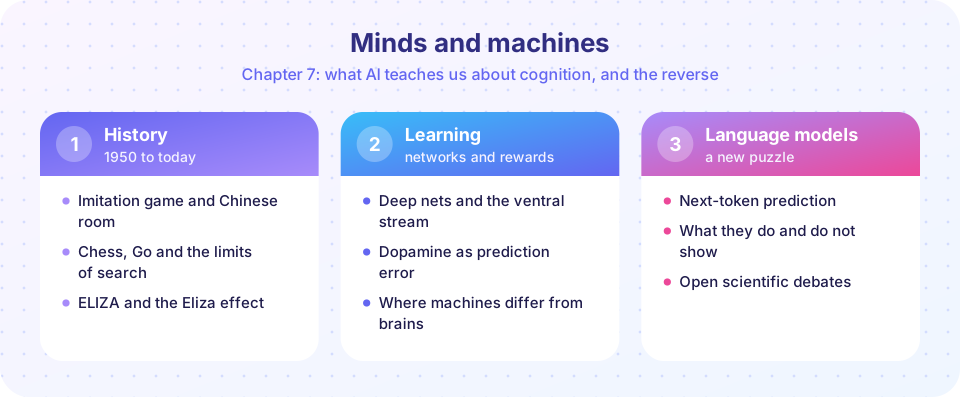
A map of chapter 7: how AI has served as a test bed for theories of mind, how deep networks and reinforcement learning compare with brains, and the puzzle of language models.
Cognitive science and artificial intelligence were born together. The 1956 Dartmouth workshop that gave AI its name brought together some of the same people, such as Allen Newell and Herbert Simon, who helped launch the cognitive revolution. Their shared idea: if you really understand a mental ability, you should be able to build a machine that does it. A working program is a theory with the vagueness removed.
Over seven decades, that bargain has produced surprises in both directions. Programs that play chess brilliantly turned out to say little about human thought, while networks inspired by the visual cortex now rival people at recognizing images. This chapter asks what machines can and cannot teach us about minds.
What you will learn
- Why AI is useful as a test bed for theories of cognition.
- How the chapter's two main lessons are organized.
- What caution to apply when comparing machines with brains.
Key terms
Artificial intelligence (AI): the study and construction of systems that perform tasks normally thought to require intelligence.
Strong versus weak AI: in John Searle's usage, strong AI claims a suitably programmed computer literally has a mind, while weak AI treats computers as tools for studying minds.
Benchmark: a standard test used to compare systems.
Brain-score: a measure of how well a model's internal activity predicts brain recordings.
AI as a test of theories
Two directions
Keep in mind
What each lesson covers
- Minds and machines: the Turing test, the Chinese room, ELIZA, chess and Go, and why hard things for humans can be easy for machines and the reverse.
- Learning machines and brains: deep networks and the visual system, reinforcement learning and dopamine, and what large language models do and do not show.
- Chapter review: summary and mixed quiz.
Try it
Press Run (or Ctrl + Enter) to see the console output here.
No output.
Check your understanding
Quick check · 3 questions
of 3 answered You scored / 3 · perfect!
-
1. Why is a working program useful as a theory of cognition?
To build a program you must specify every step, which exposes gaps in a theory. -
2. In Searle's terms, weak AI claims that:
Strong AI claims real minds; weak AI treats programs as models and tools. -
3. Similar behavior in a machine and a brain shows that:
Different mechanisms can produce similar behavior, so extra evidence is needed.
Summary
- AI and cognitive science grew up together; programs act as sharp theories.
- Machines have taught us as much from their failures as from their successes.
- Matching behavior is not the same as matching mechanism.
- The next two lessons trace the history and the learning-based turn.
Next: Minds and machines
Track your progress
Create a free account to tick off lessons and pick up where you left off on any device.
of Cognitive Science lessons completed