


















Lesson 24 of 43 · Models of Cognition
The Bayesian Brain and Predictive Processing
See how Bayes' rule models perception and judgment, how the brain may combine cues by reliability, what predictive processing claims, and why critics push back.
Look at a coin lying heads-up on a table. Is it a fair coin? You cannot tell from one look. Now watch ten flips land heads eight times. Your belief shifts, but by how much depends on what you thought before. If you believed the coin came from a bank, you stay skeptical. If you found it in a magician's drawer, you update more.
That everyday reasoning is the logic of Bayes' rule, and since the late 1990s many cognitive scientists have argued that perception, learning and decision-making all follow it, at least approximately. This is the Bayesian approach to cognition. It is a model family built around uncertainty: the world is noisy, the senses are unreliable, so the mind must weigh evidence.
What you will learn
- What prior, likelihood and posterior mean and how they combine.
- How the brain may merge two senses by weighting the more reliable one more.
- What predictive processing says about prediction error.
- Which criticisms of Bayesian models are most important.
Key terms
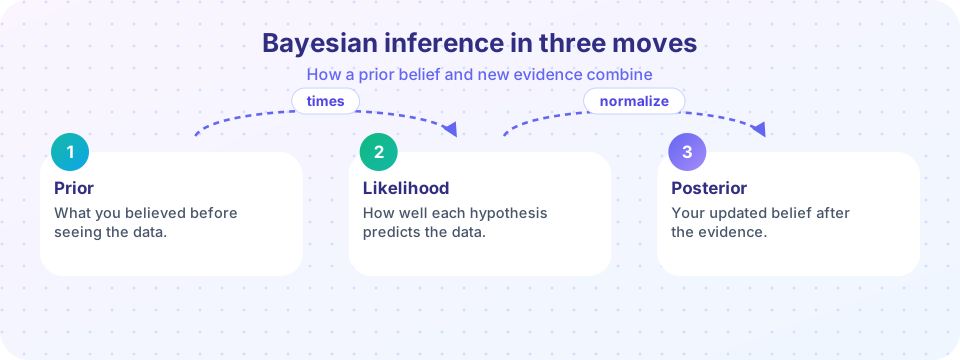
Prior: the probability you assign to a hypothesis before seeing the new evidence.
Likelihood: how probable the evidence would be if a hypothesis were true.
Posterior: the updated probability after taking the evidence into account.
Precision: the inverse of variance, a measure of how reliable a signal is.
Prediction error: the difference between what a system expected and what it received.
Bayes' rule in plain terms
Thomas Bayes' theorem, published after his death in 1763 and developed by Pierre-Simon Laplace, states:
P(H | D) = P(D | H) * P(H) / P(D)
Read P(H | D) as "the probability of hypothesis H given data D". The posterior is proportional to the likelihood times the prior. The denominator P(D) only rescales so the probabilities add up to 1.
A key lesson: weak evidence barely moves a strong prior, and strong evidence overrides a weak one. That feels right. A single odd result should not overturn a well-established theory, while a mountain of data should.
Evidence that people reason this way
- Everyday predictions. In 2006 Thomas Griffiths and Joshua Tenenbaum asked people to predict totals from partial information, for example how long a cake will bake if it has been in the oven for some minutes. Their answers matched predictions made from the real-world statistics of those quantities fairly closely, as if people carried sensible priors.
- Combining senses. Marc Ernst and Martin Banks (2002) had people judge the size of an object using sight and touch, with the visual image made more or less noisy. As vision got noisier, people relied more on touch, and the combined judgments were very close to the statistically optimal weighting.
- Motor control. Konrad Körding and Daniel Wolpert (2004) showed that people learn a prior for a hand displacement and combine it with feedback.
Such results led to the slogan "the Bayesian brain" in the early 2000s, summarized by David Knill and Alexandre Pouget in 2004.
Cue combination by reliability
When two independent cues each give an estimate with variance, the best combined estimate is a weighted average with weights proportional to precision (1 divided by variance). The combined estimate is also more precise than either cue alone. That is why holding a cup is easier when you can both see and feel it.
Predictive processing
Another idea says the brain does not passively receive data but constantly predicts its input. Higher areas send predictions downward, lower areas send back only the prediction error, and the error is used to correct the model. Rajesh Rao and Dana Ballard proposed an early version of this "predictive coding" in 1999 for visual cortex. Karl Friston generalized it into the free-energy principle, and Andy Clark popularized the view for a wide audience.
An attractive feature is unification: perception, attention and action are all ways of reducing prediction error. Perception changes the model to fit the world, action changes the world to fit the model. Critics note that the framework is so general that it can be hard to say what observation would contradict it, and the evidence for specific neural implementation remains debated.
Limits and criticism
- Just-so stories. Matt Jones and Bradley Love (2011) warned of "Bayesian fundamentalism": priors and likelihoods can often be tuned after the fact to fit any data, so a good fit may not be strong evidence.
- Systematic deviations. People violate probability rules in documented ways (the conjunction fallacy, base-rate neglect) that a strict Bayesian view must explain as limits or approximations.
- Computation. Exact Bayesian inference is often intractable, so the mind would have to use shortcuts, and then we need to know which.
- Levels. Many Bayesian models are at Marr's computational level. They say what the mind should compute, not how neurons do it.
Common misconceptions
"The Bayesian brain means people do conscious calculation." No. The claim is that behavior is well described by Bayesian computation, not that anyone is working out equations.
"Bayesian models prove people are optimal." Optimal compared with what? Bayesian models can also capture suboptimal behavior if the assumed prior or noise is wrong.
Try it
Press Run (or Ctrl + Enter) to see the result here.
Program input · what you'd type while the program runs
Type the answers before you press Run, one per line. Each time the program reads a line (with input()), it gets the next line from this box.
Press Run (or Ctrl + Enter) to see the result here.
Program input · what you'd type while the program runs
Type the answers before you press Run, one per line. Each time the program reads a line (with input()), it gets the next line from this box.
Check your understanding
Quick check · 5 questions
of 5 answered You scored / 5 · perfect!
-
1. In Bayes' rule, what is the posterior proportional to?
The posterior is proportional to likelihood times prior; the denominator only rescales. -
2. When vision becomes noisier, an optimal observer combining sight and touch should:
Cues are weighted by their precision, so a noisier visual cue receives less weight. -
3. What does the brain send up the hierarchy in predictive coding?
Higher areas send predictions down, and lower areas return the prediction errors. -
4. What is the main worry behind 'Bayesian fundamentalism'?
Jones and Love noted that freely adjustable assumptions weaken the evidential value of a good fit. -
5. A strong prior and weak evidence usually give:
Weak evidence moves a strong prior only a little.
Summary
- Bayes' rule updates beliefs: posterior is proportional to prior times likelihood.
- People and animals often combine cues in a roughly reliability-weighted way.
- Predictive processing proposes that cortex sends predictions down and errors up.
- Critics warn about flexible assumptions, known human deviations and intractable computation.
- Bayesian models are strongest at the computational level of Marr's scheme.
Next: Chapter review
Track your progress
Create a free account to tick off lessons and pick up where you left off on any device.
of Cognitive Science lessons completed