


















Lesson 41 of 43 · Projects and Practice
Glossary of Cognitive Science Terms (Chapters 5 to 8)
A glossary of key terms from models of cognition, language, vision, embodiment, AI and consciousness, with one-line definitions and flashcards for self-testing.
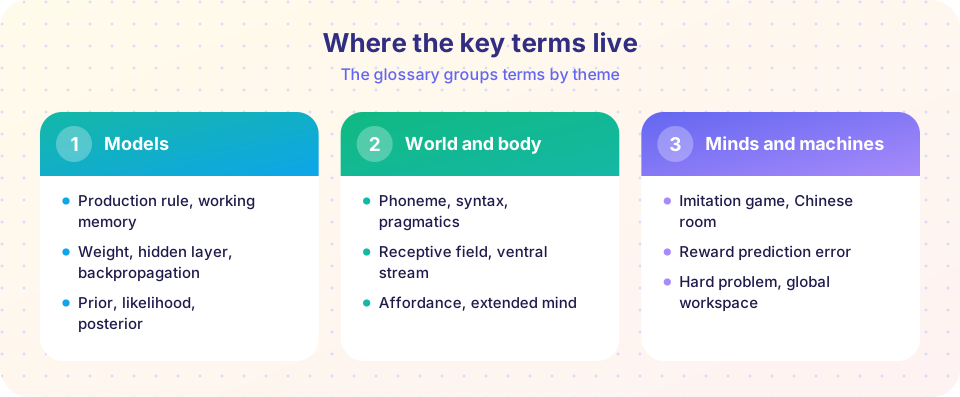
Technical vocabulary is the entrance fee to any field. This glossary collects the terms introduced in chapters 5 to 8, grouped by theme, with one-line definitions. Use it to look things up, and then test yourself with the flashcards at the end.
What you will learn
- The meaning of the main terms of the second half of the course.
- Which chapter each term belongs to.
- How to self-test with flashcards.
Models of cognition (chapter 5)
| Term | Definition |
|---|---|
| Model | A precise description of a system that produces testable predictions |
| Physical symbol system | A machine that builds and transforms symbol structures by rules (Newell and Simon) |
| Production rule | An IF-THEN rule matched against working memory |
| Working memory | The small store of currently active facts |
| Recognize-act cycle | The loop of matching, choosing and firing rules |
| Cognitive architecture | A fixed theory of cognitive structure, such as ACT-R or Soar |
| Marr's levels | Computational, algorithmic and implementational levels of explanation |
| Frame problem | How to represent what stays unchanged after an action |
| Perceptron | A single-layer threshold unit with a learning rule |
| Hidden layer | Units between input and output that learn internal features |
| Backpropagation | Learning by passing error backward to adjust weights |
| Distributed representation | A concept coded as a pattern across many units |
| Graceful degradation | Gradual loss of performance as units fail |
| Prior, likelihood, posterior | Belief before evidence, fit of evidence to a hypothesis, and updated belief |
| Precision | Inverse variance, the reliability of a signal |
| Predictive coding | Higher areas predict, lower areas report prediction errors |
Language, vision and embodiment (chapter 6)
| Term | Definition |
|---|---|
| Phoneme | A sound unit that distinguishes words |
| Morpheme | The smallest meaningful unit of a word |
| Syntax, semantics, pragmatics | Sentence structure, literal meaning and meaning in context |
| Mental lexicon | Stored knowledge of words |
| Garden-path sentence | A sentence that misleads incremental parsing |
| Semantic priming | Faster processing of a word after a related word |
| Linguistic relativity | The idea that language influences thought |
| Receptive field | The stimulus region that drives a neuron |
| Ventral and dorsal streams | Visual routes for recognition and for guiding action |
| Visual agnosia | Failure to recognize objects despite intact basic vision |
| Inattentional blindness | Missing an unexpected event while attending elsewhere |
| Affordance | An action possibility offered by an object |
| Braitenberg vehicle | A simple sensor-motor machine with lifelike behavior |
| Extended mind | The thesis that tools can be part of cognition |
AI and consciousness (chapters 7 and 8)
| Term | Definition |
|---|---|
| Turing test | A conversational imitation game for judging machine intelligence |
| Eliza effect | Attributing understanding to a simple conversational program |
| Chinese room | Searle's argument that symbol manipulation is not understanding |
| Moravec's paradox | Perception is harder for machines than abstract reasoning |
| CNN | A network applying shared filters across image positions |
| Reinforcement learning | Learning actions from reward |
| Reward prediction error | Reward received minus reward expected |
| Language model | A system trained to predict the next token |
| Hard problem | Why processing is accompanied by experience |
| Neural correlates of consciousness | Minimal brain events tied to an experience |
| Global workspace | A broadcast system for selected information |
| Integrated information (phi) | IIT's measure of irreducible causal structure |
| Blindsight | Above-chance guessing without reported seeing |
| d-prime | A bias-free measure of sensitivity |
| No-report paradigm | Studying experience without asking for reports |
Try it
Check your understanding
Quick check · 4 questions
of 4 answered You scored / 4 · perfect!
-
1. Which term means the inverse of variance, a measure of a signal's reliability?
Precision is 1 divided by variance and sets the weight of a cue. -
2. A morpheme is:
Examples are un-, happy and -ness. -
3. Reward prediction error is:
It is the quantity dopamine neurons appear to signal. -
4. Which term refers to the minimal brain events tied to an experience?
NCC is the standard abbreviation.
Summary
- Chapters 5 to 8 introduced vocabulary for models, language, vision, embodiment, AI and consciousness.
- Many terms come in pairs or triples: prior, likelihood, posterior; syntax, semantics, pragmatics.
- Use the flashcards, and then write your own definitions from memory.
Next: Cheat sheet
Track your progress
Create a free account to tick off lessons and pick up where you left off on any device.
of Cognitive Science lessons completed