


















Lesson 32 of 43 · Artificial Intelligence and Cognition
Minds and Machines: Turing, Searle and Game-Playing AI
Trace the history of AI as a test of theories of mind: the imitation game, ELIZA, the Chinese room, Deep Blue, AlphaGo and Moravec's paradox, with a runnable game search.
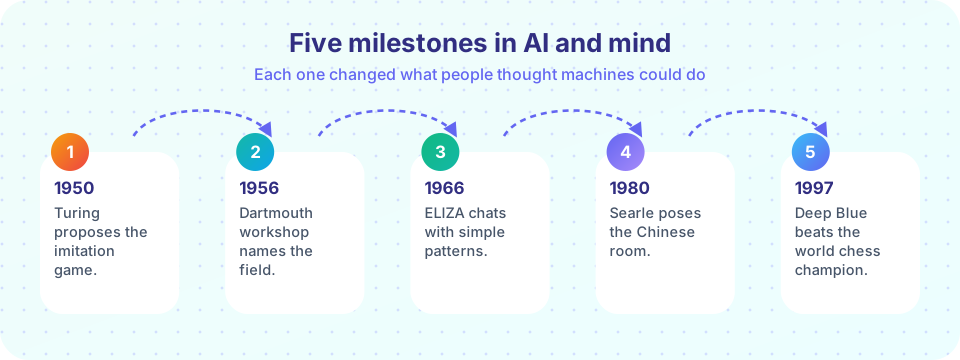
In 1950 Alan Turing opened a paper with a question he thought too vague to answer: "Can machines think?" He proposed to replace it with a game. A human judge chats by text with two hidden parties, one a person and one a machine. If the judge cannot reliably tell which is which, then, Turing suggested, we have no good grounds for denying that the machine thinks.
Few ideas have been argued over as much. This lesson follows the argument from the optimism of the 1950s through the first great objections to the game-playing triumphs, and ends with a surprise: the things people find hardest are often easiest for machines.
What you will learn
- What the Turing test is and what it does not show.
- How ELIZA fooled people with simple pattern matching.
- What Searle's Chinese room argues and how critics replied.
- Why chess and Go are different challenges.
- What Moravec's paradox says about difficulty.
Key terms
Turing test: a text conversation test, also called the imitation game, in which a judge tries to tell machine from human.
Eliza effect: the tendency to read understanding into a program's text output.
Search: exploring possible future moves in a game tree.
Heuristic: a rule of thumb that cuts down search.
Moravec's paradox: high-level reasoning is relatively easy for computers while perception and movement are hard.
The imitation game
Turing's 1950 paper, "Computing Machinery and Intelligence", argued that behavior is the right ground for judging intelligence, as it is for other people. We never inspect another person's mind directly either. Objections include that the test measures mimicry and deception more than thinking, and that a program could pass with clever tricks. Turing anticipated several objections, including the claim that machines cannot be creative or conscious, and responded to each.
In August 1955 John McCarthy, Marvin Minsky, Nathaniel Rochester and Claude Shannon wrote the proposal for a summer workshop at Dartmouth College held in 1956, and it is where the term "artificial intelligence" was adopted. Early AI projects used symbolic reasoning of the kind described in chapter 5, such as the Logic Theorist.
ELIZA: shallow tricks, deep impressions
In 1966 Joseph Weizenbaum wrote ELIZA, a program whose "DOCTOR" script imitated a Rogerian therapist. It matched keywords in your sentence, reversed pronouns and turned statements into questions: "I am sad" became "Why do you say you are sad?" It had no understanding at all.
Yet users confided in it. Weizenbaum's own secretary reportedly asked him to leave the room so she could talk to it privately. Weizenbaum was disturbed by how readily people attributed understanding to the program, and he became a critic of the field. We now speak of the Eliza effect: people read minds into text. It is a warning against judging a system's inner life from its surface behavior, and it matters again with today's chatbots.
The Chinese room
In 1980 philosopher John Searle published "Minds, Brains, and Programs", with a famous thought experiment.
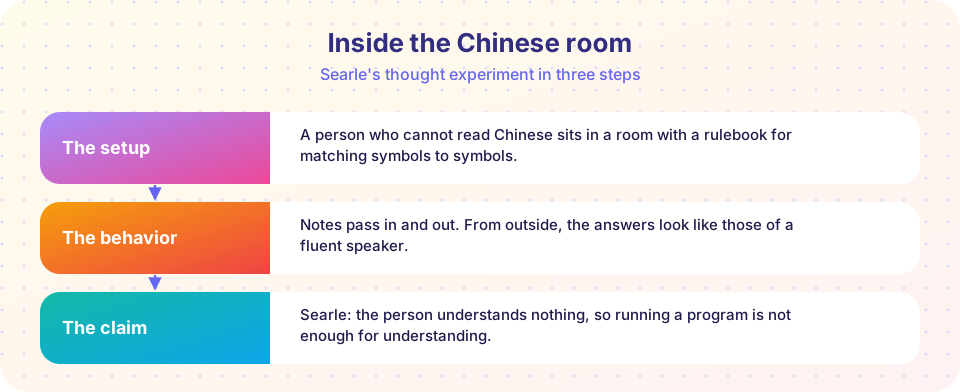
Imagine you, who understand no Chinese, are locked in a room. Chinese symbols come in through a slot. You have a big rulebook in English telling you which symbols to pass out in response. To the people outside, your answers are indistinguishable from a native speaker's. Yet you understand nothing. Searle concluded that running a program, which is just symbol manipulation, is not sufficient for understanding. Syntax, he said, is not semantics.
Common replies include:
- The systems reply: you are only one part. The whole system, room plus rulebook plus you, understands. Searle answered that you could memorize the rules and still understand nothing.
- The robot reply: give the system a body and sensors, so its symbols connect to the world. This links to the symbol grounding problem and to embodied cognition.
- The brain simulator reply: simulate neurons in detail. Searle replied that simulating a process is not producing it, much as a simulated storm does not get anything wet.
The argument remains debated. It sharpens a question every theory of mind must answer: what, beyond the right input-output behavior, is required for understanding?
Chess, Go and the nature of difficulty
In May 1997 IBM's Deep Blue defeated world champion Garry Kasparov in a six-game match, 3.5 to 2.5. It relied mostly on massive search: evaluating hundreds of millions of positions per second with human-designed evaluation rules. Human grandmasters examine far fewer moves but use deep pattern knowledge to choose which lines are worth searching. Deep Blue's win said little about how people play.
Go has far more possibilities: the number of legal positions is on the order of 10^170, compared with something like 10^44 for chess. Brute-force search was hopeless. In March 2016 DeepMind's AlphaGo beat Lee Sedol 4 to 1, combining deep neural networks, trained on human games and then by self-play, with a tree search. That was a different recipe, closer to learned intuition, and a topic for the next lesson.
Moravec's paradox
Hans Moravec and others noted in the 1980s that "it is comparatively easy to make computers exhibit adult-level performance on intelligence tests or playing checkers, and difficult or impossible to give them the skills of a one-year-old when it comes to perception and mobility". Evolution has spent hundreds of millions of years refining perception and movement, while abstract reasoning is recent and, as it turns out, easier to specify in rules. Hubert Dreyfus had argued in 1972 in What Computers Can't Do that human expertise depends on bodily, intuitive know-how that rules cannot capture, a view that aligns with the embodied approaches of chapter 6.
Common misconceptions
"Passing the Turing test proves a machine thinks." It shows the machine can be mistaken for a human in a conversation, which is evidence, not proof, and judges can be fooled.
"Deep Blue showed machines think like grandmasters." It used far more search and far less pattern knowledge than a human.
Try it
Press Run (or Ctrl + Enter) to see the result here.
Program input · what you'd type while the program runs
Type the answers before you press Run, one per line. Each time the program reads a line (with input()), it gets the next line from this box.
Press Run (or Ctrl + Enter) to see the console output here.
No output.
Check your understanding
Quick check · 6 questions
of 6 answered You scored / 6 · perfect!
-
1. What did Turing propose in 1950?
He proposed judging machine intelligence by whether a judge could tell it from a person in conversation. -
2. What does the Eliza effect describe?
Weizenbaum saw users read minds into a pattern-matching script. -
3. The point of Searle's Chinese room is that:
Searle argued that following a program, which is syntax, does not produce semantics. -
4. Which is the 'systems reply' to the Chinese room?
The systems reply locates understanding in the entire room-plus-rulebook system. -
5. Deep Blue's 1997 win over Kasparov relied mainly on:
It searched very large numbers of positions per second using designed evaluation rules. -
6. Moravec's paradox says that:
Skills evolution refined over a long time are hard to specify, while formal reasoning is easier to encode.
Summary
- Turing proposed judging machine intelligence by behavior, and critics argue that behavior is not enough.
- ELIZA showed how little is needed to create an illusion of understanding.
- Searle's Chinese room challenges the idea that programs alone suffice for understanding, and the replies remain contested.
- Chess fell to search, Go to learning plus search, and each says different things about minds.
- Moravec's paradox reminds us that what is hard for people and what is hard for machines differ.
Track your progress
Create a free account to tick off lessons and pick up where you left off on any device.
of Cognitive Science lessons completed