


















Lesson 14 of 43 · Philosophy of Mind
The Chinese room and intentionality
Walk through Searle's Chinese room, the syntax versus semantics argument, the systems, robot and brain-simulator replies, and Block's lookup-table Blockhead.
In 1950 Alan Turing proposed a test: if a machine converses so well that an interrogator cannot tell it from a person, we should say it thinks. Thirty years later, the philosopher John Searle asked whether passing the test would really show understanding. His answer was a thought experiment that has probably generated more argument than any other in philosophy of mind: the Chinese room.
What you will learn
- Searle's thought experiment and his argument that syntax is not enough for semantics.
- The strong AI and weak AI distinction.
- The main replies (systems, robot, brain simulator) and Searle's responses.
- Block's Blockhead and the symbol grounding problem.
Key terms
Strong AI (Searle's term): the claim that an appropriately programmed computer literally has a mind and understands.
Weak AI: the claim that computers are useful tools for studying the mind.
Syntax: formal rules about symbols and their shapes.
Semantics: what symbols mean.
Intentionality: the aboutness of mental states, a term revived by Franz Brentano.
Turing test: judging whether a machine's conversation is indistinguishable from a human's.
The thought experiment
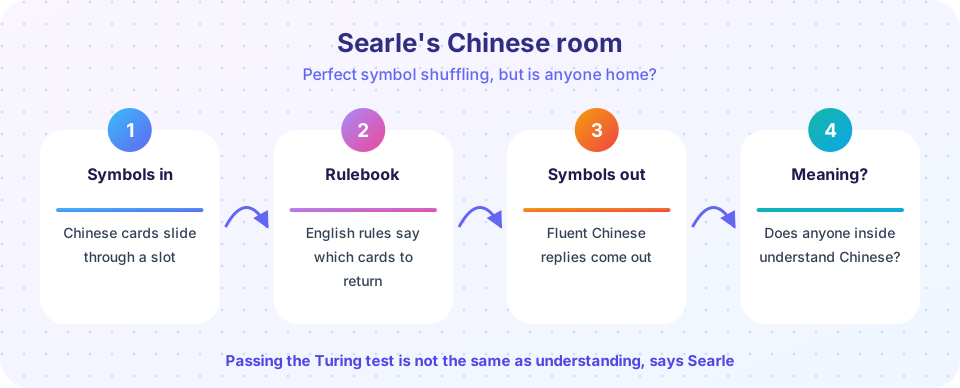
Searle (1980, in the journal Behavioral and Brain Sciences) imagines himself locked in a room. He speaks no Chinese. Through a slot come cards with Chinese characters. In the room is a big rulebook, written in English, that tells him which characters to pass out in response to which patterns coming in. He follows the rules faithfully. To people outside, the answers are indistinguishable from those of a native speaker, so the room passes the Turing test.
Yet Searle says he understands nothing of the Chinese. He is manipulating shapes according to formal rules. And a digital computer, he adds, does exactly this: it manipulates symbols by their form. So running the right program cannot be sufficient for understanding.
The argument in three premises
Searle later distilled the point:
- Programs are formal (syntactic): they are defined by symbol manipulation rules.
- Minds have mental contents (semantics): thoughts mean something.
- Syntax by itself is neither constitutive of nor sufficient for semantics.
- Therefore, programs by themselves are neither constitutive of nor sufficient for minds.
The target is strong AI. Searle does not say that machines cannot think. He says that brains do think, and that any machine with the same causal powers as a brain might. The claim is that running a program is not enough.
The replies
The systems reply
Perhaps Searle does not understand Chinese, but the whole system, including the room, the rulebook and Searle, does. Searle answers: let him memorize the rules and do everything in his head. He is then the whole system, yet still understands nothing. Critics respond that this is a different system implemented inside him, a "virtual mind" that might understand even if Searle does not (a reply sometimes called the virtual minds reply).
The robot reply
Give the system a body: cameras, arms, sensors, so its symbols are connected to the world. Searle replies that the sensor data would arrive as more uninterpreted symbols. Others, such as Stevan Harnad (1990), accept the underlying worry and call it the symbol grounding problem: symbols need some connection to the world to mean something. Embodied approaches in chapter 6 take this seriously.
The brain simulator reply
Suppose the program simulates, neuron by neuron, the brain of a native Chinese speaker. Searle answers that a simulation of a thing is not the thing: a simulated storm does not make anything wet. Defenders note that the analogy is imperfect, since a simulated mind processes information, which may be what mattered.
The other minds reply
We attribute understanding to other people only on the basis of behavior. If behavior suffices for them, why not for the machine? Searle answers that we know the mechanism in the machine's case and know it is mere symbol shuffling, but critics say that is exactly what is in dispute.
Intentionality
The deeper issue is intentionality. Your belief that Paris is in France is about Paris. Words on a page have meaning only because minds interpret them (Searle calls this derived intentionality), while the mind's own aboutness is intrinsic. Searle thinks intrinsic intentionality is a biological phenomenon, produced by brains the way digestion is produced by stomachs. Functionalists reply that intentionality might be a matter of the right causal and informational relations to the world, which a computer could have.
Blockhead: a look-up table
Ned Block (1981) imagined a machine with a gigantic table holding a sensible reply to every possible conversation of up to an hour. It would pass any Turing test by simple lookup, but it seems to have no intelligence. Block's moral: behavior alone is not enough, the internal organization matters. This challenges behaviorist readings of the Turing test, though such a table could never be built. A quick calculation shows why: the number of possible conversations explodes exponentially.
Why it still matters
Today, language models produce fluent text, and people ask whether such systems "understand". The Chinese room is the standard background for that debate. Whatever you conclude, the thought experiment forces a question every theory of mind must answer: what, besides correct input-output behavior, would make a system understand?
Common misconceptions
"Searle proved computers cannot think." The argument targets the claim that running a program suffices. Searle accepts that artificial systems with the right causal powers might think.
"The systems reply refutes Searle." It is one reply among several, and Searle's internalization response, and the dispute over virtual minds, remain open. Few philosophers regard the argument as settled either way.
"The Turing test is the definition of intelligence." Turing proposed it as a practical substitute for a vague question, and critics have long pointed out that it tests imitation of conversation.
Try it
A Chinese-room-style rule follower. The program matches an incoming string to a rule and returns the scripted reply, with no model of what anything means. It is a toy illustrating symbol manipulation by form, not a claim about real language systems.
Press Run (or Ctrl + Enter) to see the result here.
Program input · what you'd type while the program runs
Type the answers before you press Run, one per line. Each time the program reads a line (with input()), it gets the next line from this box.
Block's look-up table fails by sheer size. This chart counts the possible strings of a given length over a 27-symbol alphabet (26 letters and a space) and compares them with a rough estimate of the number of atoms in the observable universe, commonly given as about 10^80.
Press Run (or Ctrl + Enter) to see the result here.
Program input · what you'd type while the program runs
Type the answers before you press Run, one per line. Each time the program reads a line (with input()), it gets the next line from this box.
Check your understanding
Quick check · 5 questions
of 5 answered You scored / 5 · perfect!
-
1. What is Searle's central claim in the Chinese room argument?
Searle targets strong AI: syntax alone does not give semantics. -
2. Which reply says the whole room, not the person, understands Chinese?
The systems reply attributes understanding to the entire system. -
3. What is the symbol grounding problem?
Harnad argued that symbols defined only by other symbols are ungrounded. -
4. What does Block's Blockhead suggest?
A table that passes the Turing test by lookup seems to have no intelligence. -
5. Searle's term for the 'aboutness' of mental states, taken from Brentano, is
Intentionality is the directedness of thoughts toward things.
Summary
- Searle's Chinese room argues that following formal rules (syntax) does not by itself produce understanding (semantics), targeting strong AI.
- Replies include the systems, robot, brain simulator and other minds replies, each with a Searlean response and further counter-replies.
- The debate connects to intentionality, symbol grounding and the limits of the Turing test.
- Block's Blockhead shows that identical behavior can come from very different internal organization.
Next: Chapter 3 review
Track your progress
Create a free account to tick off lessons and pick up where you left off on any device.
of Cognitive Science lessons completed