


















Lesson 35 of 43 · Consciousness and Frontiers
Consciousness and Frontiers: Chapter Overview
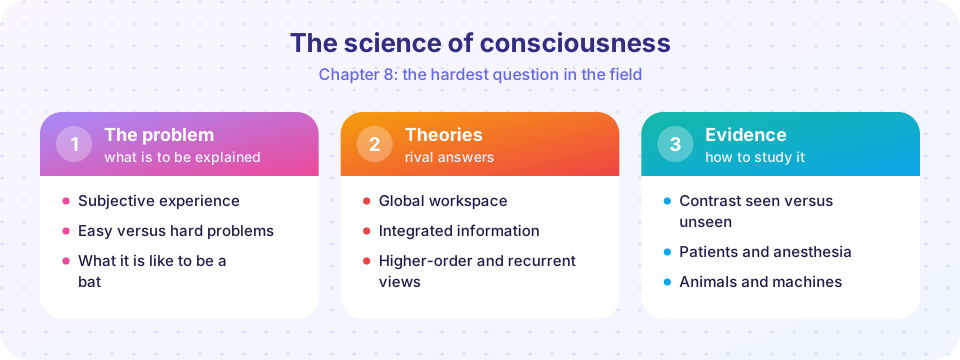
A map of chapter 8: what consciousness is, the hard problem, the main scientific theories, how researchers try to measure it, and the open frontiers.
Right now you are seeing words, perhaps hearing a faint sound, and feeling the weight of your body on a chair. There is something it is like to be you in this moment. That inner, first-person side of life is consciousness, and explaining it is often called the hardest problem in science.
For most of the twentieth century the topic was nearly off limits in psychology. Behaviorists thought inner experience was unscientific. That changed around the 1990s, when neuroscientists such as Francis Crick and Christof Koch argued that the brain correlates of consciousness could be studied experimentally. Today there are rival theories, large collaborative experiments and new questions about animals and machines.
What you will learn
- The central questions of consciousness science.
- How the chapter divides the topic.
- Why this area needs special care with claims and evidence.
Key terms
Consciousness: subjective experience, the fact that there is something it is like to be a creature in a given state.
Neural correlates of consciousness (NCC): the minimal brain events that go with a particular conscious experience.
Access versus phenomenal consciousness: information available for report and control, versus the raw experience itself (a distinction drawn by Ned Block).
Qualia: the felt qualities of experience, such as the redness of red.
What is the puzzle?
Science attacks it in parts
Frontiers
What each lesson covers
- Theories of consciousness: the hard problem, global workspace, integrated information, higher-order, recurrent processing and illusionism, plus the adversarial collaborations that test them.
- Measuring consciousness and its frontiers: blindsight, masking, signal detection, patients, anesthesia, animals and the question of machine consciousness.
- Chapter review: summary and mixed quiz.
Try it
Press Run (or Ctrl + Enter) to see the console output here.
No output.
Check your understanding
Quick check · 3 questions
of 3 answered You scored / 3 · perfect!
-
1. What does 'consciousness' refer to in this chapter?
The scientific puzzle concerns subjective experience, not just wakefulness or intelligence. -
2. What is an NCC?
NCC stands for neural correlates of consciousness. -
3. Ned Block's distinction separates:
Access concerns information available for report and control, phenomenal concerns raw experience.
Summary
- Consciousness science studies subjective experience through contrasts, correlates and rival theories.
- The field is young, contested and open about how to settle disagreements.
- The next lessons cover the main theories and the methods for catching consciousness.
Track your progress
Create a free account to tick off lessons and pick up where you left off on any device.
of Cognitive Science lessons completed