


















Lesson 36 of 43 · Consciousness and Frontiers
Theories of Consciousness
Learn the hard problem, then compare global workspace, integrated information, higher-order, recurrent processing and illusionist theories, and how rivals are tested.
Suppose you knew everything about the brain: every neuron, every connection, every chemical. Would you then know why seeing red feels the way it does? Philosophers and scientists disagree, and their disagreement is the starting point of consciousness science.
In 1974 Thomas Nagel asked "What is it like to be a bat?", arguing that no description of echolocation circuits would tell us what bat experience is like from the inside. In 1995 David Chalmers sharpened the point by separating the easy problems of consciousness (explaining attention, memory, report and the control of behavior, all hard in practice but approachable by standard science) from the hard problem: why any of this processing is accompanied by experience at all. Joseph Levine called the gap between physical description and experience the explanatory gap in 1983.
This lesson introduces the main scientific theories that try to bridge it, and how they are being tested against each other.
What you will learn
- The hard problem and the explanatory gap.
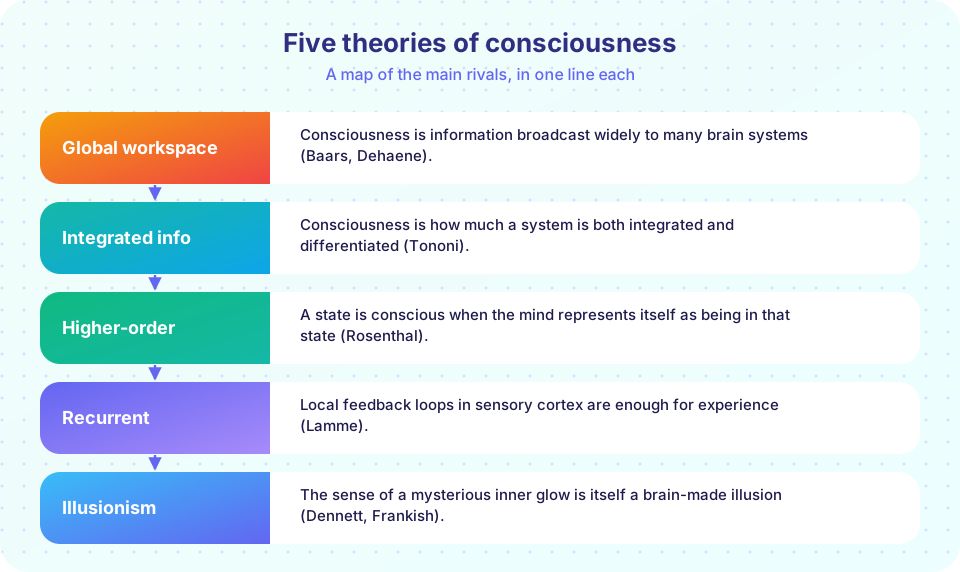
- The core claims of five theories and one key name for each.
- What each theory predicts about where consciousness arises.
- How adversarial collaborations try to settle disputes, and why it is difficult.
Key terms
Hard problem: why physical processing gives rise to subjective experience at all.
Global workspace: a limited-capacity system that broadcasts selected information to many brain processes.
Ignition: a sudden, nonlinear, widespread activation when a stimulus reaches the workspace.
Integrated information (phi): in IIT, a mathematical measure of how much a system is more than the sum of its parts.
Higher-order representation: a mental state about another mental state.
Global workspace theory
Bernard Baars proposed in 1988 a theater metaphor: the mind has many unconscious specialists, and a spotlight of attention selects content that is then broadcast to the whole audience: memory, language, planning and action. Stanislas Dehaene and Jean-Pierre Changeux developed the global neuronal workspace version, tying it to the brain. A stimulus that wins the competition produces an ignition: a late, sudden, widespread burst of activity involving prefrontal and parietal regions, typically a few hundred milliseconds after the stimulus. A weak stimulus fades locally, and that is the unconscious case.
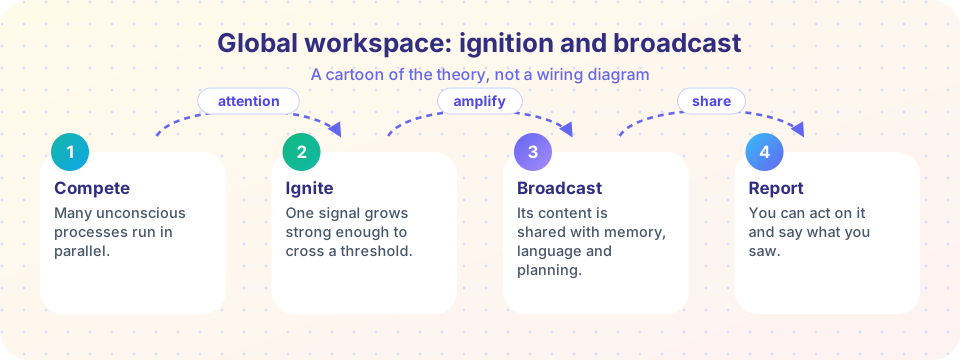
The theory is a theory of access: it explains why some information can guide report and flexible behavior. Critics say it explains the easy problems and leaves the hard one untouched, and defenders reply that functional access is what consciousness science should study.
Integrated information theory
Giulio Tononi's integrated information theory (IIT), from 2004 onward, starts from axioms about experience, such as that every experience is unified and specific, and derives requirements on physical systems. The key quantity, phi, measures how much a system's causal structure is irreducible to its parts. In IIT, consciousness depends on the physical causal structure, not on what the system computes. A conventional digital computer, with its small, sequential causal interactions, would have very little phi however smart its software.
IIT has attracted attention and controversy. Supporters value that it begins with experience itself and gives a quantitative proposal. Critics point out that phi is practically impossible to compute for real brains, that it has counterintuitive implications (some simple grid-like systems could have high phi), and that parts of it are hard to test. In 2023 a letter signed by over a hundred researchers called IIT pseudoscience, drawing a strong response from its defenders, a sign of how contested the field is.
Higher-order theories
David Rosenthal's higher-order thought theory says a mental state is conscious only when you are aware of being in it, that is, when a higher-order representation targets it. Seeing a red patch unconsciously is a first-order state. It becomes a conscious experience when a thought about it, usually linked to prefrontal cortex, accompanies it. Hakwan Lau and Rosenthal (2011) argued for a version based on this. Objections include that infants and animals might have experiences without sophisticated self-representations, and defenders reply with simpler forms of higher-order state.
Recurrent processing
Victor Lamme argued that local recurrent processing, feedback loops within sensory cortex, is what makes experience, with no need for frontal broadcast. On this view, you might consciously see something you cannot report. That sets it against workspace theory, and the difference is testable in principle, though it is hard to test conscious experience that cannot be reported, a problem we meet again in the next lesson.
Illusionism and other views
Illusionists such as Daniel Dennett (Consciousness Explained, 1991) and Keith Frankish argue that the sense of a mysterious inner glow, the qualia that make the hard problem seem hard, is itself a representation the brain builds. The task is then to explain why we believe in qualia, which is a tractable scientific problem. Critics reply that this denies the very thing to be explained.
A few researchers appeal to quantum effects in microtubules (the Penrose and Hameroff Orch OR proposal), but this idea is a minority view and most neuroscientists regard it as unsupported.
Testing rivals: adversarial collaboration
Because theories talk past each other, funders and researchers have organized adversarial collaborations: proponents of rival theories agree beforehand on predictions that would count against them, and an independent team runs the experiment. The Cogitate consortium tested predictions of workspace theory and IIT with several brain-imaging methods. Early results, reported from 2023 onward, supported some predictions of each theory and challenged others. No theory emerged as the winner, though the exercise showed that sharper tests are possible.
Common misconceptions
"Scientists already know what consciousness is." There is no consensus theory. Several theories are active, and each faces objections.
"Consciousness theories are just philosophy." The theories make empirical predictions, such as ignition and specific brain regions, that can be tested, even if interpretation is difficult.
Try it
Press Run (or Ctrl + Enter) to see the result here.
Program input · what you'd type while the program runs
Type the answers before you press Run, one per line. Each time the program reads a line (with input()), it gets the next line from this box.
Press Run (or Ctrl + Enter) to see the console output here.
No output.
Check your understanding
Quick check · 6 questions
of 6 answered You scored / 6 · perfect!
-
1. What is Chalmers's 'hard problem'?
The hard problem asks why there is experience at all, beyond explaining function. -
2. In global workspace theory, ignition refers to:
Ignition is a late, nonlinear burst of activity across brain regions. -
3. Which theory says consciousness depends on a system's physical causal structure, measured by phi?
IIT ties consciousness to irreducible causal structure rather than to computation. -
4. A higher-order theory says a state is conscious when:
Higher-order theories require a representation of the first-order state. -
5. What is the main idea of an adversarial collaboration?
The design commits rivals to predictions that would count against them. -
6. Illusionism claims that:
Illusionists try to explain why we believe in qualia rather than explaining qualia as such.
Summary
- The hard problem asks why processing comes with experience, and the explanatory gap names the difficulty.
- Global workspace, IIT, higher-order, recurrent and illusionist theories give different answers and different predictions.
- None is established. Adversarial collaborations are a way to make progress.
- Be wary of anyone who claims the problem is solved.
Track your progress
Create a free account to tick off lessons and pick up where you left off on any device.
of Cognitive Science lessons completed