


















Lesson 34 of 43 · Artificial Intelligence and Cognition
Artificial Intelligence and Cognition: Chapter Review
Review chapter 7: the imitation game, the Chinese room, search versus learning, CNNs and the ventral stream, dopamine as prediction error, and language models, with a quiz.
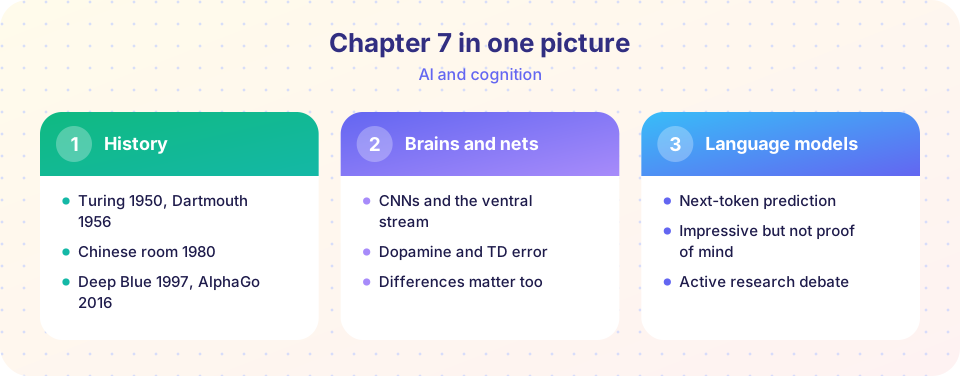
Chapter 7 examined what building machines has taught cognitive science. This review collects the main arguments and results, and gives you a quiz to check your understanding. The chapter's moral is double: machines are powerful tools for testing ideas about minds, and similar behavior never settles whether the mechanism is similar.
What you will learn
- How to place each milestone of AI in a line of argument.
- Which findings link learning machines to brain data.
- What the open questions about language models are.
Recap table
| Idea | What it says | Key names | Limit or caution |
|---|---|---|---|
| Imitation game | Judge intelligence by conversational behavior | Turing 1950 | Can be passed by tricks; Eliza effect |
| ELIZA | Pattern matching can seem to understand | Weizenbaum 1966 | No understanding at all |
| Chinese room | Symbol manipulation is not enough for understanding | Searle 1980 | Systems, robot and brain-simulator replies |
| Deep Blue | Brute-force search beats the champion | 1997 | Not human-like play |
| AlphaGo | Deep learning plus search beats a Go champion | 2016 | Trained with huge compute and data |
| Moravec's paradox | Perception and movement are harder than logic | Moravec; Dreyfus | Informal generalization |
| CNNs and cortex | Layers resemble stages of the ventral stream | Hubel and Wiesel; Yamins and DiCarlo | Adversarial fragility, data hunger |
| TD learning | Dopamine signals reward prediction error | Sutton; Schultz, Dayan, Montague | Dopamine does more than this |
| Language models | Next-token predictors with surprising abilities | Vaswani et al. 2017; Bender et al. 2021 | Understanding is contested |
Questions to carry forward
- When is it justified to say a machine "understands"?
- What would count as evidence that a mechanism, and not just behavior, matches the brain?
- Which parts of human learning are missing in current machines: efficiency, grounding, embodiment, motivation?
Chapter 8 turns to the hardest version of these questions: consciousness.
Check your understanding
Quick check · 10 questions
of 10 answered You scored / 10 · perfect!
-
1. Turing's 1950 proposal replaced 'Can machines think?' with:
The imitation game is a text conversation test. -
2. ELIZA is important because it showed:
People read understanding into ELIZA's scripted replies, the Eliza effect. -
3. Which reply to the Chinese room says the whole system understands?
The systems reply locates understanding in the entire system, not the person alone. -
4. Deep Blue and AlphaGo differ mainly in that:
Chess fell to brute-force search, while Go required learned evaluation and move selection. -
5. Moravec's paradox says that, for computers:
Skills refined by long evolution are hard to specify, while formal reasoning is comparatively easy. -
6. CNNs optimized for object recognition predicted what, in the work of Yamins and DiCarlo?
Their internal representations matched neural responses at the top of the ventral stream. -
7. In temporal-difference learning, the error is:
The TD error compares successive predictions with the reward received. -
8. Schultz's monkey dopamine neurons, after learning, fired to:
The prediction error shifted to the earliest reliable predictor. -
9. An adversarial example shows that networks can be:
Such fragility is one difference between deep networks and human vision. -
10. Which is a fair statement about language models?
The evidence is mixed and the field moves quickly.
Summary
- AI has served as a test bed for theories of mind, with failures teaching as much as successes.
- Search and learning solve different problems, and neither alone is how humans play.
- Deep networks and RL link to brain data, but with clear differences.
- Language models are a new, unsettled puzzle about understanding.
Track your progress
Create a free account to tick off lessons and pick up where you left off on any device.
of Cognitive Science lessons completed