


















Lesson 2 of 43 · Getting Started
What is cognitive science?
Define cognitive science, learn the idea that the mind computes with representations, and use David Marr's three levels to organize any question about the mind.
Ask ten people what the mind is and you will get ten answers. Cognitive science does not try to settle that argument by definition. Instead it makes a bet: that mental activity such as seeing, remembering and reasoning can be explained as information processing, and that the explanation can be tested with experiments, brain measurements and working models.
This lesson gives you the working definition, the central assumption, and a tool called Marr's three levels that you will use in every later chapter.
What you will learn
- A working definition of cognitive science and its main assumption.
- What "representation" and "computation" mean in this field.
- David Marr's three levels and how to sort a question into one of them.
- Why the field is interdisciplinary and what it does not claim.
Key terms
Cognitive science: the interdisciplinary study of minds as information-processing systems.
Representation: an internal state that carries information about something else (a place, a word, a goal).
Computational level: what problem a system solves and why that solution is appropriate.
Algorithmic level: which representations and which steps the system uses to solve it.
Implementational level: the physical substance that carries out the steps.
A working definition
Cognitive science is the scientific study of the mind, using ideas from several fields to explain how perception, attention, memory, language, reasoning, decision making and action work. Notice three things about this definition.
First, it is scientific. A claim about the mind counts only if it can be tested, usually against behavior (what people do and say) and increasingly against brain activity.
Second, it is interdisciplinary. Psychology supplies experiments, neuroscience supplies mechanisms, linguistics supplies detailed descriptions of one remarkable ability, computer science supplies the language of algorithms, philosophy supplies conceptual clarity, and anthropology supplies the variety of human cultures.
Third, it is organized around a central hypothesis: that cognition is a kind of computation over representations. This is sometimes called the computational theory of mind. It does not say the brain is a laptop. It says that to understand what a mind does, it helps to ask what information it takes in, how that information is encoded, and how it is transformed into behavior.
Representation and computation
Think of a map. A map is not the territory, but it stands for the territory, and you can use it to plan a route without walking every road. In the same way, a rat that has explored a maze may hold an internal structure that stands for the layout and use it to take a shortcut it never practiced. That internal structure is a representation.
Computation is the rule-governed use of such representations: comparing, combining, looking up, predicting. When you multiply 12 by 15 in your head, you hold digits in memory, apply learned rules and produce a new representation, the answer. The brain does not need to look like a calculator for this description to be useful.
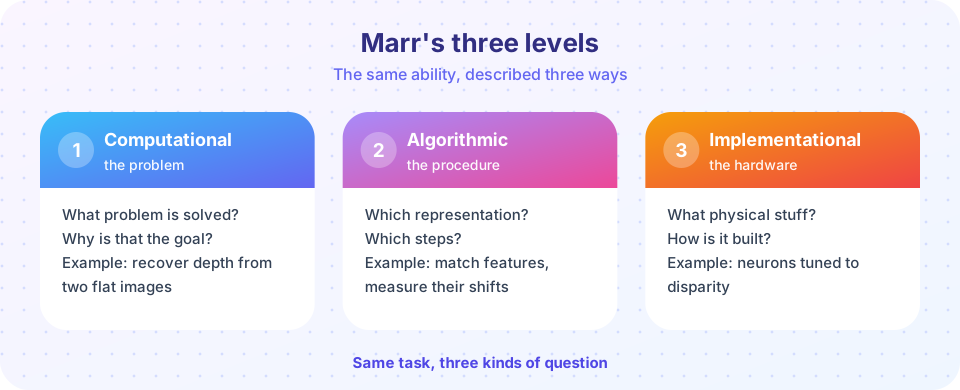
Marr's three levels
David Marr was a British neuroscientist who worked on vision, and his book Vision (published in 1982, after his death in 1980) proposed that any information-processing system must be understood at three levels. His own example was a cash register.
| Level | Question | Cash register example |
|---|---|---|
| Computational | What is the goal, and why is this the right goal? | The register must add. Addition has known properties: order does not matter, zero changes nothing. |
| Algorithmic | Which representation and steps? | Numbers as decimal digits, added column by column with carries. |
| Implementational | How is it physically built? | Electronic circuits, or gears in a mechanical till. |
The levels are loosely coupled. The same computation can be done by different algorithms (a person might count up in ones, a machine might use binary), and the same algorithm can run on different hardware. This matters because a good explanation at one level does not automatically answer questions at another.
Applying the levels to a mental ability
Take depth perception.
- Computational: the eyes receive flat images, but the world is three-dimensional. The goal is to recover distances from cues such as the small differences between the two eyes' views.
- Algorithmic: match features between the two images, measure how far each shifts, and convert the shift into a distance estimate.
- Implementational: neurons in visual cortex that respond to particular disparities between the eyes.
A study that records from neurons speaks to the third level. A model that predicts what people will misjudge speaks to the second. An analysis of what information the images contain speaks to the first. Knowing which level a claim belongs to prevents many pointless arguments.
Why not just study the brain?
You might think neuroscience alone should be enough. The difficulty is that a complete list of neuron activity would not tell you what the activity is for. Marr argued that trying to understand vision by studying neurons alone is like trying to understand bird flight by studying feathers: you need the theory of aerodynamics, the computational-level idea of what flight requires. Brain data and abstract theories need each other.
The reverse also holds. A beautiful algorithm that no brain could run, or that contradicts human errors, is not a theory of the human mind.
Common misconceptions
"Cognitive science says the brain is a computer." The claim is narrower: that cognition can be explained as information processing. Brains differ from digital computers in speed, wiring, noise and learning, and many cognitive scientists stress those differences.
"Studying the mind means studying only the brain." The field also studies behavior, language, culture, development and artificial systems. A brain scan alone rarely explains a mental ability.
"A model that reproduces human behavior must work like the brain." Different algorithms can produce the same behavior. That is why researchers test models against errors, timing and neural data, not only against correct answers.
Try it
The same function, two algorithms. Both functions compute the same sum (computational level), but they use different steps (algorithmic level). The step counts show why the choice of algorithm matters.
Press Run (or Ctrl + Enter) to see the result here.
Program input · what you'd type while the program runs
Type the answers before you press Run, one per line. Each time the program reads a line (with input()), it gets the next line from this box.
Plot the cost of each algorithm as the second number grows. The computational-level description (addition) stays fixed while the algorithmic-level cost changes enormously.
Press Run (or Ctrl + Enter) to see the result here.
Program input · what you'd type while the program runs
Type the answers before you press Run, one per line. Each time the program reads a line (with input()), it gets the next line from this box.
Check your understanding
Quick check · 5 questions
of 5 answered You scored / 5 · perfect!
-
1. Which statement best captures the central hypothesis of cognitive science?
The computational theory of mind treats cognition as the processing of information held in representations. -
2. In Marr's cash register example, 'numbers as decimal digits added column by column' belongs to which level?
Choosing a representation and a sequence of steps is the algorithmic level. -
3. Recording from neurons that respond to binocular disparity mainly addresses which level?
It shows how the physical machinery carries out the task, which is the implementational level. -
4. Why does a model that matches human answers not prove the brain uses the same algorithm?
Equivalent input-output behavior leaves the algorithm underdetermined. Researchers test finer predictions such as errors and reaction times. -
5. Which is the best reason to combine several disciplines?
Experiments, mechanisms, formal models and conceptual analysis complement each other.
Summary
- Cognitive science studies the mind scientifically as information processing over representations.
- It is interdisciplinary because no single field supplies experiments, mechanisms, models and concepts together.
- Marr's three levels (computational, algorithmic, implementational) sort questions about any information-processing system.
- The same computation can be carried out by different algorithms and different hardware.
- The field does not claim that brains are laptops, only that information-processing explanations are productive.
Track your progress
Create a free account to tick off lessons and pick up where you left off on any device.
of Cognitive Science lessons completed