


















Lesson 39 of 43 · Projects and Practice
Project: Run Your Own Stroop Experiment
Run a Stroop task in your browser, then analyze simulated data with a paired test and effect size, and learn how real experiments control order, practice and bias.
In 1935 John Ridley Stroop published a deceptively simple finding. When people name the ink color of a word, they are slower and make more errors if the word spells a different color ("RED" printed in blue ink) than if the word matches the ink or is neutral. Reading is so automatic that it interferes with the color-naming task you actually want to do. The Stroop effect is one of the most replicated results in psychology and a standard tool for studying attention and cognitive control.
In this project you will run a small version yourself, analyze data the way a researcher would, and learn what a careful design adds.
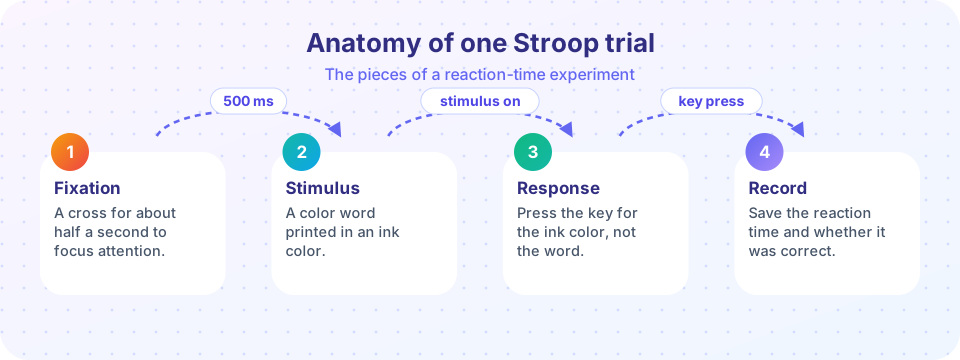
What you will learn
- How a reaction-time experiment is built from trials.
- How to compare two conditions with a paired test and an effect size.
- What controls a real study needs, and what your demo lacks.
Key terms
Congruent trial: the word and the ink color match.
Incongruent trial: the word names a different color from the ink.
Interference: the extra time needed on incongruent trials.
Within-subject design: every participant does every condition.
Effect size: the size of a difference in standard deviation units, such as Cohen's d.
Step 1: Run the task
The widget below runs 12 trials in random order, half congruent and half incongruent. Click or press the key for the ink color: R, G, B or Y. Try to be fast and accurate. This is a demonstration of the method. Twelve trials on one person is far too little to establish anything, and your browser's timing is not laboratory-grade.
If you ran the task, you probably found the incongruent trials slower. Averages over many people typically show an interference of tens of milliseconds up to well over a hundred, depending on the exact task. With only six trials per condition, your own numbers will wobble a lot.
Step 2: Analyze data like a researcher
A real study has many participants, each with a mean for each condition. Here is a simulated data set of 30 participants, so we can practice the analysis. The assumed effect of 80 ms is made up for the exercise, not a measured value.
Press Run (or Ctrl + Enter) to see the result here.
Program input · what you'd type while the program runs
Type the answers before you press Run, one per line. Each time the program reads a line (with input()), it gets the next line from this box.
The paired test asks whether the average within-person difference is distinguishable from zero. The effect size tells you how large that difference is relative to the variability across people. The confidence interval gives a range of plausible values.
Step 3: What a careful design adds
Your demo cuts several corners. A real experiment would include:
- Many more trials per condition, often 100 or more, with practice trials first.
- Balanced and randomized order, with each color and word equally often, and limits on repeats (the same stimulus twice in a row is easier).
- A neutral baseline, such as colored patches or non-color words, to see whether the effect is interference, facilitation or both.
- Accurate timing, since screen refresh rate and browser timing add noise, and careful experiments check it.
- Preregistration: stating the analysis plan before data collection to avoid choosing tests after seeing the result.
- Ethics and consent, even for a harmless task, when working with other people.
Common misconceptions
"The Stroop effect proves I am bad at focusing." It appears in nearly everyone, because reading is automatic.
"A small p-value means a big effect." The p-value says how surprising the data would be if there were no effect. The effect size tells you how large the effect is.
Check your understanding
Quick check · 5 questions
of 5 answered You scored / 5 · perfect!
-
1. In a Stroop task, an incongruent trial is one where:
Incongruent means the word and ink color conflict. -
2. Why is the design called within-subject?
Every participant provides data for both congruent and incongruent trials. -
3. What does a paired t-test compare here?
It tests whether the mean of the paired differences differs from zero. -
4. Why include a neutral baseline?
Without a neutral condition you cannot tell interference from facilitation. -
5. What is preregistration for?
It reduces the chance of choosing analyses to fit the result.
Summary
- The Stroop effect shows that automatic reading interferes with color naming.
- A simple trial structure, fixation, stimulus, response and recording, builds the experiment.
- Paired tests, effect sizes and confidence intervals summarize condition differences.
- Real studies add many trials, balanced order, baselines, accurate timing and preregistration.
Track your progress
Create a free account to tick off lessons and pick up where you left off on any device.
of Cognitive Science lessons completed