


















Lesson 21 of 43 · Models of Cognition
Models of Cognition: Chapter Overview
A map of chapter 5: three families of cognitive models, symbolic rules, connectionist networks and Bayesian inference, and what each can and cannot explain.
You cannot open a skull and watch thinking happen. What cognitive scientists do instead is build models: explicit, testable descriptions of how a mind might turn inputs into behavior. A good model makes predictions you can check. Does it say people will take longer to answer when a task is harder? Does it predict which mistakes children will make? If the model gets those right, you have learned something about the mind. If it gets them wrong, you have learned something too.
This chapter introduces the three great families of models in the field. Each started with a different answer to the question "what is knowledge?" and each still has a strong following today.
What you will learn
- Why cognitive scientists build models and what makes a model useful.
- How symbolic, connectionist and Bayesian models differ in their core assumptions.
- Which model family tends to fit which kind of phenomenon.
- How this chapter's lessons connect to each other.
Key terms
Model: a precise description of a system that can be run or calculated to produce predictions.
Representation: a state of the mind or brain that stands in for something else, such as a word, an object or a belief.
Computation: a rule-governed transformation of representations.
Level of analysis: a way of describing a system, from what it achieves down to how neurons implement it.
Why models matter
Everyday psychology is vague. "She forgot the name because she was distracted" sounds right but predicts nothing. A model forces you to say what is stored, how it is retrieved and what makes retrieval fail. That precision is the price of being wrong in an informative way.
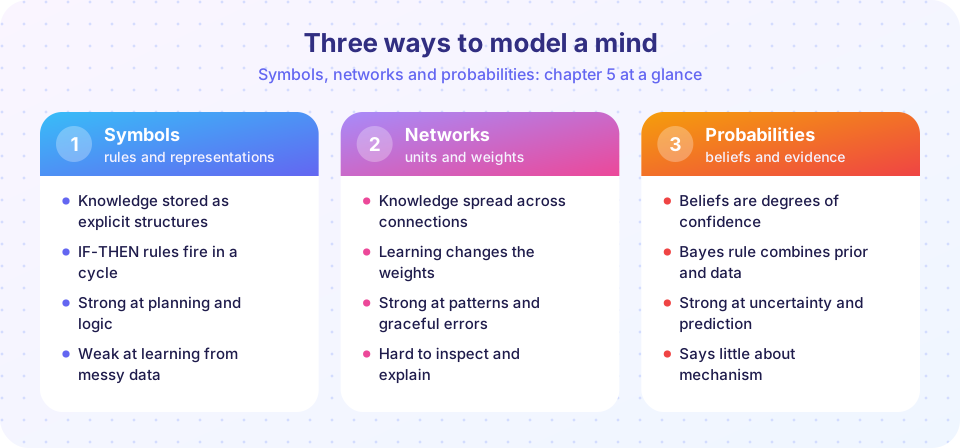
The three families answer in different vocabularies:
- Symbolic models say the mind manipulates discrete symbols according to rules, much like a program. Knowledge is explicit, and reasoning looks like steps in a proof.
- Connectionist models say the mind is a network of simple units. Knowledge lives in the strengths of connections, and nothing inside looks like a rule.
- Bayesian models say the mind weighs uncertain evidence. Knowledge is a set of degrees of belief, and perception and learning follow the logic of probability.
These are not strict rivals. Many modern models blend them, and a symbolic and a Bayesian account can describe the same behavior at different levels. You will see how in the lessons below.
Models make minds testable
Three families
Questions to ask of any model
What each lesson covers
- Symbolic systems: the physical symbol system idea, production rules, ACT-R and Soar, and Marr's three levels of explanation.
- Connectionism: artificial neurons, the perceptron, why XOR mattered, backpropagation and the past-tense debate.
- The Bayesian brain: Bayes' rule, cue combination, predictive processing and the critics of "Bayesian just-so stories".
- Chapter review: a one-page summary and a mixed quiz.
Try it
Press Run (or Ctrl + Enter) to see the console output here.
No output.
Check your understanding
Quick check · 3 questions
of 3 answered You scored / 3 · perfect!
-
1. What is the main reason cognitive scientists build models?
A model's value is that it makes predictions that data can confirm or contradict. It does not replace experiments. -
2. Which family says knowledge is stored in the strengths of connections between simple units?
Connectionist models store knowledge in connection weights, not in explicit rules. -
3. A Bayesian model treats knowledge mainly as:
Bayesian models represent beliefs as probabilities and update them when new evidence arrives.
Summary
- Models turn vague ideas about the mind into testable predictions.
- Symbolic, connectionist and Bayesian models differ in what they take knowledge to be.
- The families are complementary more than they are enemies, and hybrids are common.
- The next three lessons take each family in turn.
Next: Symbolic systems
Track your progress
Create a free account to tick off lessons and pick up where you left off on any device.
of Cognitive Science lessons completed