


















Lesson 38 of 43 · Consciousness and Frontiers
Consciousness and Frontiers: Chapter Review
Review chapter 8: the hard problem, five theories of consciousness, how researchers measure it, and the open questions about animals and machines, with a ten-question quiz.
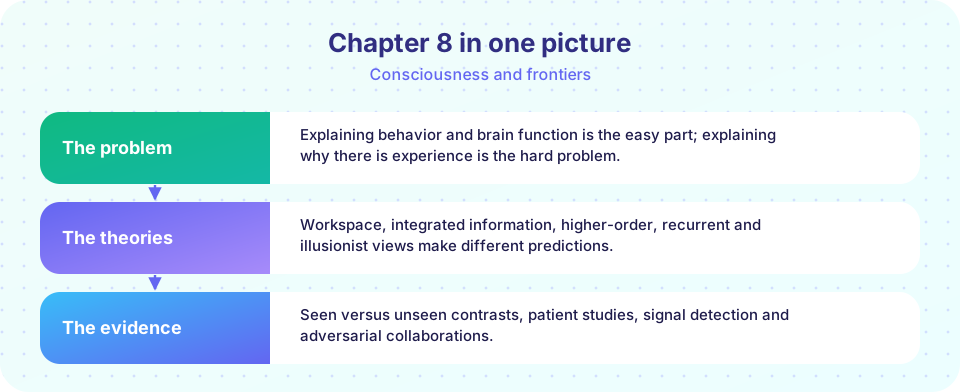
Chapter 8 tackled the question that sits behind the whole field: why is there experience at all, and how can we study it? You met rival theories, the methods used to catch consciousness in the lab and the frontier questions about patients, animals and machines. Use this review to consolidate.
What you will learn
- How to compare the main theories side by side.
- Which methods connect to which problems.
- Which open questions are likely to shape future research.
Recap table
| Theory | Core claim | Key names | Main objection |
|---|---|---|---|
| Global workspace | Consciousness is broadcast to many systems after ignition | Baars; Dehaene, Changeux | Explains access, not experience |
| Integrated information | Consciousness is integrated, differentiated causal structure (phi) | Tononi | Hard to test, counterintuitive implications |
| Higher-order | A state is conscious when represented by a higher-order state | Rosenthal; Lau | Infants and animals; what counts as such a state |
| Recurrent processing | Local feedback in sensory cortex suffices | Lamme | Hard to separate from report |
| Illusionism | The sense of qualia is a brain-made illusion | Dennett; Frankish | Seems to deny the data |
| Method | Idea | Catch |
|---|---|---|
| Masking, rivalry | Same input, different experience | Report may add activity |
| Blindsight | Guessing without reported seeing | Criterion and weak experience |
| Signal detection | Separate sensitivity from bias | Does not by itself reveal experience |
| No-report | Infer experience from eyes or other signals | Needs an inference |
| TMS-EEG complexity | Brain response complexity tracks level of consciousness | Clinical use still researched |
Take-home questions
- Is there a hard problem, or will explaining function explain experience?
- If two theories predict the same behavior, what evidence could separate them?
- Which animals, and which kinds of machines, would count as candidates, and on what grounds?
Check your understanding
Quick check · 10 questions
of 10 answered You scored / 10 · perfect!
-
1. Which pair of terms did Chalmers use to divide the problems of consciousness?
The easy problems concern function, the hard problem concerns why there is experience. -
2. Ignition is a key idea of which theory?
Workspace theory proposes sudden, widespread activation when content is broadcast. -
3. According to IIT, consciousness depends mainly on:
IIT ties consciousness to irreducible causal structure, so a digital computer would score low. -
4. A higher-order theory says an experience is conscious when:
The target state becomes conscious through a higher-order representation of it. -
5. Blindsight patients can:
After V1 damage, some patients perform above chance in forced-choice tests without reported experience. -
6. d-prime is computed from:
d' equals z(hit rate) minus z(false-alarm rate). -
7. No-report paradigms try to:
They infer experience from signals such as eye movements. -
8. What did Owen's 2006 fMRI study suggest?
A patient's brain activity followed the imagery commands like that of healthy volunteers. -
9. The Cambridge Declaration (2012) and the New York Declaration (2024) concern:
Both are statements by groups of researchers about evidence for animal consciousness. -
10. Why are adversarial collaborations valuable?
They make it harder to explain away unwelcome results afterward.
Summary
- Consciousness science combines philosophy, neuroscience and careful methods.
- Several theories coexist, and none has won.
- Measurement is hard because experience is private and report adds confounds.
- Animal and machine consciousness depend on which theory and which evidence you accept.
Track your progress
Create a free account to tick off lessons and pick up where you left off on any device.
of Cognitive Science lessons completed