


















Lesson 20 of 43 · Neuroscience Foundations
Chapter 4 review: Neuroscience foundations
Review neurons, action potentials, brain lobes, famous patients and imaging methods, work through reverse-inference arithmetic and finish with a ten-question quiz.
This review ties together the neuroscience of chapter 4: the cell, the circuit, the map and the methods. It also gives you a calculation that explains why a glowing region on a brain scan tells you less than you might think.
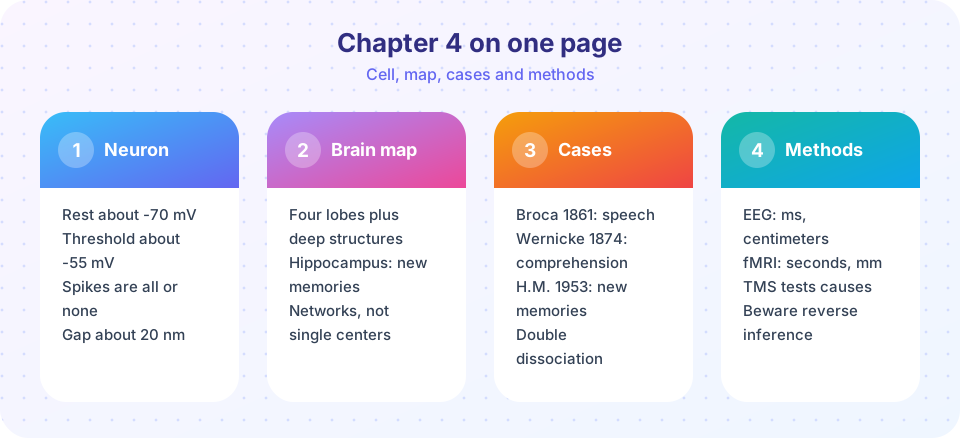
What you will learn
- The key facts from each lesson of the chapter.
- How timescales and distances shape what neurons can do.
- How to calculate how much an activation tells you about a mental process.
Recap table
| Lesson | Key facts |
|---|---|
| Overview | About 86 billion neurons; brain is about 2% of body mass and uses about 20% of resting energy; levels from synapse to system |
| Neurons and signaling | Rest about -70 mV; threshold about -55 mV; spikes are all or none; synapse gap about 20 nm; glutamate excites, GABA inhibits; Hodgkin and Huxley 1952 |
| Brain organization | Four lobes; Broca 1861, Wernicke 1874, H.M. 1953; double dissociation; networks, not isolated centers |
| Methods | EEG (ms, cm), fMRI (s, mm), single neurons (ms, micrometers), TMS tests causes; beware reverse inference and multiple comparisons |
Key terms
Action potential: all-or-none electrical spike.
Double dissociation: opposite impairments in two patients on two tasks.
BOLD: blood-oxygen-based fMRI signal.
Reverse inference: inferring a mental process from a brain activation.
Timescales and distances
Neural signaling has a speed limit. A spike lasts about a millisecond, a fast myelinated axon carries it at around 100 meters per second, and a thin unmyelinated fiber may manage only about 1 meter per second. Over a distance of 0.1 meter (across the brain), a fast axon takes about 1 millisecond, a slow one 100 milliseconds. These delays are part of why reaction times of hundreds of milliseconds (chapter 2) involve only a modest number of sequential neural steps, a point made forcefully by Jerome Feldman and Dana Ballard in their "100-step rule" for the brain: tasks done in about a tenth of a second can involve only a limited chain of sequential neural steps, so the brain must rely on massive parallelism.
Reverse inference by the numbers
Suppose a region R is active while a participant performs a task, and you want to infer whether the task engaged a particular process Y (say, fear processing). Bayes' rule gives the probability of Y given activation:
P(Y | active) = P(active | Y) P(Y) / [P(active | Y) P(Y) + P(active | not Y) P(not Y)]
If R is active nearly every time Y occurs (0.9) but also half the time when Y does not occur (0.5), with a prior of 50% that Y was engaged, the posterior is only about 64%. If R is selective (active only 10% of the time without Y), the posterior is 90%. Selectivity matters more than activation.
Common misconceptions
"A larger, brighter activation means a stronger effect." Display thresholds and statistics determine blob size. Effect size and sample size matter.
"Neurons are binary, so the brain is a digital computer." Spikes are all or none, but timing, rates, synaptic strengths and graded potentials carry information in analog ways.
Try it
A conduction-time calculator. Enter a distance and several fiber speeds to see how long a spike needs. The speeds are typical ranges, not fixed values.
Press Run (or Ctrl + Enter) to see the result here.
Program input · what you'd type while the program runs
Type the answers before you press Run, one per line. Each time the program reads a line (with input()), it gets the next line from this box.
A reverse-inference calculator. Change the numbers to see how selectivity changes the conclusion. The probabilities are made-up examples chosen to illustrate the arithmetic.
Press Run (or Ctrl + Enter) to see the result here.
Program input · what you'd type while the program runs
Type the answers before you press Run, one per line. Each time the program reads a line (with input()), it gets the next line from this box.
Check your understanding
Quick check · 10 questions
of 10 answered You scored / 10 · perfect!
-
1. What is the approximate resting membrane potential of a neuron?
Inside is about 70 millivolts negative relative to outside. -
2. Which pair of terms describes the strength of evidence from a double dissociation?
Reversed patterns across patients argue against a single common mechanism. -
3. Which technique best combines millisecond timing with non-invasive use in humans?
EEG and MEG track activity in real time but with coarse localization. -
4. A region is active in many different tasks. What does its activation tell you about any one process?
Low selectivity makes reverse inference weak. -
5. Which neurotransmitter is the main inhibitory one in the adult brain?
GABA mediates most fast inhibition. -
6. Hodgkin and Huxley's 1952 model explained
They modeled the squid giant axon's ionic currents. -
7. Which pairing of patient and finding is correct?
H.M.'s amnesia was selective, sparing procedural learning. -
8. Why does fMRI have poor temporal resolution?
The hemodynamic response peaks several seconds after the neural event. -
9. The dead salmon study warns against
Thousands of voxel tests yield false positives without correction. -
10. What is the best way to test whether a region is necessary for a function?
Causal tests require manipulation, not just observation.
Summary
- Neurons integrate inputs and fire all-or-none spikes; synapses are chemical and plastic.
- The brain has four lobes plus deeper structures, and famous patients taught us about specialization.
- Methods trade space for time, and stimulation or lesions test causation.
- Reverse inference depends on selectivity; always check sample size, statistics and corrections.
Next: Chapter 5 begins the next part of the course, on models of cognition. See the full plan on the Cognitive Science course page.
Track your progress
Create a free account to tick off lessons and pick up where you left off on any device.
of Cognitive Science lessons completed