


















Lesson 15 of 43 · Philosophy of Mind
Chapter 3 review: Philosophy of mind
Compare dualism, behaviorism, identity theory and functionalism side by side, review the Chinese room debate, and test yourself with a ten-question quiz.
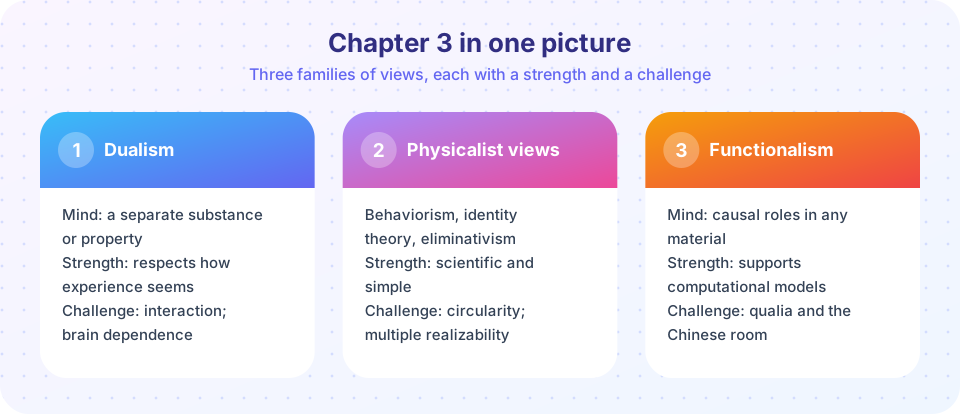
Chapter 3 followed a chain of ideas: dualism's trouble with interaction led to behaviorism, behaviorism's circularity led to identity theory, identity theory's chauvinism led to functionalism, and functionalism's apparent liberalism met Searle's challenge. This review lays the views side by side and checks that you can tell good arguments from slogans.
What you will learn
- The key claim, strength and weakness of each view.
- How the arguments connect historically and logically.
- How to separate a valid argument from a persuasive one.
Key terms
Valid argument: one where the conclusion must be true if the premises are true.
Sound argument: valid, with true premises.
Thought experiment: an imagined scenario used to test a theory.
Intentionality: the aboutness of mental states.
Views at a glance
| View | The mind is... | Main strength | Main problem |
|---|---|---|---|
| Substance dualism (Descartes) | A separate non-physical substance | Respects how different experience seems | Interaction problem; brain dependence |
| Logical behaviorism (Ryle) | Dispositions to behave | Ties mental talk to observable evidence | Circular; cannot handle pretenders or causes |
| Identity theory (Place, Smart) | The brain (type identical) | Scientific, simple | Multiple realizability |
| Functionalism (Putnam, Fodor) | Causal roles, realizable in any material | Supports computational models; allows artificial minds | Qualia; the Chinese room |
| Eliminativism (Churchlands) | Folk psychology may be replaced by neuroscience | Takes scientific revision seriously | Seems to deny what we know directly |
Related lessons: dualism, behaviorism and identity theory, functionalism and computation, the Chinese room.
Reasoning like a philosopher
Three habits help you in every debate in this chapter.
- Separate the claim from the argument. "Computers cannot understand" is a claim. The Chinese room is one argument for a version of it. A weak argument does not make the claim false, and a clever argument does not make it true.
- Check the form. Is the argument valid? An argument can be valid with a false premise, or have true premises but an invalid form (such as "if it is a mind it computes, it computes, so it is a mind").
- Find the crux. Many debates turn on one hidden premise, such as "conceivability implies possibility" or "simulation is not duplication". Naming it clarifies what evidence would matter.
Where the debate stands
None of these views has won. Most cognitive scientists work with a broadly functionalist or computational picture, but many add that the details of biological implementation, bodies and environments matter. Consciousness is the most stubborn leftover and is the subject of chapter 8. Chapter 7 returns to the question of machine minds with modern examples.
Common misconceptions
"The Chinese room settled the question." It is a famous argument with many replies and no consensus.
"Functionalism was refuted by multiple realizability objections." Multiple realizability supports functionalism against type identity. Objections to functionalism come from qualia and intentionality.
Try it
A comparison table printed from data. Edit the dictionary to add your own notes on each view, such as the best objection you have met.
Press Run (or Ctrl + Enter) to see the result here.
Program input · what you'd type while the program runs
Type the answers before you press Run, one per line. Each time the program reads a line (with input()), it gets the next line from this box.
A validity checker. It tests argument forms by brute force over every truth assignment. A form is valid if there is no case where all premises are true and the conclusion is false.
Press Run (or Ctrl + Enter) to see the console output here.
No output.
Check your understanding
Quick check · 10 questions
of 10 answered You scored / 10 · perfect!
-
1. Which problem is most associated with substance dualism?
Princess Elisabeth pressed this objection to Descartes. -
2. Why is logical behaviorism often called circular?
Analyzing a belief in behavioral terms requires mentioning other beliefs and desires. -
3. Place and Smart described the mind-brain identity as
They stressed that identity statements can be discovered by science. -
4. Which argument form is invalid?
Affirming the consequent is a fallacy: q might be true for other reasons. -
5. Which pairing is correct?
Functionalism is motivated by multiple realizability. -
6. In the Chinese room, Searle claims that
Syntax is not sufficient for semantics. -
7. Which reply says the whole system, not the operator, understands?
The systems reply attributes understanding to the room as a whole. -
8. Block's China brain is intended to challenge
A nation could mimic a brain's organization, yet it seems wrong to say it has a mind. -
9. Eliminativists hold that
They compare folk psychology to discarded theories. -
10. What does the term 'intentionality' denote?
In philosophy, intentionality is the property of being about something.
Summary
- The views form a chain: dualism, behaviorism, identity theory, functionalism, each answering its predecessor's weakness.
- Functionalism fits cognitive science but faces challenges from qualia and the Chinese room.
- Good philosophical reading separates claims from arguments, checks validity and locates the crux.
- No view has won; consciousness and machine minds stay open.
Track your progress
Create a free account to tick off lessons and pick up where you left off on any device.
of Cognitive Science lessons completed