


















Lesson 29 of 43 · Language, Vision and Embodiment
Embodied and Extended Cognition
Explore the idea that thinking depends on body, environment and tools: the four E's, Braitenberg vehicles, subsumption robots, the extended mind and replication limits.
When you do hard arithmetic, you probably reach for paper. When you rotate a puzzle piece, you might physically turn it rather than imagine it. When you give directions, your hands move. Are these just conveniences, or are they part of the thinking itself?
Traditional cognitive science, in the style of the symbolic models of chapter 5, pictured the mind as a computer in the head: take in a description of the world, compute, send out commands. Embodied cognition challenges that picture. It says a mind is a body that acts in an environment, and that much of cognition is carried by the body, by the surroundings and by the tools we use.
What you will learn
- The four E's and how they differ.
- How simple Braitenberg vehicles produce lifelike behavior without any internal model.
- What Brooks's robots and the extended mind argue.
- Which famous embodiment claims replicated poorly, and why that matters.
Key terms
Affordance: a possibility for action offered by an object to an agent, such as "graspable" or "sit-on-able" (James Gibson, 1979).
Subsumption architecture: a robot design in which simple behaviors are layered, with higher layers overriding lower ones (Rodney Brooks).
Epistemic action: an action done to simplify thinking rather than to change the world, such as rotating a puzzle piece.
Extended mind: the thesis that tools and notes can be part of a cognitive system.
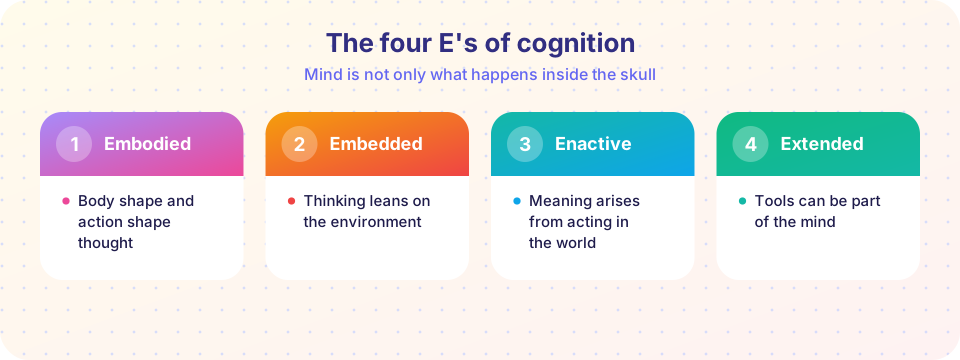
The four E's
- Embodied: body structure and sensorimotor skills shape cognition. A creature with eyes on the sides of its head thinks about space differently from one with forward-facing eyes.
- Embedded: cognition exploits the environment. You leave the car keys by the door to remind yourself.
- Enactive: following Francisco Varela, Evan Thompson and Eleanor Rosch's 1991 book The Embodied Mind, meaning arises from an organism's active engagement with its world.
- Extended: the boundary of the mind can include things outside the skin.
Related earlier ideas include George Lakoff and Mark Johnson's 1980 argument that abstract thought leans on bodily metaphors ("grasp an idea", "a warm person") and Lawrence Barsalou's 1999 proposal that concepts reuse perceptual and motor systems, called grounded cognition.
Braitenberg vehicles: behavior without a model
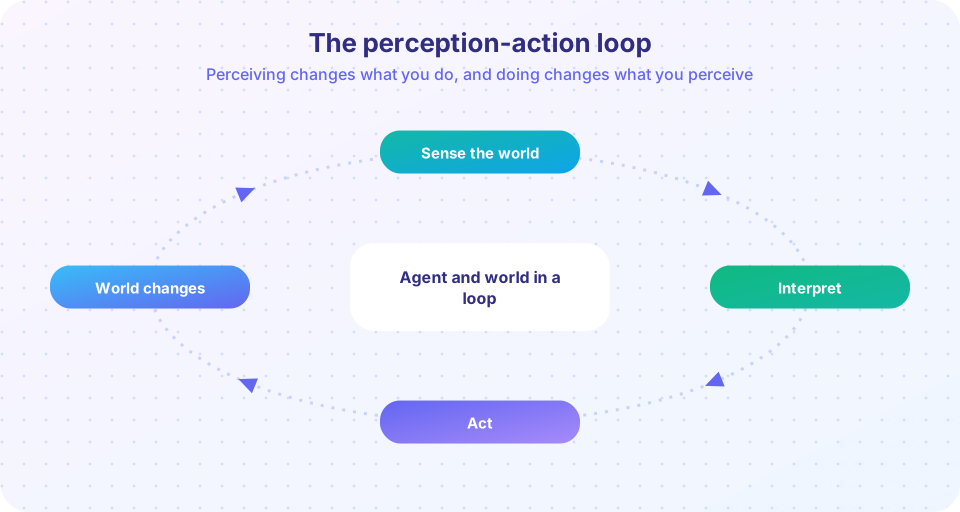
In his 1984 book Vehicles, Valentino Braitenberg imagined tiny wheeled machines with sensors wired directly to motors. Suppose a vehicle has two light sensors and two motors. If each sensor drives the motor on the same side, the vehicle turns away from light and seems to "fear" it. If the wiring is crossed, the vehicle turns toward the light and seems "aggressive". There is no map, no goal representation, only a wire, yet observers describe them in terms of motives.
The lesson is not that humans are Braitenberg vehicles. It is that a lot of apparent intelligence can come from the coupling of body, sensors and environment, so we should be careful when inferring complex internal representations from smart-looking behavior.
Intelligence without representation
Rodney Brooks, in a 1991 paper, argued that classic AI had mistaken the problem. His robots used a subsumption architecture: simple layers such as "avoid obstacles", "wander" and "explore", where lower layers always run and higher ones can override them. These insect-like robots could cross rooms without a central world model. Brooks's slogan was that the world is its own best model. The approach worked well for navigation but has not obviously scaled to the abstract reasoning and language that symbolic AI targeted, so it remains one tool rather than a replacement.
Using the world to think
Experiments by David Kirsh and Paul Maglio in 1994 on the game Tetris found that players often rotate a falling piece on screen to see whether it fits, even though mentally rotating it would be possible. They called these epistemic actions: actions that change your informational state, not the world.
Andy Clark and David Chalmers took this further in 1998 with the extended mind thesis. Their thought experiment: Otto, who has memory problems, relies on a notebook; Inga recalls the museum's address from biological memory. If the notebook plays the same role for Otto that memory plays for Inga, perhaps the notebook is part of his mind. Critics reply that this blurs the boundary between a mind and its tools, and the debate is mostly philosophical, but it shapes how researchers think about smartphones, notes and diagrams.
What does the evidence say? A critical look
Embodiment produced many striking claims, and some have not held up.
- Action-sentence compatibility. Arthur Glenberg and Michael Kaschak (2002) reported that people were faster to judge a sentence like "Open the drawer" as sensible when the response movement matched the sentence's direction. A large, preregistered multi-lab study (Morey and colleagues, 2022) did not replicate the effect.
- Facial feedback. In a 1988 study by Fritz Strack and colleagues, people holding a pen in their teeth (forcing a smile) rated cartoons as funnier. A 2016 registered replication by Eric-Jan Wagenmakers and colleagues across 17 labs found no overall effect, though research into facial feedback continues with other methods.
- Power posing. A 2010 paper by Dana Carney, Amy Cuddy and Andy Yap reported that expansive postures changed hormones and risk-taking. Later large studies did not replicate the hormone and behavior effects, and Carney publicly stated she no longer believed the original effects were real.
These failures do not refute embodiment as a research program. Studies of how action and perception are linked, such as work on reaching, tool use and affordances, are sturdy. What they show is that small, surprising laboratory effects deserve skepticism until they are replicated.
Another much-discussed finding is the mirror neurons found in macaque premotor cortex by Giacomo Rizzolatti, Vittorio Gallese and colleagues in the 1990s, which fire both when a monkey performs an action and when it sees one. Their role in humans, especially claims that they explain understanding other minds, is debated.
Common misconceptions
"Embodied cognition means thinking happens in the hands." The claim is about dependence of cognition on bodily and environmental structure, not about where neurons are.
"The failed replications mean the mind is not embodied." Only specific effects failed. Evidence about perception-action coupling and tool use remains strong.
Try it
Press Run (or Ctrl + Enter) to see the result here.
Program input · what you'd type while the program runs
Type the answers before you press Run, one per line. Each time the program reads a line (with input()), it gets the next line from this box.
Press Run (or Ctrl + Enter) to see the console output here.
No output.
Check your understanding
Quick check · 5 questions
of 5 answered You scored / 5 · perfect!
-
1. What does a Braitenberg vehicle show?
Direct wiring between sensors and motors can look like fear or aggression with no internal model. -
2. In the extended mind thesis, Otto's notebook is claimed to be:
Clark and Chalmers argued that it plays the functional role of memory for Otto. -
3. A subsumption architecture is one where:
Brooks's design layers simple behaviors without a central world model. -
4. What happened to the 1988 pen-in-mouth facial feedback finding in a 2016 registered replication across 17 labs?
Wagenmakers and colleagues found no overall effect, though the broader topic is still studied. -
5. Epistemic actions are:
Kirsh and Maglio used the term for actions that simplify thinking by changing what you perceive.
Summary
- Embodied, embedded, enactive and extended views stress the role of body, environment and tools in cognition.
- Braitenberg vehicles and Brooks's robots show how much behavior can come from coupling and layers, without a central model.
- Epistemic actions and the extended mind show people using the world to think.
- Several flashy embodiment effects have replicated poorly, so evidence quality matters.
Next: Chapter review
Track your progress
Create a free account to tick off lessons and pick up where you left off on any device.
of Cognitive Science lessons completed