


















Lesson 38 of 44 · Writing and Evaluating Research
Chapter 8 Review: Writing and Evaluating Research
Review APA report structure, statistics formatting and the four validities with a recap table, a self-audit and a ten-question quiz covering the whole chapter.
Writing and reading are two views of the same skill. When you write, you imagine a skeptical reader and give them what they need. When you read, you become that skeptical reader. This review puts the chapter on one page.
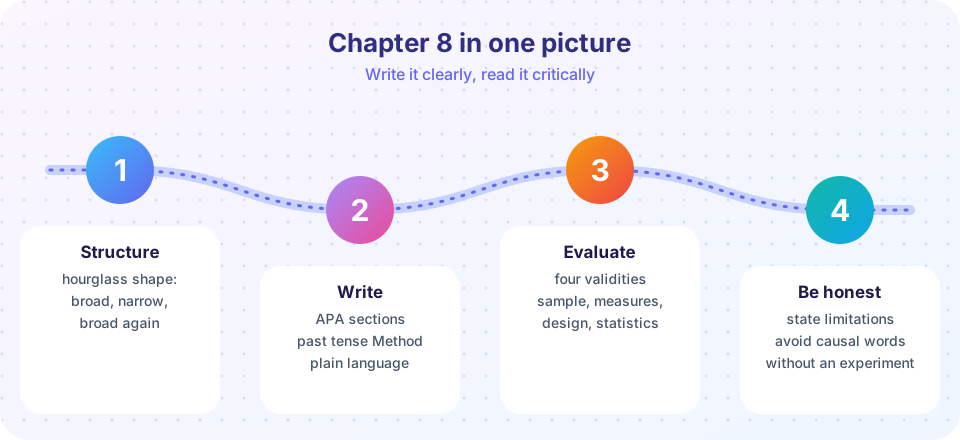
Recap table
| Topic | What to remember | Lesson |
|---|---|---|
| Hourglass | Broad, narrow, broad: intro to question, method and results, discussion | Overview |
| Method | Past tense; enough detail to replicate | APA structure |
| Results | Report, do not interpret; effect sizes and intervals | APA structure |
| APA statistics | Italic symbols, df in parentheses, exact p, no leading zero for p and r | APA structure |
| Discussion | Meaning, limits, implications, calibrated wording | APA structure |
| Construct validity | Measured the right concept? | Evaluating studies |
| Internal validity | Did the IV cause the change? | Evaluating studies |
| External validity | Does it generalize (WEIRD samples)? | Evaluating studies |
| Statistical validity | Power, tests, effect sizes, complete reporting | Evaluating studies |
A one-minute self-audit
Before submitting any report, ask: Can a stranger find my hypotheses, my sample and my main test in under a minute? Have I reported every planned analysis? Does each claim in the discussion match a result? Have I named at least one real limitation, and not just "more research is needed"? These four questions catch most of the problems that reviewers raise.
Try it
The final check is a mini linter for a results sentence. It looks for common formatting slips (a leading zero on p, p = .000, a missing effect size) in a draft. It is a teaching demonstration, not a replacement for the APA manual.
Press Run (or Ctrl + Enter) to see the console output here.
No output.
Check your understanding
Quick check · 10 questions
of 10 answered You scored / 10 · perfect!
-
1. Which is the correct APA format for a p-value of 0.0004?
Report p < .001 for very small values; never p = .000. -
2. What is the main job of the introduction?
It narrows the field step by step to your question. -
3. Which part of a report should let someone replicate the study?
The method provides participants, materials, design and procedure in detail. -
4. A study with a very large sample but a poor measure of 'happiness' is weakest in...
More participants cannot fix a measure that does not capture the concept. -
5. A paper reports a correlation and concludes 'X causes Y'. Which validity is most directly at stake?
Without manipulation and control of confounds, a causal claim is not supported. -
6. Which is NOT a red flag?
Preregistration and complete reporting are marks of good practice. -
7. In APA style, which symbol is italicized?
Latin statistical symbols are italicized; Greek letters are not. -
8. What is the best response to a news headline about a single new study?
Treat single studies as tentative and look for corroboration. -
9. Calibrated wording in a discussion means...
Language should be as strong as the evidence, no stronger. -
10. WEIRD samples are a concern for...
They limit how far findings generalize to other populations.
Summary
- A report follows the hourglass and gives each section one job; the method enables replication and the discussion states honest limits.
- APA conventions make statistics easy to read: italic symbols, df, exact p, no leading zero for p and r, effect sizes and intervals.
- Four validities (construct, internal, external, statistical) provide a systematic way to read research.
- Calibrated language and complete reporting are signs of trustworthy science.
Track your progress
Create a free account to tick off lessons and pick up where you left off on any device.
of Research Methods in Psychology lessons completed