


















Lesson 6 of 44 · The Logic of Research
Chapter 2 Overview: The Logic of Research
A preview of chapter 2: how theories, hypotheses, variables and validity link together, and why a study's conclusions are only as good as its logic.
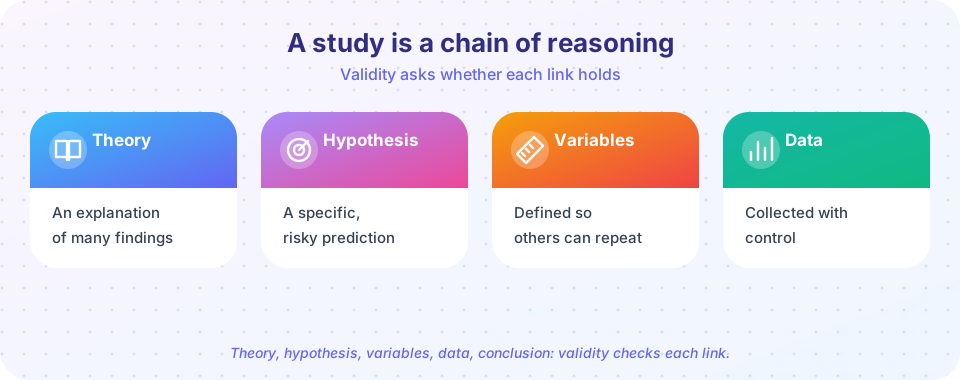
A study is an argument. It starts from a theory, moves through a prediction, collects observations and ends with a conclusion. If any link in that chain is weak, the conclusion is weak, however large the sample or fancy the statistics. This chapter teaches you to inspect each link.
You will learn how an abstract idea such as "stress" becomes something you can count, how a theory earns its place by risking being wrong, and how to judge whether a study's conclusion is really justified by what was done.
The big picture
Imagine a theory: "Sleep helps the brain consolidate new memories." That is too general to test. A researcher must:
- Derive a hypothesis: adults who sleep after learning will recall more the next day than those who do not.
- Define the variables: what counts as sleep, what counts as recall, and how each will be measured.
- Collect data under conditions that rule out other explanations.
- Draw a conclusion that fits the evidence and no further.
Every step involves a choice. A different choice could give a different answer. The study of research logic is the study of those choices.
A study is a chain
Why theories must risk failure
Four kinds of validity
What each lesson covers
| Lesson | What you will do |
|---|---|
| Variables and Operational Definitions | Turn ideas like stress or aggression into measurable variables and tell IVs, DVs and controls apart |
| Theories and Falsifiability | See how theories generate hypotheses and why they must be able to fail |
| Validity and Confounds | Learn the four kinds of validity and the common threats to a study's conclusions |
| Chapter 2 Review | One picture, a recap and a ten-question quiz |
How to approach the chapter
Read each lesson as if you were a skeptical referee. For each example, ask: what exactly was measured? What else could explain the result? Would a different but reasonable measure have given a different answer? These three questions will serve you for the rest of the course, and for the rest of your life as a reader of science news.
Check your understanding
Quick check · 3 questions
of 3 answered You scored / 3 · perfect!
-
1. Why is 'a study is an argument' a useful way to think?
A conclusion is only as strong as the weakest link between theory, hypothesis, measurement and data. -
2. Which step turns 'sleep helps memory' into something testable?
Only a specific prediction with measurable variables can be tested. -
3. A theory that can explain any possible result is
If no observation could refute it, it tells us nothing about the world.
Summary
- A study is a chain of reasoning from theory to conclusion.
- Chapter 2 covers variables, falsifiability and validity.
- Read studies like a skeptical referee: what was measured, what else could explain it, would another measure change the answer?
Track your progress
Create a free account to tick off lessons and pick up where you left off on any device.
of Research Methods in Psychology lessons completed