


















Lesson 10 of 44 · The Logic of Research
Chapter 2 Review: The Logic of Research
Review variables, operational definitions, theories, falsifiability and the four types of validity, with a recap table and a ten-question mixed quiz.
This chapter was about the reasoning inside a study. A good study links theory, hypothesis, variables and data in a chain that a skeptical reader can follow. Use this review to check your grip on each link.
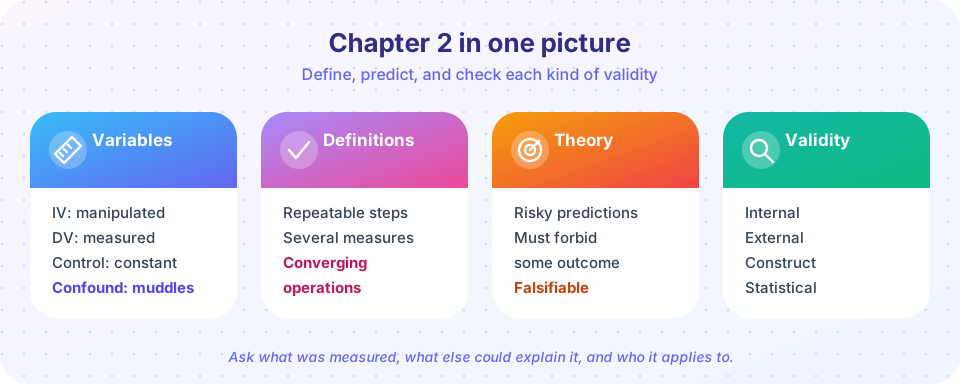
Recap table
| Idea | Key points |
|---|---|
| IV and DV | IV is manipulated or presumed cause; DV is the measured outcome |
| Control and confound | Controls are held constant; confounds vary with the IV and muddy the result |
| Operational definition | A repeatable description of how a concept is measured or manipulated |
| Converging operations | Several different measures of one concept, checked for agreement |
| Theory vs hypothesis | A theory explains many observations; a hypothesis is a specific prediction |
| Falsifiability | A claim must forbid some outcome to be informative |
| Internal validity | Did X cause Y in this study? |
| External validity | Will it generalize to other people, settings, times? |
| Construct validity | Do the measures reflect the intended concepts? |
| Statistical conclusion validity | Was the analysis sound? |
Revisit the lessons if any row feels shaky: variables, theories and validity.
Check your understanding
Quick check · 10 questions
of 10 answered You scored / 10 · perfect!
-
1. In a study of whether music improves arithmetic speed, the time taken to finish the test is the
It is the measured outcome. The music condition is the IV. -
2. Which operational definition of 'aggression' is best?
It names a procedure and a score that another researcher could repeat, though its construct validity can still be debated. -
3. Why do researchers use converging operations?
If different measures agree, the result is less likely to be an artifact of one measure. -
4. A theory predicts that anxious people will perform worse on a timed task than calm people. What would count against it?
A falsifiable theory forbids some outcome, here equal or better performance by anxious people. -
5. Which Wason selection task cards test 'if vowel then even' among E, K, 4, 7?
Only a vowel behind 7 or an odd number behind E could falsify the rule. -
6. A school gives extra help to its lowest-scoring pupils and their scores rise. A skeptic's best first question is
Without a comparable group, regression to the mean could explain the rise. -
7. Which threat is reduced mainly by random assignment?
Random assignment makes the groups equivalent on average at the start. -
8. A tightly controlled lab experiment with an artificial task is most at risk for weakness in
Control supports internal validity, while artificial settings can limit generalization. -
9. Participants work out what a study is about and act accordingly. This is
Demand characteristics threaten construct validity because behavior reflects guesses about the purpose. -
10. Why is a theory that can explain any result weak?
Informative theories take risks. One that fits everything has no testable content.
Summary
- Know the roles of variables and write operational definitions that others can repeat.
- Prefer risky, falsifiable predictions to all-purpose explanations.
- Ask four validity questions of every study: internal, external, construct and statistical.
Track your progress
Create a free account to tick off lessons and pick up where you left off on any device.
of Research Methods in Psychology lessons completed