


















Lesson 23 of 44 · Experimental Design
Between-Subjects and Within-Subjects Designs
Compare between-subjects and within-subjects experiments, learn random assignment, matched pairs and counterbalancing, and see why within designs are more sensitive.
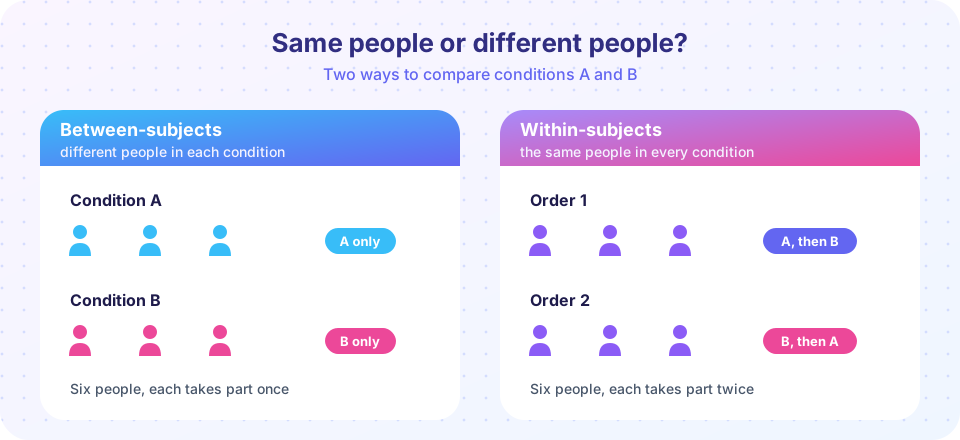
Once you know what you will manipulate, a practical question arrives: should each participant experience one condition or all of them? If you want to know whether a new font makes text easier to read, you can give one group the old font and another group the new font. Or you can have everyone read in both fonts. Both are valid experiments. They trade different strengths and weaknesses, and choosing well can double the information you get from the same budget.
What you will learn
- The difference between between-subjects and within-subjects designs.
- How simple random assignment, blocked assignment and matched pairs work.
- Why order effects occur and how counterbalancing and Latin squares handle them.
- Why a within-subjects design is usually more sensitive.
- When to choose a mixed design.
Key terms
Between-subjects design: each participant is in only one condition; you compare different groups.
Within-subjects (repeated-measures) design: each participant takes part in every condition; you compare each person with themselves.
Order effect: a change in performance caused by the position of a condition in the sequence, such as practice or fatigue.
Carryover effect: an earlier condition changes responses to a later one (for example, a drug that has not worn off).
Counterbalancing: varying the order of conditions across participants so that order effects cancel out.
Matched pairs: pairing participants who are similar on an important trait, then randomly assigning one of each pair to each condition.
Between-subjects designs
In a between-subjects design, every participant contributes one score, and the comparison is between groups. The groups must be equivalent at the start, so random assignment is essential. There are three common ways to do it.
- Simple random assignment. Each person is assigned by something like a shuffled list or random-number generator. This is fine for large samples, but with small samples chance can produce unequal group sizes.
- Blocked random assignment. Randomize within blocks, so that each block of, say, four people contains two of each condition. Group sizes stay balanced throughout, which also protects against drift over the weeks of data collection.
- Matched pairs. Measure a trait strongly related to the DV (reading ability in a reading study, say), pair up similar people, and randomly assign within each pair. This reduces the chance that the groups differ on that trait, though it does nothing for the traits you did not match.
Between-subjects designs have a big advantage: each person sees only one condition, so there is no practice, no fatigue and no carryover. They are also the only choice when the manipulation cannot be undone. You cannot teach someone a technique and then un-teach it. Their disadvantage is cost: you need enough people for every group, and the differences between people add noise to the comparison.
Within-subjects designs
In a within-subjects design, every person experiences every condition, and the comparison is each person against themselves. Reaction-time studies, perception experiments and many memory studies work this way.
The big payoff is sensitivity. People differ enormously: some are simply faster, some remember more. In a between-subjects study that variation is noise hiding the effect. In a within-subjects study each person is their own baseline, and the stable differences between people subtract out. The same effect can therefore be detected with far fewer participants.
The price is order and carryover effects. If everyone does condition A first, then B, a difference could be due to A versus B or to the simple fact that B came second. Possible culprits: practice (people get better), fatigue or boredom (people get worse), and carryover (what you did first changes how you respond afterward). There is also a risk of demand characteristics: when participants see all the conditions, the hypothesis becomes easier to guess.
Counterbalancing
The cure for order effects is not to eliminate order but to spread it evenly, so that it cannot line up with any condition. This is counterbalancing.
- Complete counterbalancing uses every possible order. With two conditions that is two orders (AB and BA). With three it is six, with four it is 24, and with five it is 120. That grows with the factorial of the number of conditions, so it quickly becomes impractical.
- Latin square designs use a smaller set of orders in which every condition appears in every position equally often. A balanced Latin square goes further and makes every condition follow every other condition equally often, which also controls simple carryover.
- Random order for each participant, used when there are many trials or conditions. On average it balances order, but with few participants it can be lumpy.
Counterbalancing does not remove order effects; it makes them equally present in all conditions. If the order effect is large, it inflates the noise, and you may need to switch to a between-subjects design or add rest breaks and washout periods.
Mixed designs
Real studies often combine both. A mixed design has at least one between-subjects factor and at least one within-subjects factor. A classic example: two groups of people (trained or untrained, assigned between) are each tested before and after an event (within). The within factor gives sensitivity; the between factor handles what cannot be repeated.
Choosing a design
| Question | Pick between | Pick within |
|---|---|---|
| Can the manipulation be undone? | No (learning, deception) | Yes |
| Is there carryover? | Likely | Unlikely |
| Are participants scarce? | Costly | Efficient |
| Would seeing all conditions reveal the hypothesis? | Yes | No |
| Is each session long? | Sessions short | Sessions too long when repeated |
Common misconceptions
"Counterbalancing removes order effects." It only distributes them evenly. The effects are still there; they just cannot create a false difference between conditions.
"Within-subjects always beats between-subjects." Not if carryover is severe, if the manipulation is irreversible, or if repeated testing exhausts participants.
"Matched pairs and random assignment are the same." Matching reduces differences on a trait you measured. Random assignment (including within matched pairs) is what protects you from everything else.
Try it
First, list the orders for complete counterbalancing and build a balanced Latin square for four conditions. The code also checks the balance: it counts how often each condition immediately follows each other condition.
Press Run (or Ctrl + Enter) to see the result here.
Program input · what you'd type while the program runs
Type the answers before you press Run, one per line. Each time the program reads a line (with input()), it gets the next line from this box.
Second, a simulation, labelled as such, of the same true effect studied both ways. People differ a lot in baseline speed, so the between design struggles, while the within design cancels those differences out.
Press Run (or Ctrl + Enter) to see the result here.
Program input · what you'd type while the program runs
Type the answers before you press Run, one per line. Each time the program reads a line (with input()), it gets the next line from this box.
Check your understanding
Quick check · 5 questions
of 5 answered You scored / 5 · perfect!
-
1. Which design needs the fewest participants for the same sensitivity, all else equal?
Each person serves as their own control, so stable differences between people cancel out and less noise remains. -
2. A researcher tests all participants in condition A first, then B. A difference between A and B could be due to...
Position in the sequence is confounded with condition unless the orders are counterbalanced. -
3. How many orders does complete counterbalancing require for four conditions?
Four conditions can be ordered in 4! = 24 ways. -
4. Why use a between-subjects design when you teach participants a new skill?
Learning is irreversible, so the second condition would be contaminated by the first. -
5. A study compares trained and untrained groups tested both before and after an event. This is a...
Group is a between factor and time of testing is a within factor.
Summary
- Between-subjects designs compare different groups; they need random assignment and avoid order effects but need more people.
- Within-subjects designs compare each person with themselves; they are more sensitive but suffer order and carryover effects.
- Counterbalancing (complete, Latin square, random order) spreads order effects evenly across conditions.
- Mixed designs combine both and are very common.
- Choose by asking whether the manipulation is reversible, how scarce participants are, and whether repeating conditions gives away the hypothesis.
Track your progress
Create a free account to tick off lessons and pick up where you left off on any device.
of Research Methods in Psychology lessons completed