


















Lesson 22 of 44 · Experimental Design
Manipulation and Control
Learn how to manipulate an independent variable, choose control groups and defeat confounds such as expectancy and demand effects with blinding and randomization.
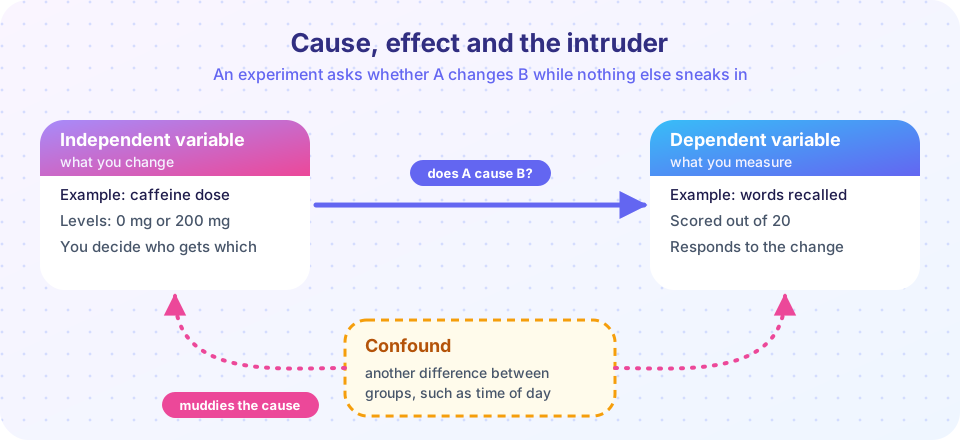
An experiment is a deliberate comparison. You create two or more situations that differ in exactly one way and see whether the outcome differs too. The skill lies in the word "exactly." Real situations differ in a hundred ways at once, and every uncontrolled difference is a rival explanation for your result. This lesson shows how to set up the one difference you want and shut out the rest.
What you will learn
- To identify the independent variable, its levels and the dependent variable.
- To turn a vague idea into an operational definition of a manipulation.
- Which kinds of control group exist and why each is used.
- How confounds, expectancy effects and demand characteristics creep in.
- How holding constant, randomization and blinding defend a study.
Key terms
Independent variable (IV): the variable the researcher manipulates; its values are called levels or conditions.
Dependent variable (DV): the outcome measured to see whether the IV had an effect.
Confound: a variable that differs systematically between conditions along with the IV, so that you cannot tell which one caused the difference.
Control group: a comparison group that does not receive the key manipulation.
Blinding: keeping participants (single-blind) or participants and experimenters (double-blind) unaware of who is in which condition.
Demand characteristics: cues in a study that suggest what behavior is expected.
The independent variable and its levels
Suppose you wonder whether noise hurts studying. "Noise" is the idea; you must turn it into something you can do. That step is the operational definition of the manipulation: for example, "participants read a passage while hearing either silence or a recording of busy street traffic at 65 decibels through headphones." Two levels: silence and traffic noise. The DV might be "number of correct answers on a ten-item comprehension quiz."
Two quick habits improve a manipulation:
- Make the levels clearly different. If your "noisy" condition is only slightly louder than your quiet one, a real effect will be invisible.
- Check that the manipulation worked. A manipulation check is a short question or measurement that confirms the participants experienced the levels as intended, such as "How distracting was the sound?"
You may have more than two levels. Three or more levels can reveal shapes that two cannot, such as the inverted-U relationship between arousal and performance described in the Yerkes-Dodson law, which two levels would miss.
Choosing a control group
A comparison only works if the comparison group is the right one.
| Control type | What the control group gets | Used when |
|---|---|---|
| No-treatment | Nothing | Simple baseline |
| Placebo | An inactive version that looks real | Testing a pill or a procedure where expectations matter |
| Waitlist | The treatment later | Therapy trials, where withholding help would be unkind |
| Active control | A different, credible intervention | Showing that the specific ingredient matters, not just attention |
The placebo idea matters a lot in psychology. People often improve because they expect to improve. A study of a new training program that compares trained people with people who were ignored will confuse the effect of the program with the effect of receiving care and attention. An active control, such as a general discussion group with equal time and enthusiasm, isolates the part of the program you actually care about.
What confounds look like
A confound is any difference between conditions other than the IV. Some classic sources:
- Time and place. Testing the treatment group in the morning and the control group in the afternoon mixes the treatment with time of day.
- Participant traits. If volunteers choose their own group, the more motivated people may cluster in the treatment group.
- Experimenter behavior. An experimenter who knows who is in which group may, without meaning to, act differently toward each.
- Materials. Using one set of stimuli in one condition and another set in a second condition confounds the stimuli with the condition.
Two well-known sources of confounding deserve names.
Expectancy effects. In 1968 Robert Rosenthal and Lenore Jacobson told teachers that certain pupils had been identified as "late bloomers," when the pupils had actually been picked at random. They reported that those pupils showed larger gains in some measures, which they read as the teachers' expectations shaping outcomes. The study has been criticized on methodological grounds, and the size of the effect is debated, but the lesson endures: expectations can leak through behavior. A far older and more charming case is Clever Hans, a horse that appeared to do arithmetic until the psychologist Oskar Pfungst showed in 1907 that Hans was reading tiny, unintended body cues from the questioner.
Demand characteristics. Martin Orne argued in the 1960s that participants are active interpreters. They try to work out what the study is "really about" and may help the experimenter, resist the experimenter or simply act the way a "good participant" should. If the procedure signals the hypothesis, behavior may reflect that signal rather than the IV.
The Hawthorne effect, the idea that people change behavior because they know they are being observed, is often cited alongside these. Later re-analyses of the original factory data at the Hawthorne Works found much weaker evidence for it than its reputation suggests, so treat it as a plausible concern rather than a proven law.
Ways to control
You have four main weapons.
- Hold constant. Make everything the same across conditions: instructions, room, time limit, equipment, the person giving instructions (use a script).
- Randomize. When you cannot hold something constant, such as every participant's personality, let chance spread it evenly. Random assignment (next lesson) does this for traits you never thought of.
- Counterbalance. Where order could matter, vary it systematically (see the within-subjects lesson).
- Blind. If participants do not know their condition, they cannot act on expectations about it. If the person measuring the outcome does not know either, their hopes cannot color the scoring. A double-blind design does both, and it is the standard in drug trials. When blinding is impossible (you cannot hide whether someone received a hug), have a blind rater score the outcome from recordings.
A caution: more control is not always better. Tightly controlled lab tasks give you strong internal validity but may look unlike real life. Experimenters balance the two, and Chapter 8 returns to this tension.
Common misconceptions
"A control group means a group that is controlled." It means a comparison group. The point is what it lacks (the key manipulation), not how tightly it is supervised.
"If I match my groups on age and gender, they are equal." Matching on measured traits leaves all the unmeasured ones free to differ. Only randomization handles those.
"Blinding is only for medicine." Any study in which expectations could shape behavior or scoring benefits from it, including studies of teaching, memory and attitudes.
Try it
The first demonstration is a simulation (a stand-in for real data) of a treatment that does nothing at all. The hidden trait is "alertness," which raises scores. In the self-selected design, alert people are more likely to choose the treatment; in the randomized design chance decides. Watch what happens to the estimated effect.
Press Run (or Ctrl + Enter) to see the result here.
Program input · what you'd type while the program runs
Type the answers before you press Run, one per line. Each time the program reads a line (with input()), it gets the next line from this box.
The second demonstration plots the spread of those 2,000 estimates for each design. The randomized estimates cluster around zero, which is the truth; the self-selected ones are shifted. A confound does not add random noise; it adds a systematic error that more data cannot remove.
Press Run (or Ctrl + Enter) to see the result here.
Program input · what you'd type while the program runs
Type the answers before you press Run, one per line. Each time the program reads a line (with input()), it gets the next line from this box.
Check your understanding
Quick check · 5 questions
of 5 answered You scored / 5 · perfect!
-
1. A study gives the treatment group an hour with an enthusiastic trainer and the control group nothing. What is the main problem?
Any improvement could come from receiving attention, not from the specific training. An active control group would separate the two. -
2. What is a manipulation check?
It confirms that, for example, the 'noisy' condition was actually experienced as noisier. -
3. Which design is double-blind?
Double-blind means both the participants and the experimenters or raters are unaware of condition. -
4. What did the Clever Hans episode teach researchers?
Pfungst showed that the horse responded to the questioner's tiny cues, a model for expectancy effects. -
5. Matching two groups on age and gender is weaker than random assignment because...
Hidden traits can still differ. Randomization balances them on average.
Summary
- The IV is what you change; the DV is what you measure; a confound is any other systematic difference.
- Operationalize the manipulation and check that it worked.
- Choose the control group that isolates the ingredient you care about (placebo, waitlist, active).
- Expectancy effects (Rosenthal, Pfungst's Clever Hans) and demand characteristics (Orne) show that people and experimenters shape results.
- Defend with holding constant, randomizing, counterbalancing and blinding.
Track your progress
Create a free account to tick off lessons and pick up where you left off on any device.
of Research Methods in Psychology lessons completed