


















Lesson 5 of 44 · Getting Started
Chapter 1 Review: Getting Started
Review the first chapter of Research Methods in Psychology: ways of knowing, biases, hypotheses and the main research designs, with a ten-question mixed quiz.
You have now seen why psychology needs research methods, how a topic becomes a hypothesis, and which designs answer which questions. This review pulls the chapter into one picture, a recap table and a mixed quiz.
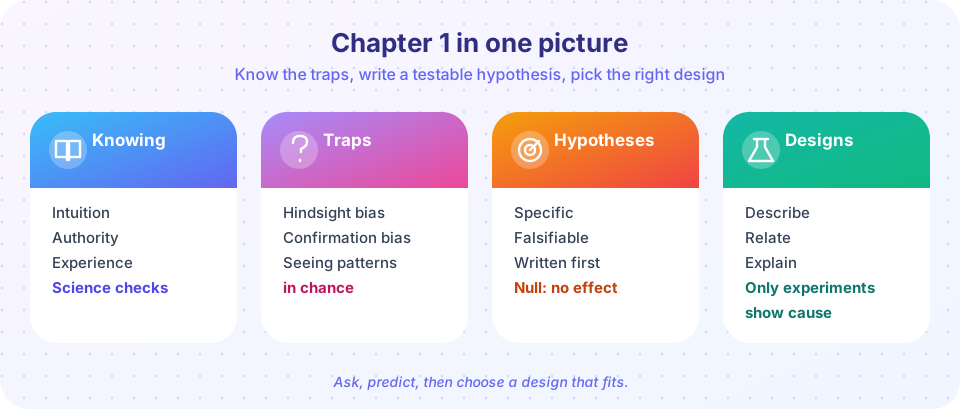
Recap table
| Lesson | Big idea | One thing to remember |
|---|---|---|
| Course Map | The course follows a study from idea to report | Judge claims by their methods |
| Psychology as a Science | Intuition and authority mislead; science adds checks | Hindsight and confirmation bias affect everyone |
| Research Questions and Hypotheses | A question must be researchable; a hypothesis must be falsifiable | Write predictions before the data |
| The Research Toolkit | Describe, relate or explain, each with its own design | Only experiments show cause |
Before the quiz: three self-checks
- Can you explain, in one sentence each, hindsight bias and confirmation bias, and give an example of each from daily life?
- Can you turn "Does exercise help students?" into a specific directional hypothesis?
- Can you name a question that an experiment cannot ethically answer, and say which design you would use instead?
Check your understanding
Quick check · 10 questions
of 10 answered You scored / 10 · perfect!
-
1. A friend says a psychology finding is 'obvious.' What is a good test of whether it really was?
If you could explain either outcome, the feeling of obviousness comes from hindsight, not from real predictive power. -
2. Which of these is a feature of scientific knowledge?
Public checking and willingness to revise are what make the method self-correcting. -
3. In Wason's 2-4-6 task, which test would be most informative about the rule 'add two'?
1, 2, 3 does not follow 'add two.' If it still gets a yes, the guess is shown to be too narrow. -
4. Which is a researchable question?
It names groups, conditions and a measurable outcome, so data can bear on it. -
5. A null hypothesis says that
H0 is the 'no difference or no relationship' statement that tests are built around. -
6. A directional hypothesis differs from a non-directional one because it
Directional predictions specify higher or lower; non-directional ones predict only a difference. -
7. Which design can best establish cause and effect?
Manipulating the IV and randomly assigning participants lets differences be attributed to the IV. -
8. A researcher wants to know how long people with a rare condition take to be diagnosed. Which design fits best?
You cannot assign people to a condition, so a descriptive design is the realistic choice. -
9. What did Oskar Pfungst's work on Clever Hans demonstrate about method?
He removed the questioner's cues and the effect vanished, a model of experimental control. -
10. In the chance simulation, group A scored higher in roughly half of experiments with no real effect. The lesson is that
Random variation produces gaps in both directions, so we need statistics to judge whether a gap is bigger than chance.
Summary
- Intuition, authority and experience are fallible; science adds public, systematic checks.
- A hypothesis is a falsifiable prediction written in advance.
- Descriptive, correlational and experimental designs answer different questions, and only experiments show cause.
Track your progress
Create a free account to tick off lessons and pick up where you left off on any device.
of Research Methods in Psychology lessons completed