


















Lesson 25 of 44 · Experimental Design
Chapter 5 Review: Experimental Design
Review experimental design in psychology: independent and dependent variables, control, random assignment, between and within designs and factorial interactions.
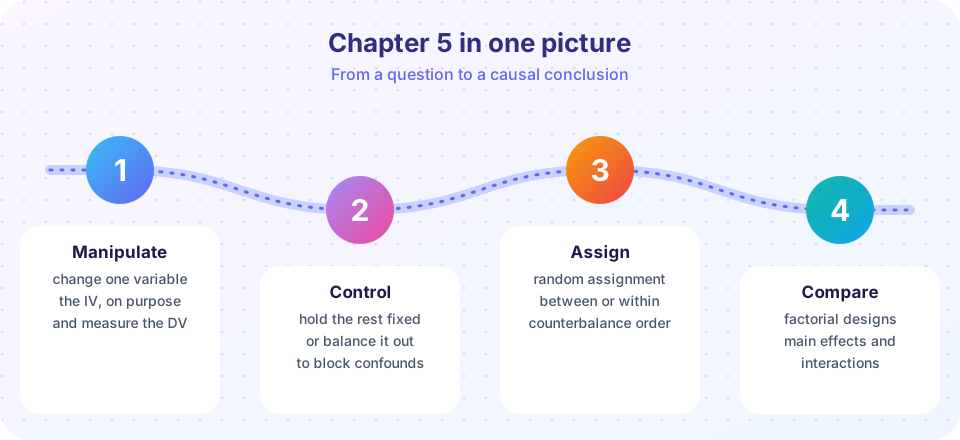
You now have the vocabulary and the logic of the experiment. This review gathers the chapter into one picture and one table, then tests it with a longer quiz that mixes all the lessons.
Recap table
| Idea | One-line summary | Lesson |
|---|---|---|
| Independent variable | What the researcher changes | Manipulation and control |
| Dependent variable | What gets measured | Manipulation and control |
| Confound | A second difference between conditions that muddies the cause | Manipulation and control |
| Blinding | Hide condition from participants and raters to block expectancy effects | Manipulation and control |
| Random assignment | Chance decides who gets which condition | Between and within designs |
| Between-subjects | Different people per condition | Between and within designs |
| Within-subjects | Same people in all conditions; counterbalance order | Between and within designs |
| Factorial design | Two or more IVs in all combinations | Factorial designs and interactions |
| Interaction | One factor's effect depends on another | Factorial designs and interactions |
A rapid self-check
Before running any experiment, ask yourself five questions.
- What is my IV, and what are its levels? Did I operationalize it?
- What is my DV, and is it a valid, reliable measure? (Chapter 3.)
- What could differ between conditions besides the IV?
- How will participants be assigned: between, within, or mixed? If within, how will I counterbalance?
- Does theory suggest that a second factor changes the effect? If so, should I add it?
Here is a small habit worth building: write the design as a sentence. "This is a 2 (caffeine: none, some; between) x 2 (task: easy, hard; within) mixed design with words recalled as the DV." If you cannot write the sentence, the design is not ready.
Try it
A short script that, given a few facts about a design, describes it in words. It is a demonstration of the checklist logic, not a substitute for thinking.
Press Run (or Ctrl + Enter) to see the result here.
Program input · what you'd type while the program runs
Type the answers before you press Run, one per line. Each time the program reads a line (with input()), it gets the next line from this box.
Check your understanding
Quick check · 9 questions
of 9 answered You scored / 9 · perfect!
-
1. A researcher lets volunteers choose between a new training program and a waitlist. What is the key problem?
People who choose to train may be more motivated, so groups differ before the manipulation. Random assignment would fix this. -
2. Which is the best way to control an experimenter's expectations?
If experimenters do not know the condition, their hopes cannot leak into behavior or scoring. -
3. A placebo control group is used mainly to...
Expectations alone can produce improvement; a placebo shows how much. -
4. Which situation calls for a between-subjects design?
Teaching cannot be undone, so participants cannot return to a naive state for the second condition. -
5. With five conditions, how many orders does complete counterbalancing need?
5! = 120, which is why Latin squares are used instead. -
6. In a 2 x 3 x 2 design, how many cells are there?
2 x 3 x 2 = 12. -
7. Cell means: Method A helps novices by 10 points and helps experts by 0 points. This is...
The effect of method depends on expertise, which is an interaction. -
8. What does a manipulation check do?
It tests that the levels of the IV differed in the way the researcher intended. -
9. Why is a within-subjects design usually more sensitive?
Differences between people no longer add noise to the comparison of conditions.
Summary
- An experiment manipulates an IV, measures a DV, controls extraneous variables and randomizes assignment.
- Confounds, expectancy effects and demand characteristics are the enemies; holding constant, randomizing, counterbalancing and blinding are the weapons.
- Between designs avoid carryover; within designs are more sensitive; mixed designs combine them.
- Factorial designs reveal interactions, which should be read before main effects.
Track your progress
Create a free account to tick off lessons and pick up where you left off on any device.
of Research Methods in Psychology lessons completed