


















Lesson 8 of 44 · The Logic of Research
Theories and Falsifiability
How psychological theories generate testable hypotheses, why they must risk being wrong, and what Popper's idea of falsifiability means in practice. Includes the Wason selection task.
A theory is not a wild guess. In science it means an organized set of ideas that explains a range of observations and predicts new ones. Evolution by natural selection is a theory. So is the idea that working memory has limited capacity. What makes a theory scientific is not that it is certain. It is that it sticks its neck out: it forbids some outcomes, so some observation could show it wrong.
This lesson explains how theories produce hypotheses, what Karl Popper meant by falsifiability, and why a theory that can explain everything is worth very little.
What you will learn
- What a scientific theory is, and how it differs from a hypothesis and from a hunch.
- How deduction and induction both appear in research.
- What falsifiability means, with examples of falsifiable and unfalsifiable claims.
- Why good theories are judged on several criteria, not just on being "proved."
Key terms
Theory: an organized set of principles that explains observations and generates predictions.
Hypothesis: a specific prediction derived from a theory.
Deduction: reasoning from general principles to specific predictions.
Induction: reasoning from specific observations to a general pattern.
Falsifiability: the property of a claim that some possible observation could show it false.
From theory to hypothesis
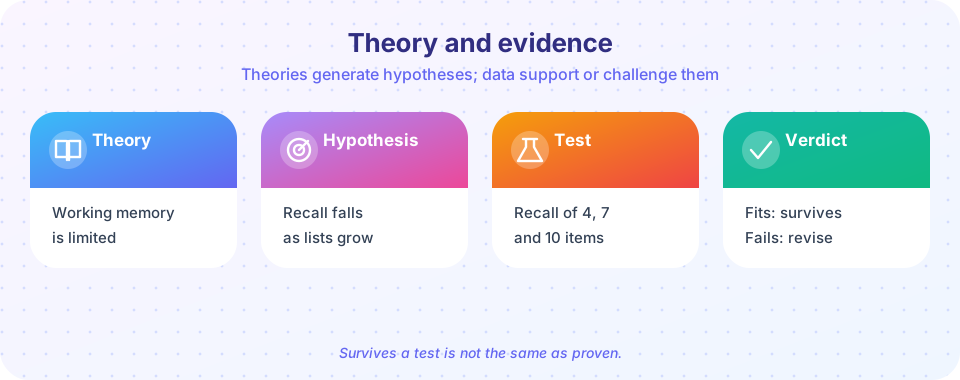
Consider the theory that working memory has a limited capacity. It is general. To test it, you derive a specific prediction by deduction:
- Theory: Working memory holds only a few items at once.
- Deduction: So people should recall fewer items from a longer list when they must hold them for a few seconds.
- Hypothesis: The percentage of items correctly recalled will fall as list length rises from 4 to 10.
You run the study and compare the data with the prediction. If recall does not fall with list length, the theory is in trouble. If it does, the theory survives this test, and that is all: it survives. The next test might go the other way.
Research also works in the opposite direction. Induction starts with observations, such as many patients showing a similar pattern, and proposes a general idea. Theories are often built inductively and tested deductively. George Miller's 1956 paper on the "magical number seven, plus or minus two" collected data on how many items people could hold. Later researchers, such as Nelson Cowan, argued that the true limit for new items is closer to four chunks. Both worked from observations to a theory and then back to tests.
Falsifiability
The philosopher Karl Popper (1902 to 1994) argued that what distinguishes science from non-science is not that scientific claims can be proved, but that they can be falsified. No number of white swans proves "all swans are white," but one black swan refutes it. A claim is scientific if it forbids something: if you can say in advance what observation would count against it.
Falsifiable versus unfalsifiable
| Claim | Falsifiable? | Why |
|---|---|---|
| People recall fewer words as list length increases | Yes | A flat or rising pattern would contradict it |
| Everyone has a hidden unconscious motive that no test can reveal | No | No observation could count against it |
| Anxious people will perform worse on a timed task than calm people | Yes | Equal or better performance would contradict it |
| Behavior is caused by whatever drives the person, shown by their behavior | No | It is circular: any behavior "proves" it |
Popper criticized theories that seemed to explain every possible case. A theory that accommodates a person who gives help and a person who refuses to help, both as "proof," has stopped saying anything. Informative theories take risks.
A more realistic picture
Strict falsification is an ideal. In practice, a failed prediction can mean the theory is wrong, but it can also mean a measure was poor, the sample was odd or the equipment failed. Philosophers such as Imre Lakatos and Thomas Kuhn described how scientists protect good theories from single failures while still revising them when evidence accumulates. Researchers therefore judge theories by several criteria.
- Testability: does it make risky, specific predictions?
- Parsimony: does it explain a lot with few assumptions?
- Scope: does it cover many findings?
- Support: do independent tests, using different measures, agree?
- Productivity: does it suggest new questions?
A theory that has survived many varied tests is said to be well supported. It is never declared proven.
Why this matters when you read research
Be suspicious when a theory is protected from every challenge by added excuses ("it did not work because the person was resistant"). Look for what the theory forbids. And remember that supporting a hypothesis is weaker than testing it hard. A test that could not have gone against the theory supports it only a little.
Common misconceptions
"A theory is just a guess." In science a theory is a well-developed explanation backed by evidence. A guess is closer to a hunch.
"One failed study destroys a theory." One failed study is a warning. Researchers look at the quality of the study, whether it replicates, and whether the theory can be adjusted.
"Supported means proven." Evidence raises plausibility. In psychology particularly, conclusions stay open to revision.
Try it
Press Run (or Ctrl + Enter) to see the result here.
Program input · what you'd type while the program runs
Type the answers before you press Run, one per line. Each time the program reads a line (with input()), it gets the next line from this box.
Check your understanding
Quick check · 5 questions
of 5 answered You scored / 5 · perfect!
-
1. Which claim is falsifiable?
Only the second forbids some outcomes, such as equal or higher recall for longer lists. -
2. Deduction in research means
Deduction moves from theory to a testable hypothesis. Induction moves from observations to a general idea. -
3. In the Wason task, which cards test the rule 'if vowel then even'?
A vowel behind 7 or an odd number behind E would break the rule. 4 and K cannot contradict it. -
4. Why is a theory that fits every outcome weak?
Informative theories forbid outcomes; those that explain everything have no predictive content. -
5. A well-supported theory is best described as
Support is cumulative evidence, and conclusions stay open to revision.
Summary
- A theory explains many observations and generates specific hypotheses by deduction.
- Falsifiability, as Popper emphasized, means a claim must forbid something so evidence could count against it.
- Theories are judged by testability, parsimony, scope, support and productivity.
- Be wary of theories protected by excuses, and prefer tests that could really fail.
Next: Validity and Confounds
Track your progress
Create a free account to tick off lessons and pick up where you left off on any device.
of Research Methods in Psychology lessons completed