


















Lesson 15 of 44 · Measurement and Sampling
Chapter 3 Review: Measurement and Sampling
Review levels of measurement, reliability, validity and sampling methods with a recap table and a ten-question mixed quiz covering all of chapter 3.
You now know how numbers attach to mental and behavioral variables, how to judge a measure, and how a sample can fairly represent a population. This review puts the chapter on one page and tests it.
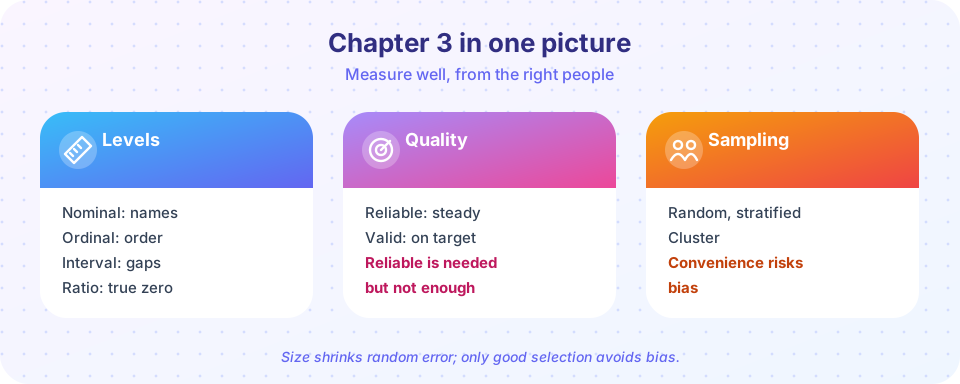
Recap table
| Topic | What to remember |
|---|---|
| Levels | Nominal, ordinal, interval, ratio; each level adds a property and allows more statistics |
| Reliability | Consistency: test-retest, internal consistency (alpha), inter-rater (kappa) |
| Validity of measures | Face, content, criterion and construct; convergent and discriminant evidence |
| Relationship | Reliability is necessary but not sufficient for validity |
| Sampling | Random, stratified, cluster versus convenience and volunteer |
| Bias vs error | Bias is systematic and not fixed by size; error is random and shrinks with size |
Check your understanding
Quick check · 10 questions
of 10 answered You scored / 10 · perfect!
-
1. Which variable is measured at the ratio level?
Words recalled has equal gaps and a true zero, so ratios make sense. -
2. The median is most appropriate for which type of data?
It uses order only. Nominal data call for the mode. -
3. A questionnaire gives wildly different scores when the same people repeat it a week later. It lacks
Inconsistent scores across time show low test-retest reliability. -
4. What does Cronbach's alpha estimate?
It summarizes how well items in a scale hang together. -
5. A scale correlates strongly with another measure of the same construct and weakly with unrelated ones. This supports
Convergent plus discriminant evidence supports construct validity. -
6. A measure that is consistent but off target is
Consistency does not guarantee that the measure captures the intended concept. -
7. Which sampling method guarantees proportional representation of subgroups?
Stratified sampling draws randomly within each subgroup in proportion to its size. -
8. Why did a bigger sample not rescue the Literary Digest poll?
A biased method gives a systematically wrong answer, and more of the same only makes it look precise. -
9. How does the 95% margin of error change when n is multiplied by four?
Error shrinks with the square root of n, so four times the people halves it. -
10. Which statement is correct?
They are different steps that protect external and internal validity respectively.
Summary
- Choose the highest practical level of measurement and match statistics to it.
- Check reliability first, then build the case for validity with several kinds of evidence.
- Use probability sampling when you can; remember that size cannot cure bias.
Next: Chapter 4 Overview: Descriptive and Correlational Studies
Track your progress
Create a free account to tick off lessons and pick up where you left off on any device.
of Research Methods in Psychology lessons completed