


















Lesson 11 of 44 · Measurement and Sampling
Chapter 3 Overview: Measurement and Sampling
A preview of chapter 3: how psychologists measure mental and behavioral variables, judge reliability and validity of measures, and choose who takes part in a study.
Two questions sit under every psychological study. First: how did you measure it? Second: who did you measure? A brilliant design with a poor measure produces numbers without meaning. A good measure on an unrepresentative group produces results that describe nobody in particular.
This chapter teaches both. You will learn how numbers are assigned to things, what separates a good measure from a poor one, and how a sample can fairly stand in for a population.
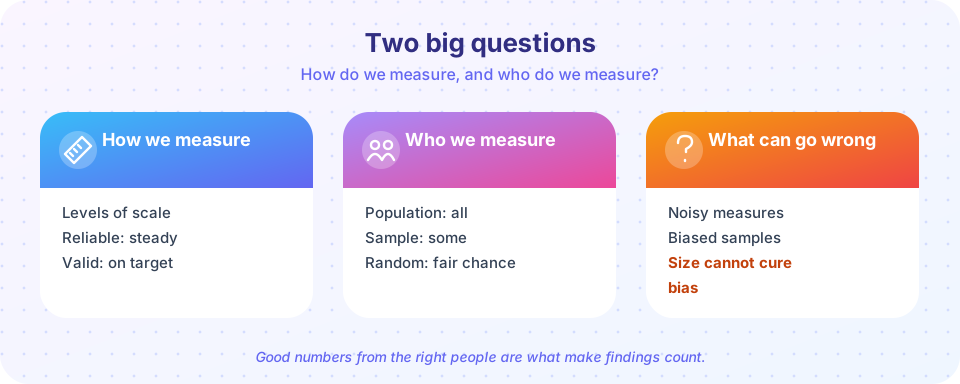
The big picture
Measurement means assigning numbers or labels to observations according to rules. A reaction time in milliseconds, a score on a 5-point agreement scale and a category such as "right-handed" are all measurements, and each carries different information.
Good measurement has two main qualities. A measure is reliable if it gives consistent results. It is valid if it measures what it claims to. A scale that reads 2 kg too heavy every time is reliable but not valid. A scale that jumps randomly is neither.
Sampling is about generalizing. You rarely study everyone, so you study a sample and use it to learn about a population. How the sample is chosen decides how far that learning can go.
Measure
Sample
The trap
What each lesson covers
| Lesson | What you will do |
|---|---|
| Levels of Measurement | Tell nominal, ordinal, interval and ratio data apart and see which statistics fit each |
| Reliability and Validity of Measures | Compute test-retest and internal consistency, and learn the types of validity of a measure |
| Sampling and Populations | Compare random, stratified and convenience sampling, and see how bias arises |
| Chapter 3 Review | One picture, a recap and a ten-question quiz |
Check your understanding
Quick check · 3 questions
of 3 answered You scored / 3 · perfect!
-
1. A bathroom scale always reads 2 kg too high, but gives the same number every time. It is
It is consistent (reliable) but systematically wrong (not valid). -
2. What is a population in research?
The sample is drawn from the population, and conclusions are meant to apply to it. -
3. Which problem can a larger sample NOT fix?
Bias in selection stays the same however many people you add.
Summary
- Measurement assigns numbers or labels by rules; good measures are reliable and valid.
- Sampling lets you learn about a population by studying part of it.
- How a sample is chosen matters more than how big it is.
Next: Levels of Measurement
Track your progress
Create a free account to tick off lessons and pick up where you left off on any device.
of Research Methods in Psychology lessons completed