


















Lesson 36 of 44 · Writing and Evaluating Research
The Structure of an APA-Style Research Report
Learn what belongs in each section of an APA-style empirical report, how to format statistics, and the habits of clear, honest scientific writing.
Scientific writing is unlike essay writing. Nobody reads a method section for suspense. The aim is the opposite: a reader should know exactly what happened, in what order, with no surprises, and be able to repeat it. The American Psychological Association (APA) publishes a style manual, now in its seventh edition, that sets the format used by most psychology journals and many university courses. This lesson walks through each section of an empirical report, shows how to report statistics, and offers writing habits that make the difference between a clear report and a confusing one.
What you will learn
- The purpose and content of each section.
- How to describe participants, materials and procedure so others can replicate.
- How to format statistics, tables and figures in APA style.
- How to write limitations and conclusions honestly.
- Good habits: tense, voice, clarity, bias-free language and citation.
Key terms
Empirical report: a paper describing a study the authors carried out, with its own data.
Abstract: a short, self-contained summary of the study, usually 150 to 250 words.
Replicable: described in enough detail that another researcher could repeat the study.
Limitation: a feature of the study that restricts what can be concluded.
In-text citation: a brief reference in the text (author and year) that points to the full entry in the reference list.
Title page and abstract
The title page has the title, the authors' names and affiliations, and an author note. A good title is specific: it names the variables and, ideally, the population or design ("Spaced practice improves vocabulary recall in undergraduates" beats "A study of learning").
The abstract is a standalone summary. A strong one has four parts in a few sentences each: the question and its importance, the method (participants, design), the main results (with an effect size, not just "significant"), and the meaning. Write it last, after the paper is finished. Many readers will read nothing else, so it must not overclaim.
Introduction
The introduction follows the top half of the hourglass.
- Open broadly. State the topic and why it matters.
- Review the relevant literature, organized by ideas rather than by paper-by-paper summaries. Show what is known, and critically, what is not known or is in dispute.
- Identify the gap or the puzzle that motivates your study.
- State your hypotheses at the end, clearly and specifically, saying which direction you expect and why. If the study was preregistered, say so.
Do not pad. Every paragraph should move the reader closer to your question.
Method
The method section is a recipe. Write it in the past tense, in enough detail for replication, and organize it with subheadings.
- Participants. Who took part, how many, how they were recruited, relevant demographics, any exclusions and why, and how the sample size was chosen (a power analysis, ideally). Mention compensation and ethics approval.
- Materials or measures. Describe every questionnaire, task or apparatus, with reliability information for scales (for example, Cronbach's alpha) and example items. Cite published instruments.
- Design. Name the design: "a 2 (study schedule: spaced, massed) x 2 (delay: immediate, one week) mixed design", with the IVs and DVs and how participants were assigned.
- Procedure. Describe what happened in order, from consent to debriefing, in plain steps.
A helpful test: could a competent graduate student repeat the study from your method alone, without emailing you? If not, add detail.
Results
The results section reports what you found without interpreting it. Interpretation belongs in the discussion.
- Preliminary analyses. Data screening, exclusions, checks of assumptions, manipulation checks.
- Descriptive statistics. Means, standard deviations and sample sizes for each condition, often in a table.
- Main inferential tests, matched to the hypotheses in the same order, with effect sizes and confidence intervals.
- Exploratory analyses, clearly labelled as such.
Formatting statistics in APA style
- Italicize statistical symbols (M, SD, t, F, p, r, d, N, n), but not Greek letters.
- Put degrees of freedom in parentheses: t(62) = 2.31.
- Report exact p-values to two or three decimals, and write p < .001 for smaller values. Do not write p = .000.
- Omit the leading zero for statistics that cannot exceed 1 (p, r): p = .033, r = .45. Keep the zero for those that can (d = 0.52, M = 0.8).
- Report an effect size and a confidence interval with each key test.
- Use numerals for statistical results and for numbers 10 and above; spell out numbers below 10 when they are not measurements.
Example: "Participants in the spaced condition recalled more words (M = 28.4, SD = 5.1) than those in the massed condition (M = 24.9, SD = 5.6), t(62) = 2.60, p = .012, d = 0.65, 95% CI [0.8, 6.2]." (A made-up illustration of the format.)
Use tables for many numbers and figures for patterns. Every table and figure needs a number, a title and a note, and must be mentioned in the text. Show the data: bar charts with error bars alone hide the distribution, so consider showing individual points.
Discussion
The discussion is the bottom half of the hourglass, widening from your results.
- Summarize the main finding in plain words and say whether it supports the hypotheses.
- Interpret it: what does it mean, and how does it fit with earlier work?
- Limitations. Be specific and honest: sample (all undergraduates?), measures, design, power, possible confounds. Do not bury or minimize them.
- Implications and future directions. What should researchers or practitioners do differently? What study comes next?
- Conclusion. A final paragraph with the take-home message, no more than the data justify.
A frequent beginner error is to claim causation after a correlational study, or to declare that a non-significant result "proves" there is no effect. Use calibrated verbs: "suggests", "is consistent with", "provides evidence that".
References
Every source cited in the text must appear in the reference list, and vice versa. APA uses the author-date system: (Simmons et al., 2011) in the text, with the full entry in an alphabetical list at the end. Cite the original source and read what you cite; do not copy citations from other papers without checking them.
Habits of good scientific writing
- Be concise and concrete. "Participants pressed the left key" is better than "responses were made."
- Use the active voice where it is clearer. APA 7 permits first person ("we recruited").
- Use tense consistently. Past tense for what you did and found; present tense for established facts and your interpretation.
- Define terms on first use and avoid jargon that a reader outside your subfield cannot follow.
- Use bias-free language. Describe people with precision and respect ("participants who were 65 or older" rather than "the elderly"; "people with schizophrenia" rather than "schizophrenics").
- Give credit and avoid plagiarism: paraphrase in your own words and cite, quote only when the exact wording matters.
- Report everything, including results that did not turn out as expected.
Common misconceptions
"The method section should be brief because it is boring." It should be as long as replication requires.
"The abstract can promise more than the paper delivers." It must match the results, including the limits.
"Leave out non-significant results." Omitting them is selective reporting. Report all planned analyses.
"Writing is done after the research." Writing the plan first (in a preregistration) and drafting the introduction and method before data collection is good practice.
Try it
A statistics formatter that applies the APA conventions above. Give it a t statistic, degrees of freedom, p, d and a confidence interval and it returns the formatted string. It is a convenience demonstration; always check your output against the manual.
Press Run (or Ctrl + Enter) to see the result here.
Program input · what you'd type while the program runs
Type the answers before you press Run, one per line. Each time the program reads a line (with input()), it gets the next line from this box.
Next, a word-budget planner. APA reports have no fixed length, but a typical short student report has roughly the shares below. The tool distributes a target word count across sections.
Press Run (or Ctrl + Enter) to see the console output here.
No output.
Check your understanding
Quick check · 6 questions
of 6 answered You scored / 6 · perfect!
-
1. Which section should describe participants, materials, design and procedure?
The method is the recipe that lets others replicate the study. -
2. How should p = 0.033 be written in APA style?
Drop the leading zero for statistics that cannot exceed 1, such as p and r. -
3. Which belongs in the discussion rather than the results?
Interpretation, limits and implications are the job of the discussion. -
4. Which tense is normally used in the method section?
You describe what you already did. -
5. A correlational study finds a relationship between sleep and grades. Which sentence is best?
Calibrated wording matches what the design allows. -
6. When should you write the abstract?
It summarizes the finished paper, so it is easiest to write last.
Summary
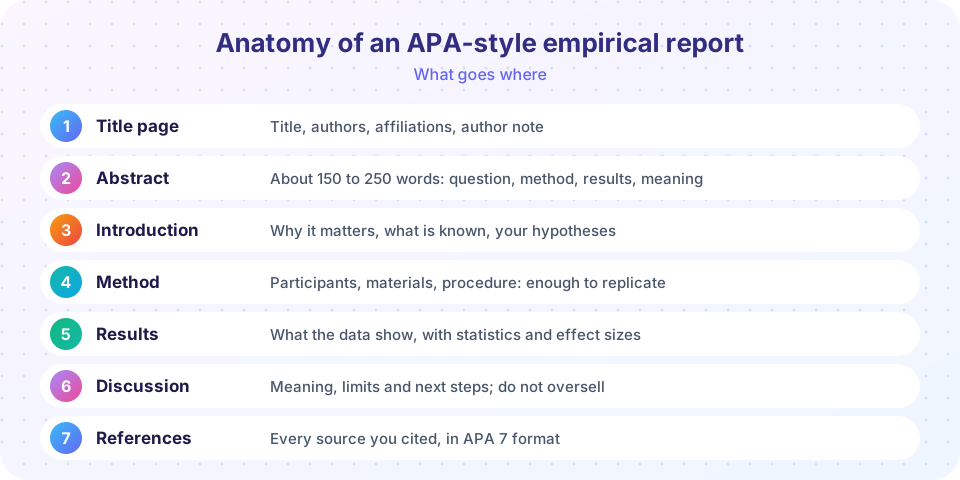
- A report has a title page, abstract, introduction, method, results, discussion and references, each with one job.
- The method must allow replication; the results report without interpreting; the discussion interprets and states limits.
- APA formatting: italic symbols, df in parentheses, exact p-values, no leading zero for p and r, effect sizes and intervals.
- Write concisely, in a consistent tense, with bias-free language, honest limits and complete references.
Track your progress
Create a free account to tick off lessons and pick up where you left off on any device.
of Research Methods in Psychology lessons completed