


















Lesson 35 of 44 · Writing and Evaluating Research
Chapter 8 Overview: Writing and Evaluating Research
Preview how psychology research is written up in APA style and how to read and judge studies critically using the hourglass structure and the four validities.
Research is not finished until someone else can read it. A study that is carried out beautifully but written up badly cannot be understood, checked or built upon. In the same way, a reader who cannot judge a study's strengths and weaknesses is at the mercy of headlines. This chapter has two halves that mirror each other: how to write a research report so that others can follow and repeat your work, and how to read one so that you know how far to trust it.
What you will learn
- The standard sections of an APA-style empirical report and the job of each.
- How to report statistics in APA format.
- Habits of clear, honest scientific writing.
- Four questions (the four validities) for judging any study.
- How to separate what a study showed from what a headline claims.
The big picture
A scientific paper is built to be read in a particular order and by a particular kind of reader: someone skeptical, short of time, and perhaps hoping to repeat your study. That is why the format is so regular. A reader should be able to find your hypotheses in the final paragraph of the introduction, your sample in the first paragraph of the method, and your central test in the first few lines of the results. The regularity is a courtesy.
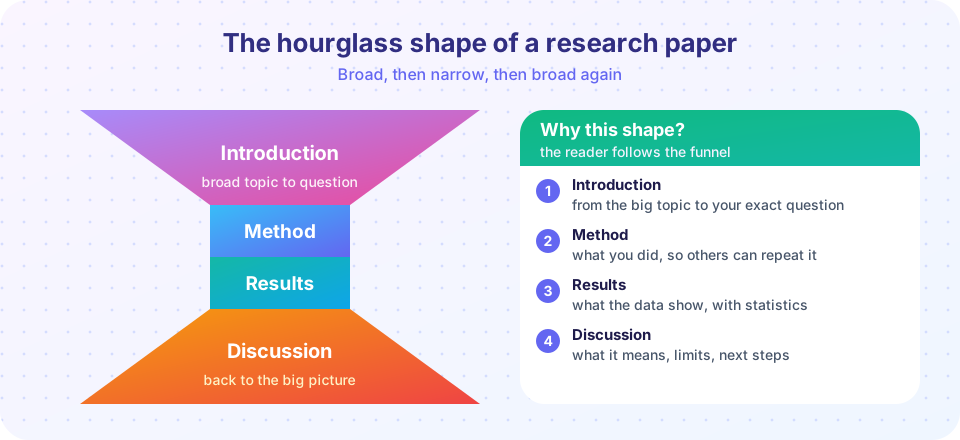
The hourglass is a useful mental picture. The introduction begins with a broad topic and narrows to your specific question. The method and results sit in the narrow middle, where you say exactly what you did and found. The discussion widens back out: what does this mean, and for whom?
Writing a report
Closing the loop
Reading with a critical eye
What each lesson covers
| Lesson | Question it answers |
|---|---|
| APA report structure | What goes in each section, and how are statistics reported? |
| Evaluating studies critically | How do I judge the quality and limits of a study? |
| Chapter review | Can I write and read research with confidence? |
Try it: an abstract length checker
Paste any abstract (or use the sample) and see whether it falls in the usual 150 to 250 word range for APA-style abstracts.
Check your understanding
Quick check · 3 questions
of 3 answered You scored / 3 · perfect!
-
1. Why is the structure of a research report so regular?
A predictable layout lets skeptical, busy readers locate hypotheses, methods and results quickly. -
2. Which part of the hourglass is the widest at the start?
The introduction starts with the broad topic and narrows to the specific question. -
3. The four validities are a tool for...
They give four systematic questions about a study's measures, causal logic, generalizability and statistics.
Summary
- A research report follows a fixed structure so that readers can find and check each part.
- The hourglass runs broad to narrow to broad.
- Reading critically means asking about construct, internal, external and statistical validity.
Next: APA report structure
Track your progress
Create a free account to tick off lessons and pick up where you left off on any device.
of Research Methods in Psychology lessons completed