


















Lesson 3 of 44 · Getting Started
Research Questions and Hypotheses
How to turn a curiosity about people into a researchable question and a testable hypothesis, with directional and non-directional predictions, null hypotheses and worked examples.
A study begins with a question, but not every question can be studied. "What is the meaning of happiness?" is a wonderful question for a philosopher. A psychologist needs something narrower: "Do people who spend ten minutes outdoors report a better mood than people who spend ten minutes indoors?" The second question names what will be done, who will do it and what will be compared.
This lesson shows how to move from an interesting topic to a researchable question and then to a hypothesis, which is a precise prediction that the data can support or contradict. The skill is more important than it looks. Most badly designed studies were badly designed at this very step.
What you will learn
- Where research ideas come from.
- What makes a question researchable.
- How to write a hypothesis, including directional, non-directional and null versions.
- How to check that a hypothesis is specific enough to test.
Key terms
Research question: a question that a study is designed to answer.
Hypothesis: a specific, testable prediction about the relationship between variables.
Directional hypothesis: predicts which way an effect goes (for example, "higher").
Non-directional hypothesis: predicts a difference or relationship without saying which way.
Null hypothesis (H0): the statement that there is no effect or relationship in the population.
Where ideas come from
Good ideas come from a handful of places.
- Everyday puzzles. Why do some people stay calm in an emergency while others freeze?
- Existing theory. If a theory says attention is limited, what should happen when someone drives while talking on a phone?
- Earlier studies. Every paper ends with limits and suggestions. A replication, an extension to a new group or a better measure is all legitimate research.
- Real-world problems. Schools, hospitals and companies ask questions that psychologists can help answer.
Ideas are cheap. What turns an idea into research is the work of narrowing it.
What makes a question researchable
A researchable question has four features.
- It is empirical. Some observation could bear on it. "Is it wrong to cheat?" is a moral question. "Do students who are told about a consequence cheat less?" is empirical.
- It is specific. It names the groups, conditions and behaviors involved.
- It is measurable. You can describe a way to record the key ideas (this is operationalization, covered in the next chapter).
- It is feasible and ethical. You have the time, access and permission to do it without harming anyone.
Compare the two versions below.
| Too broad | Researchable |
|---|---|
| Does music affect people? | Do adults complete a short arithmetic task faster with quiet instrumental music than in silence? |
| Is social media bad? | Is the number of hours per day spent on social media related to self-reported sleep length in 16 to 18 year olds? |
| Do kids learn better with praise? | Do children who are praised for effort persist longer on a hard puzzle than children praised for ability? |
The last example reflects the research tradition of Carol Dweck and colleagues on mindsets, which has produced many useful findings and also some debate about how large and general the effects are. It is an example of a question that is researchable even though its answer is still being refined.
From question to hypothesis
A hypothesis is a prediction, written before the data are collected, in a form that the data could show to be wrong. It usually links two or more variables.
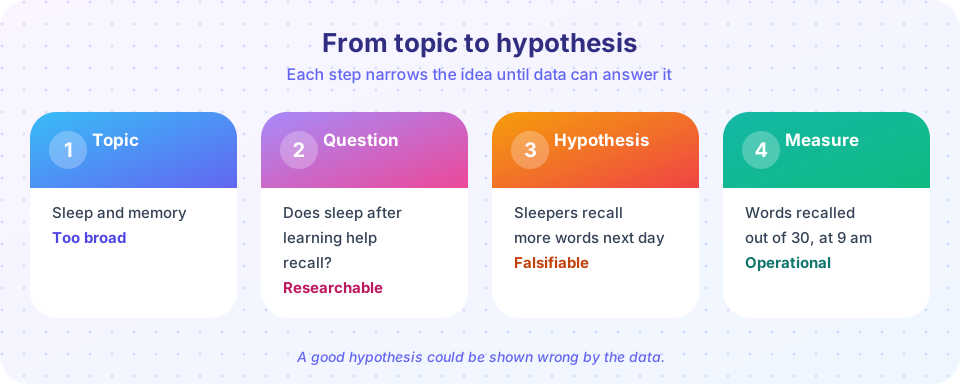
Question: Does sleep affect memory?
Hypothesis: Participants who sleep for eight hours after learning a word list will recall more words the next morning than participants who stay awake for the same time.
Notice what this hypothesis has: groups (sleep, awake), a measure (words recalled), a time (next morning) and a direction (more).
Directional and non-directional
A directional hypothesis says which way: "The sleep group will recall more words." Use it when theory or earlier results give a clear reason. A non-directional hypothesis says only that a difference exists: "The groups will differ in the number of words recalled." Use it when the evidence points both ways, or when you have no prior reason to pick a direction.
Choosing the direction after seeing the data is a form of cheating, because it lets you claim a prediction you never made. This is one reason many researchers now write down their predictions in advance (preregistration, see chapter 7).
The null hypothesis
Statistics works by testing a different statement from the one you hope is true. The null hypothesis says that, in the population, there is no difference or relationship. The researcher's prediction is the alternative hypothesis. Statistical tests ask: if the null were true, how surprising would my data be? You will meet this logic in chapter 6. For now, note that the null is the starting assumption, not a belief.
Writing a good hypothesis: a checklist
- Does it name the variables, and could each be measured?
- Does it say who the participants are?
- Is the relationship clear (a difference, an increase, a link)?
- Is it falsifiable? Is there a possible outcome that would count against it?
- Is it written as a statement, not a question?
Weak: "Stress is bad for students." Better: "University students in the week before exams will report higher perceived stress scores than the same students in the first week of term."
Common misconceptions
"A hypothesis is a guess." It is a reasoned prediction grounded in theory or earlier evidence, stated precisely enough to be wrong.
"The goal is to prove the hypothesis." The goal is to test it fairly. A study that cannot come out against the hypothesis is not a test.
"A result that does not support the hypothesis means the study failed." Unexpected results are informative, and a well-run study that finds no effect is a valid contribution.
Try it
Press Run (or Ctrl + Enter) to see the result here.
Program input · what you'd type while the program runs
Type the answers before you press Run, one per line. Each time the program reads a line (with input()), it gets the next line from this box.
Check your understanding
Quick check · 5 questions
of 5 answered You scored / 5 · perfect!
-
1. Which question is researchable?
It is empirical, specific and measurable. The others are moral or too broad to test as stated. -
2. A non-directional hypothesis predicts
Non-directional means a difference or relationship of unspecified direction. 'No difference' is the null. -
3. The null hypothesis states that
H0 is the starting assumption that statistical tests evaluate; it is not a belief about the theory. -
4. Why is choosing the direction of a hypothesis after seeing the data a problem?
A prediction must come before the data to be a fair test. This is one motivation for preregistration. -
5. In the simulation, group A scored higher in about half of the experiments. What does that show?
With no true effect, small random gaps appear in both directions, so statistics must decide when a gap is too big to be luck.
Summary
- Ideas come from puzzles, theory, earlier studies and real problems, but they must be narrowed.
- A researchable question is empirical, specific, measurable, feasible and ethical.
- A hypothesis is a precise, falsifiable prediction written before the data.
- Directional hypotheses name the direction; non-directional ones name only a difference.
- The null hypothesis is the "no effect" starting point of statistical testing.
Next: The Research Toolkit
Track your progress
Create a free account to tick off lessons and pick up where you left off on any device.
of Research Methods in Psychology lessons completed