


















Lesson 21 of 44 · Experimental Design
Chapter 5 Overview: Experimental Design
See how experiments work in psychology: manipulating a variable, controlling confounds, random assignment and comparing conditions to show cause and effect.
Of all the tools in a psychologist's kit, the experiment is the only one that can answer the question "does this cause that?" Surveys, interviews and observation can show that two things go together. An experiment can show that changing one thing changes another. That is why experiments sit at the center of research methods, and why this chapter is the longest in the course.
What you will learn
- Why an experiment can support causal claims when other studies cannot.
- What the independent variable, dependent variable and confounds are.
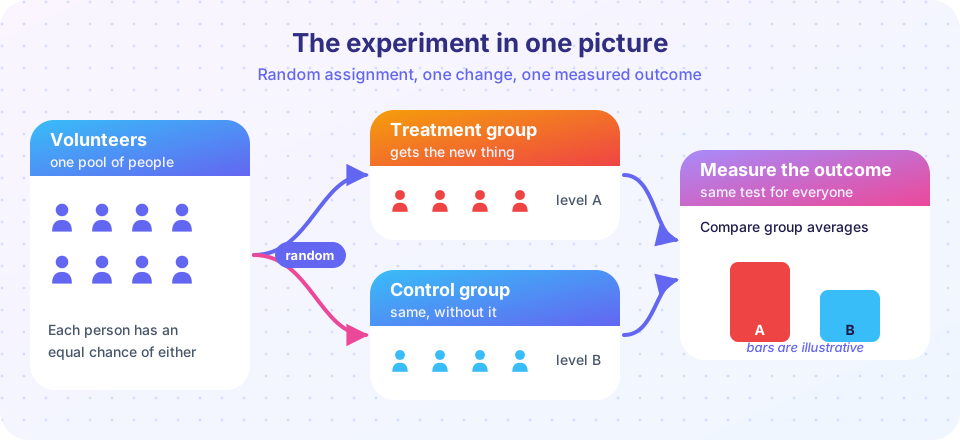
- How random assignment makes groups equal on average before the study starts.
- How between-subjects, within-subjects and factorial designs differ.
- How to read an interaction in a graph.
The big picture
An experiment has four ingredients, and the whole chapter is about getting them right.
- Manipulation. The researcher deliberately changes one thing, the independent variable (IV), such as caffeine dose, teaching method or noise level.
- Measurement. The researcher records an outcome, the dependent variable (DV), such as words recalled or reaction time.
- Control. Everything else is held constant or balanced out, so that nothing but the IV can explain a difference.
- Random assignment. Chance, not the participant or the researcher, decides who experiences which condition.
If all four hold and the groups end up with different outcomes by more than chance would produce, the best explanation is that the manipulation did it. The logic is old: John Stuart Mill described the "method of difference" in the 1840s, and Ronald Fisher put random assignment on a firm statistical footing in agricultural experiments in the 1920s. Psychology borrowed both.
Four ingredients of an experiment
Why random assignment?
Designs you will meet
What you can claim
What each lesson covers
| Lesson | Question it answers |
|---|---|
| Manipulation and control | What exactly do I change, what do I hold steady, and what can go wrong? |
| Between and within designs | Should each person take part in one condition or in all of them? |
| Factorial designs and interactions | What if two factors work together? |
| Chapter review | Can I put it all together? |
Try it: shuffle people into groups
This tiny script is a stand-in for the process real labs use. It lists 12 participant numbers and lets chance decide who goes where. Run it several times and notice that every run gives different groups, and that nobody (including you) can predict who lands where.
Press Run (or Ctrl + Enter) to see the console output here.
No output.
Check your understanding
Quick check · 4 questions
of 4 answered You scored / 4 · perfect!
-
1. Which feature of an experiment lets it support causal claims?
Manipulation plus random assignment makes the groups equal on average, so a later difference points to the manipulation. -
2. In the sentence 'We varied room temperature and measured typing errors', typing errors are the...
The outcome that is measured is the dependent variable. Room temperature, the thing varied, is the independent variable. -
3. What does random assignment balance across groups?
Chance does not know about hidden traits, so on average they spread evenly across groups. -
4. Who is credited with putting random assignment on a statistical footing in the 1920s?
Fisher developed randomized experiments and their analysis in his agricultural work at Rothamsted.
Summary
- An experiment manipulates an independent variable, measures a dependent variable, controls other factors and assigns participants at random.
- Random assignment is the feature that most separates experiments from other designs.
- Between, within and factorial designs are the main layouts you will use.
- A well-run experiment is the strongest everyday tool psychology has for testing cause and effect.
Next: Manipulation and control
Track your progress
Create a free account to tick off lessons and pick up where you left off on any device.
of Research Methods in Psychology lessons completed