


















Lesson 43 of 44 · Projects and Practice
Research Methods Cheat Sheet
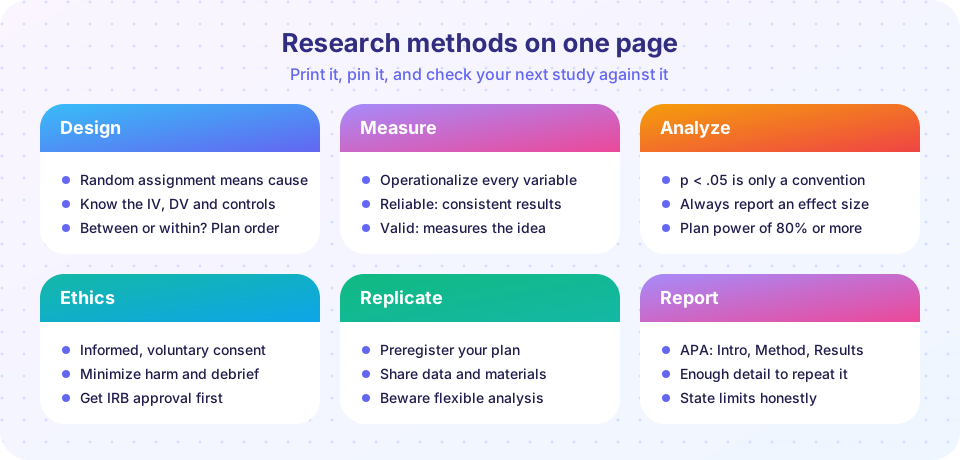
A one-page recap of research methods in psychology: designs, measurement, statistics, ethics, replication and reporting, with a poster, formulas and a test chooser.
Here is the whole course on one page. Print it, pin it above your desk, and check each new study (yours or someone else's) against it.
What you will learn
- A compact checklist from design to report.
- Which common statistic fits which design.
- The formulas and numbers worth memorizing.
Key terms
Operationalize: turn an idea into a measurable procedure.
Randomize: let chance assign participants or order.
Preregister: record your plan before collecting data.
Report fully: include all measures, exclusions and tests you planned.
From question to report in eight steps
- Ask a testable question and turn it into a hypothesis.
- Operationalize variables: define each IV and DV concretely and pick reliable, valid measures.
- Choose a design: experiment (manipulate and randomize) for causes; correlational or observational for relationships; between, within or factorial as needed.
- Plan power: decide the smallest effect that matters and compute the sample size.
- Get ethics approval, prepare the consent form and debrief.
- Preregister the hypotheses, exclusions and main analysis.
- Collect and analyze as planned, reporting effect sizes and confidence intervals; label exploratory work.
- Write up with the hourglass structure; state limits honestly; share data and materials where possible.
Which test for which design?
| Situation | Typical analysis |
|---|---|
| Two independent groups, numeric outcome | Independent (Welch) t-test; Cohen's d |
| Same people, two conditions | Paired t-test; d_z |
| Three or more groups or conditions | ANOVA; eta squared |
| Two factors | Factorial ANOVA; check the interaction first |
| Two numeric variables, relationship | Correlation r (association, not cause) |
| Two categorical variables | Chi-square test; odds ratio or Cramer's V |
| Predict a numeric outcome from others | Regression |
(This course explained the t-tests and the logic of effect sizes; the tracks listed in the next lesson cover ANOVA, regression and more.)
Numbers worth memorizing
| Item | Value |
|---|---|
| Conventional alpha | .05 |
| Typical power target | 80% to 90% |
| Cohen's d anchors | 0.2 small, 0.5 medium, 0.8 large |
| n per group for d = 0.5, 80% power | about 64 |
| n per group for d = 0.2, 80% power | about 394 |
| False-positive chance across 5 independent null tests | about 23% |
| 95% CI of a mean (large n) | mean ± about 1.96 standard errors |
| Complete counterbalancing orders for k conditions | k! |
| Cells in an a x b x c design | a * b * c |
Try it
A test chooser: describe your design in four answers and get a suggested analysis. It is a study aid built from the table above, not a replacement for judgment.
Press Run (or Ctrl + Enter) to see the result here.
Program input · what you'd type while the program runs
Type the answers before you press Run, one per line. Each time the program reads a line (with input()), it gets the next line from this box.
Check your understanding
Quick check · 4 questions
of 4 answered You scored / 4 · perfect!
-
1. You compare memory scores in the same 30 people before and after sleep. Which analysis fits?
Two measurements of the same people call for a paired test. -
2. Which number is closest to the n per group needed for 80% power at d = 0.5?
About 64 per group, from the standard two-sample t-test power calculation. -
3. Which step comes BEFORE data collection?
Planning, ethics approval and preregistration all precede data collection. -
4. In a factorial design, what should you check first?
A significant interaction can make main effects misleading.
Summary
- Eight steps carry a study from question to report; most protections happen before data collection.
- Match the analysis to the design: independent versus paired, number of groups, number of factors.
- Remember the key numbers: alpha .05, power 80% to 90%, d anchors, sample sizes, 1 - 0.95^k.
- Randomize, preregister, report fully and be honest about limits.
Track your progress
Create a free account to tick off lessons and pick up where you left off on any device.
of Research Methods in Psychology lessons completed