


















Lesson 32 of 44 · Ethics and Replication
Ethical Principles and Landmark Cases
Learn the Belmont principles, informed consent, deception, debriefing and ethics board review, and see how the Tuskegee study and Milgram's experiments shaped the rules.
Most research ethics rules were written in response to harm. That history gives them their force. When you read a consent form or sit through an ethics review, you are meeting a lesson someone learned the hard way. This lesson traces the main cases, states the principles that came from them, and shows how those principles become concrete steps in a study you design.
What you will learn
- The key cases and codes that shaped research ethics.
- The three Belmont principles and the five APA principles.
- What informed consent must contain, and the special case of deception.
- How ethics boards weigh risk against benefit.
- How to protect participant privacy in data.
Key terms
Informed consent: a participant's voluntary agreement to take part after being told what the study involves, including risks and the right to withdraw.
Deception: misleading participants about the purpose or procedure of a study.
Debriefing: explaining the true purpose and any deception after participation and addressing concerns.
Institutional review board (IRB): a committee that reviews planned studies with human participants (also called a research ethics committee outside the US).
Minimal risk: harm no greater in probability and size than that ordinarily met in daily life or routine tests.
Anonymous / confidential: anonymous means nobody can link data to a person; confidential means the researcher knows but promises not to disclose.
Cases that shaped the rules
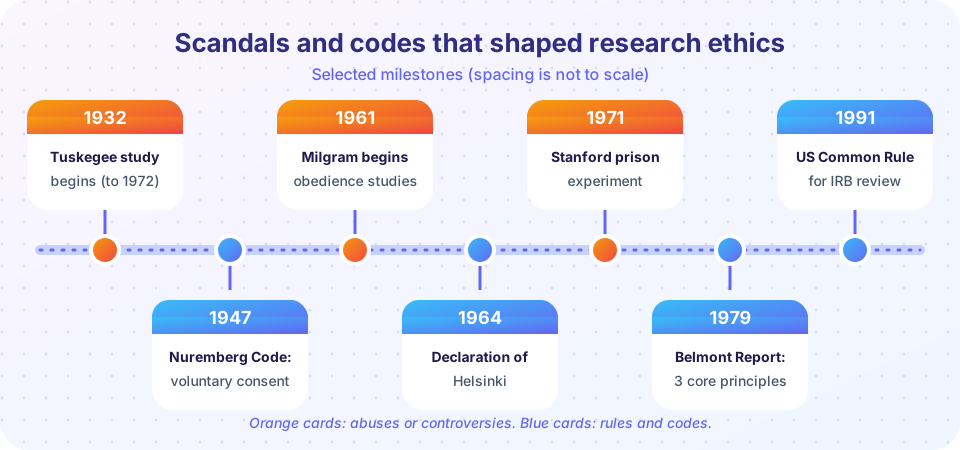
Nuremberg (1947). After the Second World War, judges at the Doctors' Trial convicted physicians who had performed brutal experiments on prisoners. The judgment set out ten principles, the Nuremberg Code, beginning with the statement that the voluntary consent of the human subject is absolutely essential. The World Medical Association's Declaration of Helsinki (1964) later laid out ethical guidance for medical research from within the profession.
Tuskegee (1932 to 1972). The US Public Health Service followed roughly 600 Black men in Alabama, around two-thirds of whom had syphilis, to observe the untreated disease. The men were told they were being treated for "bad blood". Penicillin became the standard cure in the 1940s, yet treatment was withheld and the study continued for decades, until a press report in 1972 led to its end. The public outrage led to the US National Research Act (1974) and a commission whose output was the Belmont Report. In 1997 President Clinton formally apologized on behalf of the nation. Tuskegee is also a reminder that researchers can abuse trust of communities that already face unequal treatment.
Milgram (1961 to 1963). Stanley Milgram's obedience experiments at Yale asked volunteers, as "teachers", to give what they believed were increasingly strong electric shocks to a "learner" (an actor) when he answered incorrectly. In the best-known version about two-thirds of participants went all the way to the maximum 450 volts. Diana Baumrind criticized the studies in 1964 for the stress they caused and the deception involved. Milgram replied that, according to his follow-up surveys, the great majority of participants were glad to have taken part, but the debate over whether the benefits justified the distress continues. Later archival work has also raised questions about how closely the script was followed.
The Stanford prison experiment (1971). Philip Zimbardo's simulation of a prison, with student volunteers as guards and prisoners, was planned for two weeks and stopped after six days when several prisoners showed severe distress. It is widely taught as a story of how situations shape behavior, but critics have since argued that guards were coached on how to behave and that participants may have been acting out what they thought was expected (demand characteristics), which weakens its scientific conclusions as well as raising ethical issues.
The Belmont Report and its principles
The Belmont Report (1979) named three principles.
- Respect for persons. People are autonomous and must be allowed to decide for themselves. Those with reduced autonomy (children, people with certain cognitive conditions, prisoners) deserve extra protection. In practice: informed, voluntary consent.
- Beneficence. Do no harm, and maximize possible benefits while minimizing possible harms. In practice: a risk-benefit assessment.
- Justice. The burdens and benefits of research should be shared fairly. In practice: don't draw participants from vulnerable groups just because they are convenient, and don't leave groups out of the benefits.
In the US these ideas were made law as the Common Rule (1991), which requires IRB review for federally funded research on humans. The American Psychological Association's Ethical Principles of Psychologists and Code of Conduct (first published 1953, with the current text dating from 2002 and later amendments) lists five general principles: beneficence and nonmaleficence, fidelity and responsibility, integrity, justice, and respect for people's rights and dignity.
Applying the principles in practice
Informed consent
A good consent process tells participants, in plain language, the purpose of the study, what they will be asked to do and for how long, any foreseeable risks or discomforts, the benefits (if any), that participation is voluntary, that they may stop at any time without penalty, how their data will be protected, and whom to contact with questions. Consent is a process, not a signature: participants should have time to ask questions. For children, researchers typically need a parent's or guardian's permission and the child's own assent.
Deception and debriefing
Sometimes telling participants the true purpose would ruin the study; if they knew you were measuring conformity, they would behave differently. The APA code permits deception only if it is justified by the study's significant scientific, educational or applied value, if no effective non-deceptive alternative exists, and if the deception does not concern aspects likely to cause physical pain or severe emotional distress. It must be explained as early as possible, and a thorough debriefing follows: participants learn what was hidden and why, may withdraw their data, and can ask questions.
Risk and benefit
An IRB asks whether risks are minimized, whether they are reasonable in relation to anticipated benefits and the importance of the knowledge, whether participant selection is fair, and whether consent and privacy protections are adequate. Studies of minimal risk (an anonymous questionnaire, say) can be reviewed quickly; riskier work gets full committee review. Researchers cannot approve their own studies, which is why the review is independent.
Privacy and data protection
Remove direct identifiers (names, emails), replace them with codes, store the key separately from the data, restrict access, and think about combinations of details. A dataset with age, postcode and occupation may identify a person even without a name. In Europe, data protection law (GDPR) adds legal duties on how personal data are collected and stored.
Animals
Research with animals follows the "three Rs" proposed by Russell and Burch in 1959: replace animals where possible, reduce the number, and refine procedures to reduce suffering.
Common misconceptions
"If participants signed a form, the study is ethical." A signed form is necessary but not sufficient. Risks must still be justified, selection fair and privacy protected.
"Anonymous and confidential mean the same thing." Anonymous data cannot be tied to a person; confidential data can, but are protected by the researcher's promise.
"Deception is always forbidden." It is allowed under tight conditions, with justification and debriefing.
"Ethics boards exist to block research." Their job is to protect participants and to improve the study, and most proposals are approved, often after changes.
Try it
An interactive study-plan checklist. Tick the items your imaginary study has; the tool lists what you still need before going to an ethics board. It is a learning aid, not an official review.
Next, a data-protection demonstration with made-up records. The code swaps names for random codes and then checks how many people share the same combination of age band and postcode area. A group of one is a person who could be identified.
Press Run (or Ctrl + Enter) to see the result here.
Program input · what you'd type while the program runs
Type the answers before you press Run, one per line. Each time the program reads a line (with input()), it gets the next line from this box.
Check your understanding
Quick check · 5 questions
of 5 answered You scored / 5 · perfect!
-
1. Which principle most directly requires informed consent?
Respecting autonomy means people decide for themselves, with adequate information. -
2. What was the central ethical failure of the Tuskegee study?
The men were misled about their condition and left untreated, even after penicillin became the standard cure. -
3. Under APA rules, deception in a study must...
Deception is a last resort with a strong justification and a debrief. -
4. 'Anonymous' data means...
Confidential data can be linked to identities by the researcher; anonymous data cannot. -
5. What does the 'justice' principle warn against?
Fair distribution of burdens and benefits is the core of justice.
Summary
- Nuremberg, Helsinki, Tuskegee and Milgram-era debates produced codes (Nuremberg, Helsinki), the Belmont Report (respect, beneficence, justice) and the Common Rule.
- Informed consent, minimizing risk, fair selection and privacy protection translate the principles into practice.
- Deception is allowed only when justified and followed by debriefing.
- IRBs give independent review before any data are collected.
- Anonymous and confidential are different promises, and combinations of details can identify people.
Track your progress
Create a free account to tick off lessons and pick up where you left off on any device.
of Research Methods in Psychology lessons completed