


















Lesson 24 of 44 · Experimental Design
Factorial Designs and Interactions
Learn how factorial experiments test two or more independent variables at once, read cell means, spot main effects and understand interactions with graphs.
The world rarely hands you one cause at a time. Does caffeine improve performance? That depends on the task. Does a new teaching method help students? Perhaps it helps beginners and hurts experts. Questions of the form "it depends on..." are questions about interactions, and the design that answers them is the factorial experiment: you manipulate two or more independent variables at once, in every combination.
What you will learn
- How to name a factorial design (2 x 2, 2 x 3, 2 x 2 x 2) and count its cells.
- How to compute and read main effects from marginal means.
- What an interaction is and how to recognize one in a table and in a graph.
- Why you should interpret interactions before main effects.
- Why factorial designs are efficient.
Key terms
Factor: an independent variable in a design that has more than one.
Level: one value of a factor (easy or hard; no caffeine or caffeine).
Cell: one combination of levels; its mean is a cell mean.
Main effect: the overall effect of one factor, averaged over the levels of the other.
Interaction: the effect of one factor depends on the level of another.
Marginal mean: the average of the cell means in a row or column.
Naming and counting
A design is named by the number of levels of each factor. A 2 x 2 design has two factors, each with two levels, giving four cells. A 2 x 3 design has six cells. A 2 x 2 x 2 design has three factors and eight cells. The product of the numbers gives the cell count, and each cell needs its own set of participants (in a between design) or its own measurement (in a within design).
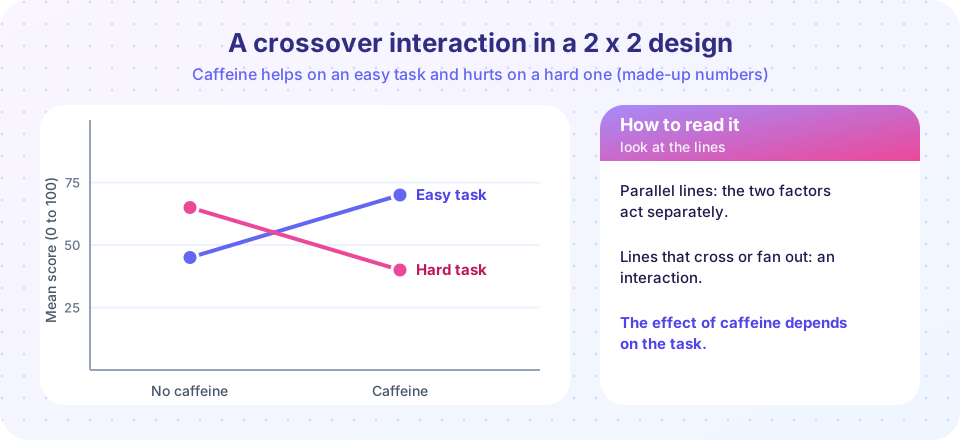
Our running example: does caffeine (none or some) affect performance, and does the effect depend on whether the task is easy or hard? That is a 2 (caffeine) x 2 (task difficulty) design. The made-up cell means below are the same numbers as in the picture above.
| No caffeine | Caffeine | Row mean | |
|---|---|---|---|
| Easy task | 45 | 70 | 57.5 |
| Hard task | 65 | 40 | 52.5 |
| Column mean | 55 | 55 |
Main effects
A main effect asks about one factor alone, ignoring the other by averaging over it. Take the column means: 55 for no caffeine and 55 for caffeine. There is no main effect of caffeine, because on average across the two tasks caffeine did nothing. The row means are 57.5 and 52.5, a small main effect of difficulty (the easy task scored five points higher on average).
Here is the catch, and the whole reason for factorial designs. The "no main effect of caffeine" conclusion would be a terrible summary of this study. Caffeine raised scores by 25 points on the easy task and lowered them by 25 points on the hard task. The averages hide two large, opposite effects.
Interactions
An interaction means the effect of one factor changes across the levels of the other. In the table, the caffeine effect is +25 for the easy task and -25 for the hard task. The difference between those effects (50 points) is the interaction.
Graphically, interactions are easy to spot. Plot one factor on the x-axis, the other as separate lines.
- Parallel lines: no interaction.
- Lines that cross (a crossover interaction, as above): the direction of the effect reverses.
- Lines that fan out or converge without crossing (a spreading interaction): the size of the effect changes but the direction does not.
Interactions are common in psychology because behavior has many causes that combine. The inverted-U relation between arousal and performance (the Yerkes-Dodson law, named after Robert Yerkes and John Dodson, who published it in 1908) is often described in terms of task difficulty: moderate arousal is best for hard tasks and higher arousal is tolerated for easy ones. Whether the law holds as neatly as the textbooks say is debated, but it shows why researchers look for interactions rather than one-size-fits-all effects.
Always look at the interaction first. If it is significant, the main effects may be misleading. You would describe the result as "caffeine helped on easy tasks and hurt on hard ones", not "caffeine has no effect".
Why factorial designs are efficient
You could run two separate experiments: one for caffeine, one for task difficulty. A factorial design gets both answers from the same participants, and it adds something neither experiment could show: the interaction. You also get more generalizable conclusions, because the effect of each factor is tested across several conditions rather than one narrow setting.
The cost is complexity. A 2 x 2 x 2 design has a three-way interaction that is hard to describe in words, and each extra factor multiplies the number of cells and the participants you need. Experienced researchers add a factor only when theory says it should matter.
Follow-up: simple effects
When an interaction is present, the usual next step is to examine simple effects: the effect of one factor at each level of the other. In the example, the simple effect of caffeine on the easy task is +25 and on the hard task is -25. A statistical test of each simple effect tells you where the effect is reliable.
Common misconceptions
"No main effect means the factor does nothing." It can mean the factor has opposite effects at different levels of another factor, so they cancel in the average.
"An interaction means the two factors are correlated." No. Factors in an experiment are manipulated independently. An interaction is about how their effects combine on the outcome.
"A bigger design is always better." Each additional factor multiplies the cell count and the demands on participants. Add factors because theory predicts something.
Try it
The first demo is a calculator, labelled as such: it applies the arithmetic from this lesson to any 2 x 2 table. Change the four numbers to explore.
Press Run (or Ctrl + Enter) to see the result here.
Program input · what you'd type while the program runs
Type the answers before you press Run, one per line. Each time the program reads a line (with input()), it gets the next line from this box.
The second demo is interactive. Drag the four sliders and watch the lines. Make them parallel and the interaction disappears; make them cross and it grows.
Check your understanding
Quick check · 5 questions
of 5 answered You scored / 5 · perfect!
-
1. How many cells does a 3 x 2 design have?
Multiply the numbers of levels: 3 x 2 = 6 combinations. -
2. In a plot with one line per level of factor B, parallel lines indicate...
Parallel lines mean the effect of A is the same at every level of B. -
3. Caffeine raises scores by 20 on easy tasks and lowers them by 20 on hard tasks. What is the likely main effect of caffeine?
Averaged over tasks, the +20 and -20 cancel. This is why the interaction must be examined first. -
4. What is a simple effect?
Simple effects break an interaction into its parts, such as the caffeine effect on the easy task alone. -
5. A key advantage of a factorial design over two separate experiments is that it...
Only varying both factors together lets you see whether one factor's effect depends on the other.
Summary
- Factorial designs manipulate two or more factors in all combinations; the cell count is the product of the level counts.
- A main effect averages over the other factors; an interaction means one factor's effect depends on another's.
- Non-parallel lines in an interaction plot signal an interaction; crossing lines show a reversal.
- Look at the interaction first, then examine simple effects.
- Add factors only when theory predicts they matter, because each one multiplies the cells.
Track your progress
Create a free account to tick off lessons and pick up where you left off on any device.
of Research Methods in Psychology lessons completed