


















Lesson 30 of 44 · Statistics for Psychologists
Chapter 6 Review: Statistics for Psychologists
Review sampling variability, p-values, t-tests, effect sizes and statistical power, with a recap table and a ten-question quiz that mixes the whole chapter.
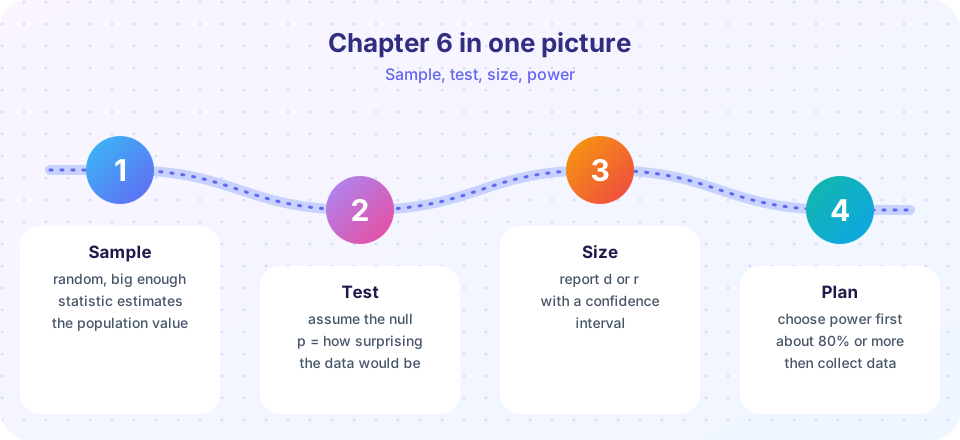
This chapter packed a lot of statistics into four lessons. The good news is that the core ideas fit on one page. The review below brings them together and ends with a longer quiz.
Recap table
| Idea | What to remember | Lesson |
|---|---|---|
| Sampling variability | Statistics from random samples wobble around the truth | Overview |
| p-value | Probability of data this extreme if the null is true; not P(null) | p-values |
| Alpha | The false-positive rate you accept when the null is true (.05 by convention) | p-values |
| Type I / II error | False positive / miss | p-values |
| t-test | Difference in means over its standard error | t-tests and effect sizes |
| Cohen's d | Difference in pooled standard deviations | t-tests and effect sizes |
| Confidence interval | Range of plausible differences | t-tests and effect sizes |
| Power | Chance of detecting a true effect; plan it in advance | Power and sample size |
| Winner's curse | Significant results from small studies exaggerate effects | Power and sample size |
A reporting template
A sentence worth memorizing: "Participants in the method group (M = 15.25, SD = 2.12) scored higher than the control group (M = 11.75, SD = 1.67), Welch t(13.3) = 3.67, p = .003, d = 1.83, 95% CI of the difference [1.44, 5.56]." It names the means, the test, the p-value, the effect size and the interval. (The numbers come from the made-up data in the t-test lesson, so you can reproduce them there.) That is nearly everything a reader needs.
Try it
A tiny helper that turns a significance result into a cautious sentence. It illustrates the language to use, which never claims more than the data support.
Press Run (or Ctrl + Enter) to see the result here.
Program input · what you'd type while the program runs
Type the answers before you press Run, one per line. Each time the program reads a line (with input()), it gets the next line from this box.
Check your understanding
Quick check · 10 questions
of 10 answered You scored / 10 · perfect!
-
1. A p-value of .03 means...
p is a probability of the data given the null, not of the null given the data. -
2. Which is NOT a determinant of power?
Power depends on sample size, effect size, alpha and variability. -
3. A researcher with 12 participants per group finds p = .11 and concludes there is no effect. What is wrong?
A small study can easily miss a real effect. -
4. Which test suits two measurements of the same people before and after training?
Paired data are analyzed through the differences. -
5. Cohen's d = 0.8 is traditionally called...
Cohen's rough anchors are 0.2 small, 0.5 medium and 0.8 large. -
6. What is the main reason to report a confidence interval?
Intervals show what the data can and cannot rule out. -
7. At alpha = .05, if the null is true in every study, about what share will be significant?
That is the Type I error rate. -
8. The winner's curse implies that...
Only unusually large observed effects reach significance in small samples. -
9. For a medium effect (d = 0.5), about how many participants per group give 80% power?
The exact two-sample t-test calculation gives 64 per group. -
10. Which statement about statistical significance is correct?
The same effect can be significant or not depending on how many people were tested.
Summary
- Inference turns a sample into a claim about a population, with uncertainty.
- p tells you how surprising the data are under the null; d tells you how big; the CI tells you how precisely; power tells you whether the study could have found it.
- Plan power in advance, report everything, and word conclusions cautiously.
Track your progress
Create a free account to tick off lessons and pick up where you left off on any device.
of Research Methods in Psychology lessons completed