


















Lesson 42 of 44 · Projects and Practice
Glossary of Research Methods in Psychology
A glossary of 40 core research methods terms in psychology, from alpha and confound to validity and WEIRD samples, with one-line definitions and a searchable tool.
Research methods has a vocabulary that sounds intimidating and is mostly common sense in disguise. This glossary gathers the terms used across the course in alphabetical order, each with a short definition. Use it as a reference while you read papers, and use the search tool below to test yourself.
What you will learn
- The precise meaning of the core terms used throughout the course.
- Which terms are easily confused and how to tell them apart.
- How to look a term up quickly and test yourself.
Key terms
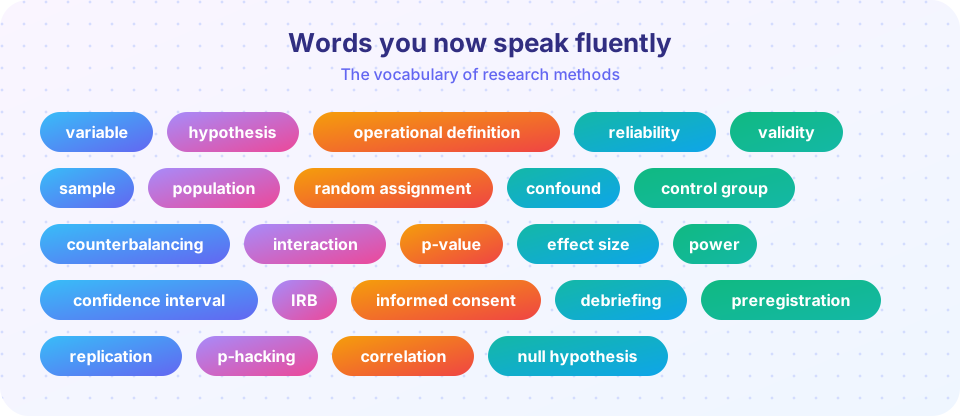
Easily confused pairs: reliability vs validity; anonymous vs confidential; independent vs dependent variable; p-value vs effect size; main effect vs interaction; correlation vs causation; replication vs reproducibility (re-running the same analysis on the same data).
The glossary
| Term | Meaning |
|---|---|
| Alpha | The Type I error rate you accept, conventionally .05. |
| Alternative hypothesis | The claim that an effect or difference exists. |
| Between-subjects design | Each participant is in only one condition. |
| Blinding | Hiding condition membership from participants (single) or participants and researchers (double). |
| Confidence interval | A range of plausible values for a population quantity. |
| Confound | A second variable that differs between conditions with the IV and offers a rival explanation. |
| Construct validity | How well a measure or manipulation represents the concept intended. |
| Control group | The comparison group that does not receive the key manipulation. |
| Correlation | A statistical relationship between two variables; says nothing alone about cause. |
| Counterbalancing | Varying condition order across participants to balance order effects. |
| Debriefing | Explaining the true purpose and any deception after a study. |
| Demand characteristics | Cues that suggest to participants how they should behave. |
| Dependent variable (DV) | The outcome that is measured. |
| Effect size | The magnitude of an effect, such as d or r, independent of sample size. |
| External validity | The extent to which findings generalize to other people, settings and times. |
| Factorial design | A design with two or more independent variables in all combinations. |
| HARKing | Hypothesizing after the results are known. |
| Hypothesis | A testable prediction derived from theory. |
| Independent variable (IV) | The variable the researcher manipulates. |
| Informed consent | Voluntary agreement to participate after being told what is involved. |
| Institutional review board (IRB) | An independent committee that reviews studies with human participants. |
| Interaction | The effect of one factor depends on the level of another. |
| Internal validity | The extent to which a study supports a causal conclusion about the IV and DV. |
| Mean | The arithmetic average. |
| Null hypothesis | The claim of no effect that a test tries to reject. |
| Operational definition | A concrete description of how a variable is measured or manipulated. |
| p-hacking | Analyzing flexibly until p < .05 and reporting only that analysis. |
| p-value | Probability of data at least as extreme as observed, if the null is true. |
| Population | The entire group a researcher wants to draw conclusions about. |
| Power | The probability of detecting a true effect of a given size. |
| Preregistration | A time-stamped public plan made before data collection. |
| Random assignment | Using chance to decide which condition each participant experiences. |
| Reliability | Consistency of a measure across time, items or raters. |
| Replication | Repeating a study to see whether the finding appears again. |
| Sample | The subset of the population actually studied. |
| Standard deviation | A measure of the typical spread of scores around the mean. |
| Standard error | The standard deviation of a statistic's sampling distribution. |
| Type I error | Rejecting a true null hypothesis (false positive). |
| Type II error | Failing to reject a false null hypothesis (miss). |
| Within-subjects design | Each participant experiences every condition. |
Try it
A small searchable glossary. Edit the search term and run it. The same pattern, a dictionary and a filter, is how many study aids work.
Press Run (or Ctrl + Enter) to see the console output here.
No output.
Check your understanding
Quick check · 4 questions
of 4 answered You scored / 4 · perfect!
-
1. Which pair describes consistency and accuracy of measurement respectively?
Reliability is consistency; validity is whether the measure captures the intended concept. -
2. A range of plausible values for a population quantity is a...
Confidence intervals show both the estimate and its precision. -
3. Which term means hiding the group a participant is in?
Blinding prevents expectations about condition from shaping behavior or scoring. -
4. 'Reproducibility' differs from 'replication' because it means...
Reproducibility checks the analysis; replication collects new data.
Summary
- Many pairs of terms sound alike but mean different things; the glossary distinguishes them.
- Design terms (IV, DV, confound, control) and statistics terms (alpha, p, power, effect size) work together.
- Ethics and open-science terms (consent, IRB, preregistration, replication) describe the promises researchers make.
Track your progress
Create a free account to tick off lessons and pick up where you left off on any device.
of Research Methods in Psychology lessons completed