


















Lesson 4 of 44 · Getting Started
The Research Toolkit: Designs at a Glance
A first tour of the main research designs in psychology: observation, case studies, surveys, correlational studies and experiments, and what each can and cannot tell you.
A carpenter does not use a hammer for every job. Psychologists also have a toolkit, and the first skill of a researcher is choosing the right tool for the question. Some questions need you to watch people in their natural setting. Others need you to ask them. Some need you to compare two conditions that you control. Each tool shows a different part of the truth and hides another.
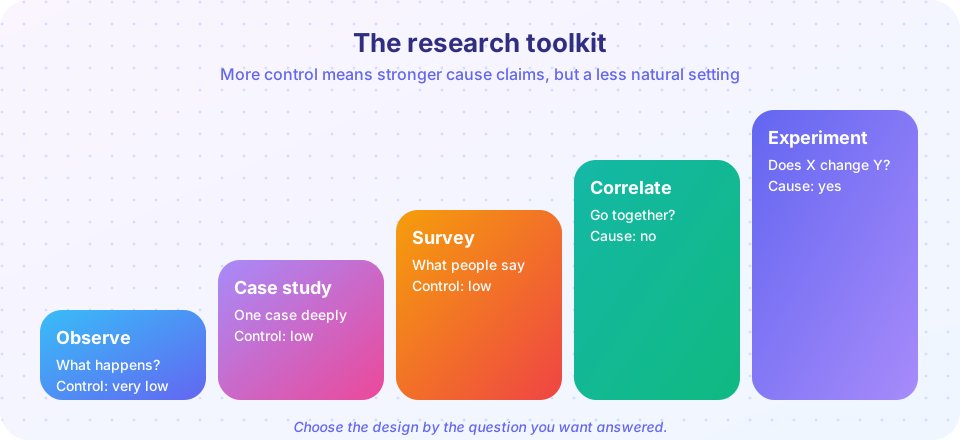
This lesson is a quick tour of the main designs. Later chapters go deep on each. For now, the goal is to understand the trade-off that runs through all of them: the more control you have over a situation, the more confidently you can say what caused what, but the further the situation may be from real life.
What you will learn
- The main families of research design: descriptive, correlational and experimental.
- What question each design is best for.
- Why only experiments can establish cause and effect, and why other designs are still valuable.
- How to pick a design for a given question.
Key terms
Descriptive research: aims to describe what is happening, without testing causes.
Correlational research: measures two or more variables and asks whether they are related.
Experiment: manipulates one variable and measures the effect on another while controlling other influences.
Independent variable (IV): the variable the researcher manipulates in an experiment.
Dependent variable (DV): the outcome that is measured.
The three families
Descriptive research answers "what is going on?" It includes observation, case studies and surveys that simply report how common something is. Jane Goodall's long study of chimpanzees at Gombe, which began in 1960, is a famous example of careful description. It overturned assumptions, for instance by documenting tool use, without manipulating anything.
Correlational research answers "are these things related?" You measure, say, hours of sleep and exam scores in the same students and calculate how closely they go together. You do not change anything.
Experimental research answers "does this cause that?" You deliberately change one thing (the independent variable), keep everything else as similar as you can, assign people to conditions at random, and see whether the outcome (the dependent variable) differs.
A closer look at each design
Naturalistic observation
You watch behavior where it happens and record it, trying not to disturb it. Strengths: realistic behavior. Limits: you cannot control events, observers may see what they expect, and you cannot say why something happened.
Case study
You study one person, family or group in depth. The famous cases of Phineas Gage (a railway worker who survived a rod through his frontal lobe in 1848) and the patient known as H.M. (who lost the ability to form new long-term memories after surgery in 1953) shaped theories of the brain. Strengths: rich detail and rare cases. Limits: one case may not generalize, and details are often gathered after the fact.
Survey
You ask a sample of people questions, usually with a questionnaire. Strengths: you reach many people cheaply and can ask about things you cannot see, such as attitudes. Limits: people may not remember well or may answer to look good.
Correlational study
You measure variables as they naturally exist and compute how strongly they are related. Strengths: you can study things you could not or should not manipulate, such as the link between childhood adversity and adult health. Limits: a relationship does not show that one variable causes the other (chapter 4).
Experiment
You manipulate the IV, measure the DV and control other factors. Random assignment makes the groups similar to start with, so a difference afterward can be attributed to the manipulation. Strengths: the best route to causal conclusions. Limits: control can make the situation artificial, and some variables cannot be manipulated.
The central trade-off
| Design | Question | Control | Can show cause? |
|---|---|---|---|
| Naturalistic observation | What happens? | Very low | No |
| Case study | What happened here, in depth? | Low | No |
| Survey | What do people report? | Low | No |
| Correlational | Are variables related? | Low to moderate | No |
| Experiment | Does X change Y? | High | Yes, when well designed |
Notice that "can show cause" is only a yes for experiments. That is the reason experiments get a whole chapter, and also the reason you should not dismiss everything else. If you want to know how common loneliness is among teenagers, an experiment would be the wrong tool and a survey is exactly right.
Choosing a design
Ask three questions in order.
- Do I want to describe, relate or explain a cause? Description points to observation or survey, relation to a correlational design, cause to an experiment.
- Can I manipulate the variable, ethically and practically? You cannot assign people to be poor, bereaved or exposed to a harmful substance. Then a correlational or quasi-experimental design is your best option.
- Do I need realism or control? Realism pushes toward field settings, control toward the laboratory.
Many research programs use several designs in sequence. Observation can reveal an interesting pattern, a survey can show how widespread it is, a correlational study can show what goes with it, and an experiment can test a cause.
Common misconceptions
"Experiments are better than other designs." They are better for causal questions. For questions about prevalence or lived experience, other designs are better.
"Correlational studies are useless." They are essential when manipulation is impossible, and they often suggest the experiments worth running.
"A lab study is not real." Lab studies test mechanisms under control. Field studies test whether the effect appears in daily life. Strong research programs use both.
Try it
Press Run (or Ctrl + Enter) to see the result here.
Program input · what you'd type while the program runs
Type the answers before you press Run, one per line. Each time the program reads a line (with input()), it gets the next line from this box.
Check your understanding
Quick check · 4 questions
of 4 answered You scored / 4 · perfect!
-
1. Which design is best for finding out how common an attitude is in a population?
Surveys describe how widespread attitudes and reports are. An experiment answers causal questions instead. -
2. What gives an experiment its advantage for causal claims?
Manipulation plus random assignment makes the groups similar at the start, so differences afterward can be attributed to the IV. -
3. A researcher wants to study the effect of bereavement on sleep. Which approach is realistic?
Assigning people to bereavement would be unethical and impossible, so a correlational or comparison design is used, with caution about cause. -
4. In the case of H.M., what was the main contribution?
H.M. could no longer form new long-term memories, which helped separate memory systems in theory. A single case still has limits.
Summary
- Descriptive, correlational and experimental research answer different kinds of questions.
- Only a well-designed experiment can show cause and effect, because of manipulation and random assignment.
- More control usually means stronger causal claims but a less natural setting.
- Choose the design by the question, the possibility of manipulation, and the need for realism.
Track your progress
Create a free account to tick off lessons and pick up where you left off on any device.
of Research Methods in Psychology lessons completed