


















Lesson 16 of 44 · Descriptive and Correlational Studies
Chapter 4 Overview: Descriptive and Correlational Studies
A preview of chapter 4: observation, case studies, surveys and correlational research, what they reveal about behavior, and why correlation does not prove causation.
Before anyone runs an experiment, someone usually has to notice that something is happening. Descriptive and correlational research does that noticing. It records what people do, asks what they think and measures how variables go together. These methods are the workhorses of psychology, and they have a famous limit: they cannot, on their own, tell you why.
This chapter covers three groups of methods. You will see what each is good for, how to use it carefully, and how to avoid the classic mistake of reading cause into correlation.
The big picture
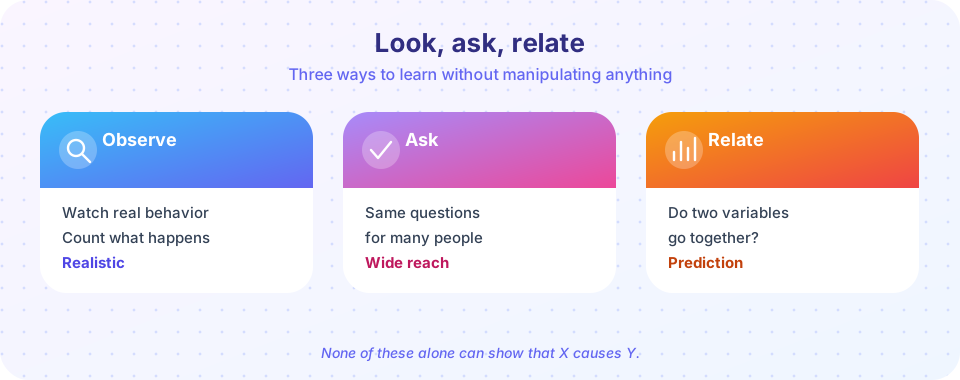
Observation and case studies let you watch behavior in context, in its natural richness. Surveys let you ask many people about experiences, attitudes and habits. Correlational studies measure two or more variables and compute how strongly they move together.
None of these manipulates a variable, so none can by itself show that X causes Y. What they can do is describe, predict and generate hypotheses. If you know that two variables are related, you can predict one from the other even without knowing the cause. And relationships found here are often the starting point for experiments.
Look
Ask
Relate
What each lesson covers
| Lesson | What you will do |
|---|---|
| Naturalistic Observation and Case Studies | Plan an observation, handle observer bias, and weigh the strengths and limits of single cases |
| Surveys and Questionnaires | Write good questions, avoid response biases, and score a scale with reverse-coded items |
| Correlation and Causation | Read scatterplots and r, spot confounds, and see why correlation is not causation |
| Chapter 4 Review | One picture, a recap and a ten-question quiz |
Check your understanding
Quick check · 3 questions
of 3 answered You scored / 3 · perfect!
-
1. Which of these can a correlational study do?
Relationships allow prediction, but without manipulation they do not establish cause. -
2. Descriptive research is mostly concerned with
It records behavior, attitudes and patterns without testing causes. -
3. Why are relationships found in correlational studies still valuable?
They guide later research and are essential when manipulation is impossible or unethical.
Summary
- Observation, surveys and correlations describe and predict but cannot alone show cause.
- Each has strengths (realism, scale, wide application) and limits (bias, wording, third variables).
- Chapter 4 prepares the ground for experiments in chapter 5.
Track your progress
Create a free account to tick off lessons and pick up where you left off on any device.
of Research Methods in Psychology lessons completed