


















Lesson 44 of 44 · Projects and Practice
Further Study: Where to Go Next
A roadmap after research methods: deeper statistics, Bayesian thinking, Python tools, psychology specialties and ways to practice reading and replicating studies.
You have finished the course, but research methods is a habit, not a subject you complete. The best next step depends on what you want to do: run your own studies, read psychology with more confidence, or go deeper into data analysis. This lesson maps the choices and points to related tracks on this site.
What you will learn
- Which statistics tracks deepen the ideas from Chapter 6.
- Which psychology tracks give you topics to study with these methods.
- A four-week plan for practicing what you learned.
- Habits that keep your skills sharp.
Deeper statistics
| If you want to... | Go to |
|---|---|
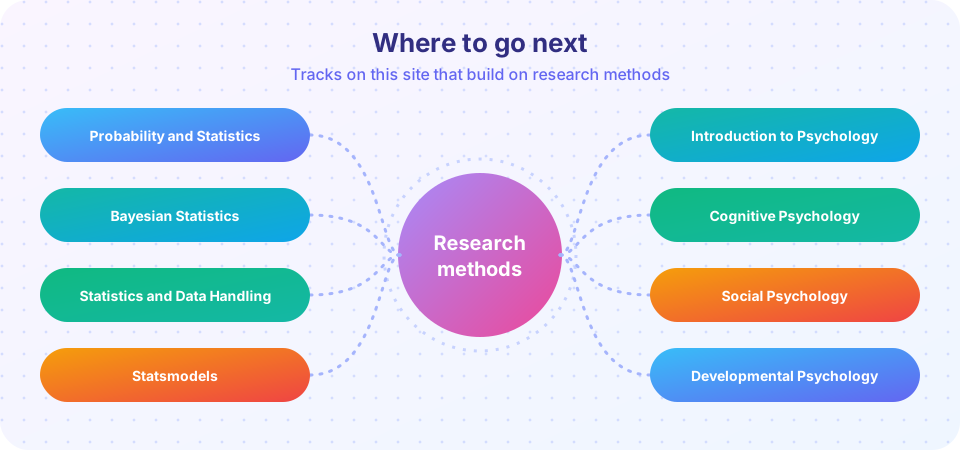
| Master probability, distributions, estimation and tests | Probability and Statistics |
| Think about evidence with priors and posteriors rather than p-values | Bayesian Statistics |
| Revisit data handling and descriptive statistics from the ground up | Statistics and Data Handling |
| Run regression, ANOVA and other models in Python | Statsmodels |
The statistics in this course (sampling variability, p-values, t-tests, effect sizes, power) are the foundation. The next topics are ANOVA for several groups, regression for predicting outcomes, mixed models for repeated-measures data, and the Bayesian alternative to significance testing.
Psychology content to study
Methods only come alive when applied to questions. The following tracks give you areas to practice on and studies to critique.
| Area | Track |
|---|---|
| Broad overview of the field | Introduction to Psychology |
| Memory, attention, thinking and language | Cognitive Psychology |
| Influence, groups, attitudes and behavior | Social Psychology |
| How people change across the lifespan | Developmental Psychology |
As you read those tracks, apply the four validities and the critique template. Ask of each classic study: What was manipulated? How was assignment done? Who were the participants? Has it replicated?
A four-week practice plan
Week 1: Read and critique. Choose two open-access psychology articles. Write a one-paragraph summary and a one-paragraph critique of each using the four validities.
Week 2: Replicate the analysis. Find a paper with shared data (many journals badge open data). Reproduce one table or figure and note any differences.
Week 3: Run a small study. Repeat the Stroop capstone with friends who give informed consent, or design a short survey. Preregister it in a text file with a date before you collect data.
Week 4: Write it up. Use the hourglass structure, report effect sizes and intervals, and state three honest limitations.
Try it
A reusable planner that prints a dated study plan from a start day. Change the dates and tasks to fit your calendar.
Press Run (or Ctrl + Enter) to see the console output here.
No output.
Habits that keep you sharp
- Read one empirical paper a week, starting with the method.
- Count the participants in every study you read and ask what power it had.
- Write down your hypothesis and plan before you open a dataset.
- Share what you can: code, materials and anonymized data.
- Stay humble about single studies; wait for replication before you rebuild your beliefs.
- Keep learning the statistics, because every new method rests on the ideas of sampling, uncertainty and effect size.
Common misconceptions
"Methods are only for researchers." Anyone who reads headlines, evaluates a workplace program or judges a health claim uses these questions.
"Once I know the tests, I can analyze anything." Choosing a test is the easy part; designing a study that can answer the question is the hard one.
"Replication is someone else's job." Every researcher benefits from planning for replication: share materials, report completely and use adequate samples.
Check your understanding
Quick check · 3 questions
of 3 answered You scored / 3 · perfect!
-
1. Which track would best deepen your understanding of significance testing and probability?
The statistics track covers probability, distributions, estimation and tests in depth. -
2. What is the best first step when you read a new empirical paper?
The method shows what the evidence can support. -
3. Why preregister a small practice study?
Practicing the habit makes it automatic in larger projects.
Summary
- Deepen your statistics with probability, Bayesian methods and modeling; apply your methods to the psychology tracks.
- Practice by critiquing papers, reproducing analyses, running a small preregistered study and writing it up.
- Keep reading methods first, counting participants and staying humble about single studies.
Return to the course overview: Research Methods in Psychology
Track your progress
Create a free account to tick off lessons and pick up where you left off on any device.
of Research Methods in Psychology lessons completed