


















Lesson 31 of 44 · Ethics and Replication
Chapter 7 Overview: Ethics and Replication
Preview the two kinds of responsibility in research: protecting participants with consent and risk review, and protecting the evidence through replication and open science.
A research project can fail you in two quite different ways. It can harm the people who volunteered, or it can produce a conclusion that is simply wrong. The first is a failure of research ethics, the second a failure of reliability. Psychology has had spectacular examples of both, and the discipline's response to each has reshaped how studies are planned, approved, run and shared. This chapter covers both, because they share a root: research is a promise. To participants, you promise their wellbeing comes first. To readers, you promise that what you report is what you found.
What you will learn
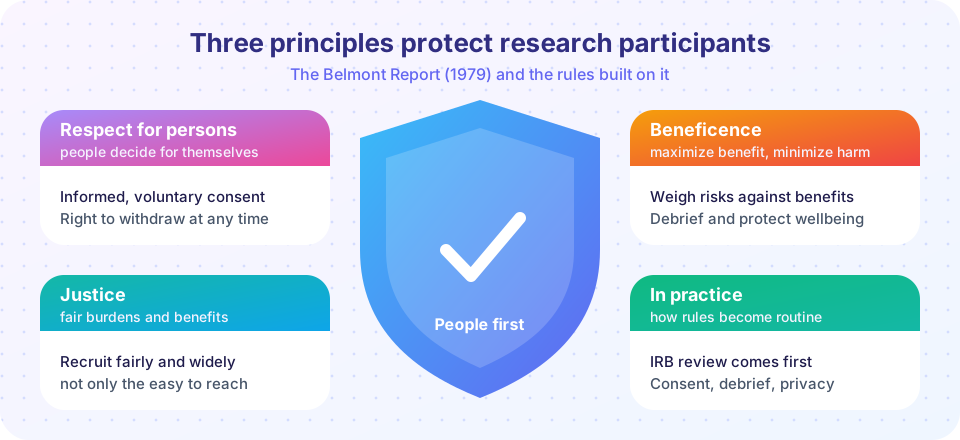
- The three Belmont principles and the rules built on them.
- How informed consent, deception, debriefing and confidentiality work.
- Which landmark studies and scandals shaped today's rules.
- What the replication crisis is, what caused it and what researchers have done in response.
- How preregistration, registered reports and open data work.
Why this matters
Ethics is sometimes treated as paperwork that stands between you and your data. In fact the rules came from real harm. Men in an American government study were left untreated for syphilis for decades. People in obedience experiments were pushed to the edge of distress. Prisoners in a famous simulation had to be released early. Each case taught the field something that is now written into codes and laws.
The reliability story is newer but equally important. In the 2010s, large projects that tried to repeat published studies found that many results did not appear again, or appeared much weaker. Researchers traced this to understandable but damaging habits: tiny samples, flexible analysis, and a literature that rewarded positive results. The solutions, which you will use in the capstone projects, are now standard good practice.
Part 1: Protect participants
Routines that make it real
Part 2: Protect the evidence
What each lesson covers
| Lesson | Question it answers |
|---|---|
| Principles and landmark cases | What rules protect participants, and where did they come from? |
| The replication crisis and open science | Why did results fail to replicate, and what changed? |
| Chapter review | Can I connect protection of people with protection of evidence? |
Try it: which principle is at stake?
A tiny self-test. Each scenario below maps to the Belmont principle it most clearly engages. Edit the table, add scenarios of your own and run it.
Press Run (or Ctrl + Enter) to see the console output here.
No output.
Check your understanding
Quick check · 3 questions
of 3 answered You scored / 3 · perfect!
-
1. Which of these is a failure of research ethics rather than reliability?
Withdrawal rights protect participants. The other options threaten the trustworthiness of results. -
2. The three principles of the Belmont Report are...
Respect for persons, beneficence and justice form the basis of modern research ethics in the US and beyond. -
3. What triggered large replication projects in psychology?
The 2010s saw fraud cases, striking implausible results published with standard methods, and a growing awareness of flexible analysis.
Summary
- Ethics protects participants; replication and open science protect the evidence.
- The Belmont principles (respect, beneficence, justice) are applied through consent, ethics review and debriefing.
- The replication crisis exposed flexible analysis, small samples and publication bias, and led to preregistration and open data.
Track your progress
Create a free account to tick off lessons and pick up where you left off on any device.
of Research Methods in Psychology lessons completed