


















Lesson 17 of 44 · Descriptive and Correlational Studies
Naturalistic Observation and Case Studies
How to watch behavior systematically: naturalistic and structured observation, sampling methods, observer agreement with Cohen's kappa, and the value and limits of case studies like Phineas Gage and H.M.
Sometimes the best way to learn what people do is to watch them do it. Children at a playground, shoppers in a store, chimpanzees in a forest: each reveals behavior that a laboratory may suppress. Careful observation is the oldest research method in psychology, and it is not as simple as just looking.
This lesson explains how to run a systematic observation, how to check that observers agree, and how a single in-depth case can teach us a great deal, and mislead us too.
What you will learn
- The difference between naturalistic and structured observation, and between participant and non-participant observation.
- How to plan an observation: behavior categories, event sampling and time sampling.
- How to measure agreement between observers with percent agreement and Cohen's kappa.
- Strengths and limits of case studies, with famous examples.
Key terms
Naturalistic observation: recording behavior in its natural setting without intervening.
Structured observation: observing in a prepared setting with defined behaviors to record.
Event sampling: recording every time a defined behavior occurs.
Time sampling: recording what is happening at set intervals.
Case study: an in-depth investigation of one individual, group or event.
Kinds of observation
Naturalistic observation takes place where the behavior normally happens, with the observer trying not to influence it. Jane Goodall's field research with chimpanzees at Gombe, begun in 1960, is the classic case. Structured observation brings some control: the researcher sets up a situation, such as a standard playroom, so that every child meets the same toys, and then records behavior. Mary Ainsworth's "Strange Situation" procedure from the 1970s, used to study how infants respond to separation from and reunion with a caregiver, is a well-known structured observation.
Observers may be non-participant, watching from outside, or participant, joining the group. Participating gives insider access but raises the risk that the observer influences events or loses objectivity. Covert observation (people do not know they are watched) reduces reactivity but raises ethical issues about consent and privacy, which are discussed in chapter 7. In public places, researchers often argue that observation of public behavior is acceptable, but each case must pass an ethics review.
Planning a good observation
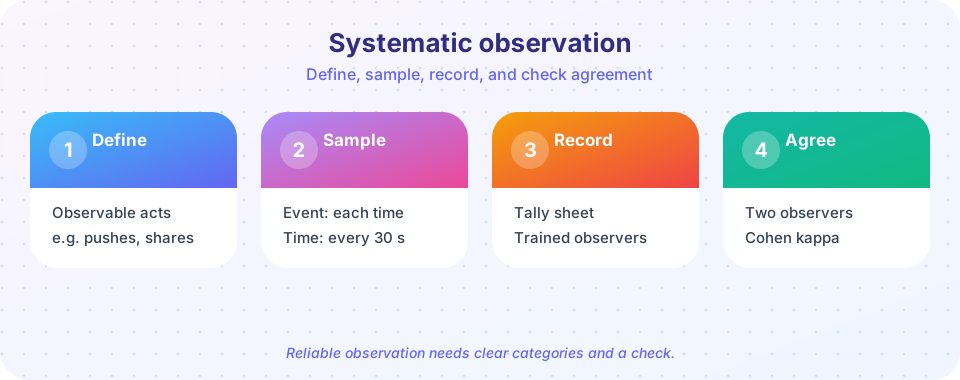
- Define the behaviors in observable, specific terms. "Aggression" is vague. "Pushes, hits or grabs another child's body or belongings" is observable.
- Build a coding scheme with a small number of categories that do not overlap.
- Decide how to sample. In event sampling you tally each occurrence of a behavior, which is good for rare events. In time sampling you note what is happening every 30 seconds, say, which is practical for frequent behavior. Time sampling can miss brief events.
- Train observers and practise on sample recordings.
- Reduce reactivity. Observers can spend time in the setting so people get used to them, or use unobtrusive recording where ethical.
- Check reliability by having two observers code the same events independently.
Observer agreement
If two observers disagree, the data are suspect. The simplest check is percent agreement: the share of intervals where both coded the same. But some agreement happens by luck. Cohen's kappa corrects for that:
kappa = (observed agreement - chance agreement) / (1 - chance agreement)
A kappa of 1 is perfect agreement and 0 is no better than chance. Commonly cited guidelines treat values around 0.6 to 0.8 as substantial and above 0.8 as excellent, though these are rules of thumb and not laws.
Strengths and limits of observation
| Strengths | Limits |
|---|---|
| Realistic behavior in context | Cannot control events, so cannot show cause |
| Finds patterns no one expected | Observer bias: people see what they expect |
| Works with those who cannot answer questions (infants, animals) | Time-consuming; small samples |
| Can generate hypotheses | Behavior may change if people know they are watched |
David Rosenhan's 1973 "On Being Sane in Insane Places" is often cited as a naturalistic study in which people were admitted to psychiatric hospitals and observed. Its conclusions have been strongly questioned by later work, including journalist Susannah Cahalan's 2019 investigation, which is a reminder to check the quality and replicability of famous studies.
Case studies
A case study examines one person or a small group in great depth, often over time, using interviews, records, tests and observation.
- Phineas Gage was a railway worker who in 1848 survived an iron rod passing through his frontal lobe. Reports of changes in his personality influenced early ideas about the frontal lobes. Modern scholars note that the original accounts were sparse and sometimes exaggerated, and that Gage seems to have recovered much function over time.
- H.M. (Henry Molaison) had parts of his temporal lobes removed in 1953 to treat severe epilepsy. Afterward he could not form new long-term memories of events, yet he could learn some motor skills. The work by Brenda Milner and colleagues showed that memory is not a single system.
Strengths: rich detail, insight into rare conditions, and a source of hypotheses and theory-testing counterexamples. Limits: one case may not generalize, interpretation is subjective, details may be remembered after the fact, and you cannot separate cause from coincidence. Findings from a case need confirmation from other cases and other methods.
Common misconceptions
"Observation is not rigorous." With defined categories, trained observers and reliability checks, it can be very rigorous.
"Percent agreement is enough." It ignores chance agreement, which is high when one category is very common.
"One striking case proves a theory." A case can disprove a universal claim or suggest a new idea, but it cannot prove a general theory.
Try it
Press Run (or Ctrl + Enter) to see the result here.
Program input · what you'd type while the program runs
Type the answers before you press Run, one per line. Each time the program reads a line (with input()), it gets the next line from this box.
Check your understanding
Quick check · 5 questions
of 5 answered You scored / 5 · perfect!
-
1. Event sampling means
Event sampling tallies every occurrence, which suits rare behaviors. -
2. Why is Cohen's kappa preferred to percent agreement?
When one category is very common, observers agree often by luck, and kappa adjusts for that. -
3. Which is the best operational definition for an observation study of aggression?
It is specific and observable, so different observers can code it consistently. -
4. A key limit of a single case study is
One case may be unusual, and without comparison, causes cannot be separated from coincidence. -
5. What did the case of H.M. help show?
His pattern of loss and preserved skill learning supported multiple memory systems.
Summary
- Naturalistic observation records behavior in context; structured observation adds some control.
- Good observation needs precise behavior definitions, a sampling plan, trained observers and a reliability check such as kappa.
- Case studies give depth and ideas but do not generalize or show cause on their own.
- Famous studies like Rosenhan's deserve a check on later critiques.
Track your progress
Create a free account to tick off lessons and pick up where you left off on any device.
of Research Methods in Psychology lessons completed