


















Lesson 7 of 44 · The Logic of Research
Variables and Operational Definitions
Learn independent, dependent, control and confounding variables, and how operational definitions turn abstract ideas like stress or aggression into measurable quantities.
Psychologists study ideas that cannot be held in the hand: intelligence, anxiety, attention, love. To study them, you must decide what to measure. If two researchers measure "stress" in different ways, they may reach different conclusions and both be correct about their own measure. The tool that makes studies comparable and repeatable is the operational definition.
This lesson introduces the vocabulary of variables and shows how a vague idea becomes something specific enough to count, time or score.
What you will learn
- What a variable is and the main types used in research.
- The difference between independent, dependent, control and confounding variables.
- What an operational definition is and how to write one.
- Why different operational definitions of the same concept can give different results.
Key terms
Variable: a characteristic that varies from person to person or from time to time.
Independent variable (IV): the variable that is manipulated, or treated as the presumed cause.
Dependent variable (DV): the variable that is measured as the outcome.
Control variable: a variable held constant so it cannot affect the result.
Confounding variable: an uncontrolled variable that changes with the IV and could explain the result.
Operational definition: a description of exactly how a concept will be measured or manipulated.
Constructs and variables
A construct is an abstract concept that psychologists use to explain behavior: motivation, memory, aggression, self-esteem. You cannot see a construct directly. You see behavior, scores and responses, and infer the construct from them.
A variable is anything that can take on different values. Height varies, so it is a variable. Whether a person was in the treatment group or the control group is also a variable, called a categorical one. A constant does not vary: if everyone in a study is 20 years old, age is a constant in that study.
Roles variables play
Take a simple experiment. A teacher wonders whether practicing with a short quiz before a test improves scores.
- IV: practice quiz (yes or no). The researcher manipulates it.
- DV: score on the test. It is measured.
- Control variables: the test, the time allowed, the room, the teacher. Kept the same for everyone.
- Possible confound: if the students who chose to take the practice quiz were already more motivated, motivation changes along with the IV and could explain the difference.
In a non-experiment, such as a survey, there is no manipulation, so researchers often speak of predictor and outcome variables instead of IV and DV. That wording is a reminder that you cannot assume the predictor is the cause.
Types of variable by their values
| Type | Example | Notes |
|---|---|---|
| Categorical | Condition: sleep or awake | Groups with no order |
| Ordinal | Rank in a race | Ordered, gaps unknown |
| Continuous | Reaction time in ms | Can take any value in a range |
| Discrete | Number of errors | Whole numbers |
Chapter 3 returns to these in detail as levels of measurement.
Operational definitions
P. W. Bridgman, a physicist, argued in 1927 that a concept means the set of operations used to measure it. Psychology borrowed the idea. An operational definition states exactly what you will do to manipulate or measure a variable, in terms another researcher could repeat.
Here is a vague statement and an operational version.
- Vague: "Participants will be aggressive."
- Operational: "Aggression will be the number of seconds a participant presses a button that, as they believe, delivers a loud noise to another person."
The operational version can be repeated exactly. It also reveals a limit: is a button press truly aggression? That question is about construct validity, which is covered in the lesson on validity and confounds.
Albert Bandura's well-known Bobo doll studies of the early 1960s defined aggression through specific acts toward an inflatable doll, such as hitting it or striking it with a mallet. Critics have since asked whether hitting a doll that is designed to be hit counts as aggression toward a person. That debate is a perfect example of why the operational definition deserves scrutiny.
Writing a good operational definition
- Name the concept.
- State the procedure or instrument.
- State the units or scoring.
- Make it detailed enough that a stranger could reproduce it.
Example: "Sleep quality" = the total score on a 19-item questionnaire completed on the morning after the night in question, higher scores meaning poorer sleep. A different researcher might define it as the minutes of uninterrupted sleep recorded by a wrist device. Both are legitimate, but they measure different things.
Why definitions matter for results
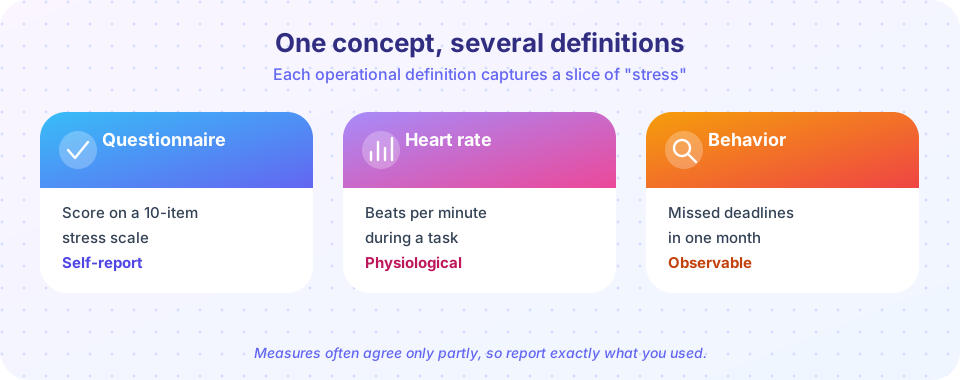
Two operational definitions of one concept often agree only partly. A person may report poor sleep while a device records a normal night. If one study uses the questionnaire and another uses the device, they can disagree without either being "wrong." Reviews of a topic therefore have to look closely at how each study defined its key terms.
The best practice is converging operations: measure the same concept in several different ways. If they all point the same direction, you can be more confident that the pattern is about the concept and not about one quirk of one measure.
Common misconceptions
"An operational definition captures the whole concept." It captures one measurable slice of it. Stress is more than a heart-rate number.
"The IV is always something the researcher controls." Only in an experiment. In other designs, the predictor is simply measured.
"Control variables are the same as the control group." A control variable is held constant. A control group is a comparison condition.
Try it
Press Run (or Ctrl + Enter) to see the result here.
Program input · what you'd type while the program runs
Type the answers before you press Run, one per line. Each time the program reads a line (with input()), it gets the next line from this box.
Press Run (or Ctrl + Enter) to see the console output here.
No output.
Check your understanding
Quick check · 5 questions
of 5 answered You scored / 5 · perfect!
-
1. In an experiment on practice quizzes and test scores, the test score is the
The DV is the outcome that is measured. The practice quiz is the manipulated IV. -
2. Which is the best operational definition of 'attention'?
It states a procedure, a score and a time frame that another researcher could repeat. -
3. A confounding variable is one that
Confounds vary systematically with the IV, so you cannot tell which one caused the change in the DV. -
4. Why use converging operations?
If several different measures agree, the result is less likely to be a quirk of one measure. -
5. Which pair is correctly matched?
A control variable is kept the same. A control group is a separate condition for comparison.
Summary
- A construct is an abstract idea; a variable is something measurable that can vary.
- IV is manipulated, DV is measured, controls are held constant, and confounds vary with the IV and muddy the result.
- Operational definitions state how a concept is measured or manipulated, precisely enough to repeat.
- Different definitions of the same concept can give different results, so check them and use converging operations.
Track your progress
Create a free account to tick off lessons and pick up where you left off on any device.
of Research Methods in Psychology lessons completed