


















Lesson 1 of 44 · Getting Started
Course Map: How Psychologists Know What They Know
Start here: what research methods in psychology covers, who the course is for, how to study it, and a map of all nine chapters from first questions to final projects.
Every claim in psychology comes from somewhere. "Sleep helps memory." "Violent games make people aggressive." "Praise should focus on effort." Behind each sentence sits a study, a way of measuring, a group of people, and a set of choices that the researchers made. This course teaches you to see those choices. Once you can, you can judge a claim instead of just believing it or rejecting it.
Research methods is sometimes called the dullest course in a psychology degree. It does not have to be. It is the course where you learn how detectives of the mind actually work: how to ask a question that data can answer, how to measure something as slippery as happiness, how to avoid fooling yourself, and how to tell a convincing result from a lucky accident.
Educational information only. This course teaches how research works. It describes studies and ideas for learning, and it is not a source of diagnosis, treatment or personal advice. If you are worried about your own mental health, talk to a qualified professional or a local health service.
What you will learn
- What this course covers and how its nine chapters fit together.
- Who the course is for and what you need to know before you start.
- A study routine that works for a methods course.
- How the interactive demonstrations in the lessons are meant to be used.
Key terms
Research method: a planned, repeatable way of collecting and checking evidence.
Empirical: based on observation or measurement rather than on authority or intuition alone.
Variable: anything that can take different values, such as age, mood or reaction time.
Hypothesis: a specific, testable prediction.
Replication: repeating a study to see whether its result appears again.
Who this course is for
The course is written for learners of about 11 to 18, for first-year university students, and for adults who want to read science news more critically. You do not need advanced mathematics. You will meet a few simple formulas in the chapters on measurement and statistics, and every one is explained with a worked example and a small program you can run in your browser.
You do need curiosity about people. If you have ever asked "how do they know that?" about a headline, you are ready.
The map: nine chapters
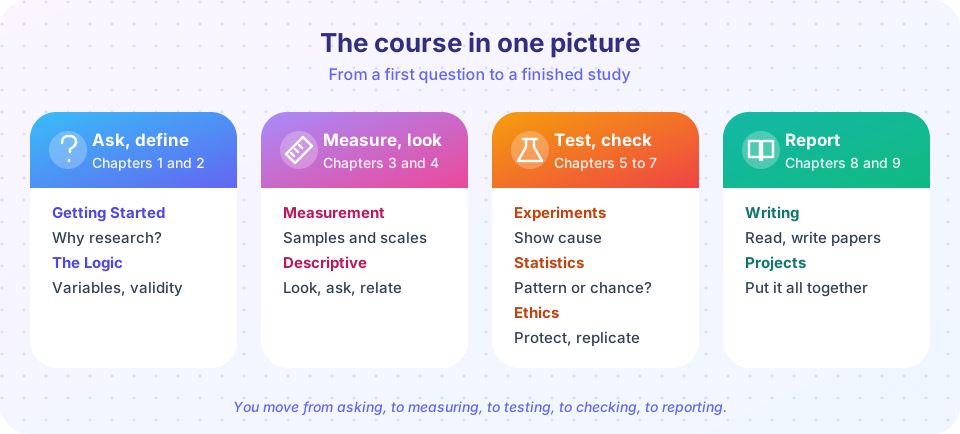
The chapters follow the life of a study, from the first idea to the printed report.
| Chapter | Question it answers |
|---|---|
| 1. Getting Started | Why does psychology need research methods at all? |
| 2. The Logic of Research | How do theories, hypotheses, variables and validity fit together? |
| 3. Measurement and Sampling | How do you measure a mind and choose who to study? |
| 4. Descriptive and Correlational Studies | What can watching, asking and correlating tell you? |
| 5. Experimental Design | How do you show that one thing causes another? |
| 6. Statistics for Psychologists | How do you tell a real pattern from chance? |
| 7. Ethics and Replication | What must researchers protect, and how do we check results? |
| 8. Writing and Evaluating Research | How do you read and write a research article? |
| 9. Projects and Practice | How do you put it all together in a complete study? |
This first set of lessons covers chapters 1 to 4. Chapter 4 ends where the experiment begins, so you will already understand why experiments were invented before you meet them.
Ask
Measure
Look and compare
Check and share
How to study this course
- Read with a pen. For every study you meet, write down four things: the question, who took part, what was measured, and what the result does and does not show.
- Run the demonstrations. The Try it boxes are small simulations. Change a number and run them again. Seeing a result move teaches more than reading about it.
- Predict before you check. In the quizzes, commit to an answer before you open the explanation.
- Keep a "can I trust this?" notebook. Each time you read a psychology headline, note what a careful reader would ask.
- Revisit the chapter reviews. Each chapter ends with a review lesson that mixes everything from that chapter in one quiz.
A note on how to read the demonstrations
The programs in this course are labelled. Some are simulations: they generate made-up people so you can see how a method behaves. Some are demonstrations of an idea, such as a scoring sheet. None of them is a psychological test, and none reports real measurements of real people. When a lesson describes a famous study, it states what the researchers reported, and where a finding has been challenged or not replicated, it says so.
Try it
Press Run (or Ctrl + Enter) to see the result here.
Program input · what you'd type while the program runs
Type the answers before you press Run, one per line. Each time the program reads a line (with input()), it gets the next line from this box.
Press Run (or Ctrl + Enter) to see the console output here.
No output.
Check your understanding
Quick check · 4 questions
of 4 answered You scored / 4 · perfect!
-
1. What does the word empirical mean?
Empirical claims rest on evidence gathered by observing or measuring, not on authority or intuition alone. -
2. In the first simulation, why did the two measurements differ for the same students?
Every measurement adds some random error. This is why measurement quality gets its own chapter. -
3. Which chapter deals with showing that one thing causes another?
Experimental design (chapter 5) is built to test cause and effect. Chapter 4 covers methods that cannot. -
4. The demonstrations in this course are best described as
They are teaching tools. They do not diagnose anyone and they do not report real data.
Summary
- Research methods teaches you how psychological claims are produced, so you can judge them.
- The nine chapters follow a study from question to report.
- Study actively: take notes on the question, sample, measures and limits of each study.
- The demonstrations are labelled simulations, not tests and not real data.
Next: Psychology as a Science
Track your progress
Create a free account to tick off lessons and pick up where you left off on any device.
of Research Methods in Psychology lessons completed