


















Lesson 2 of 44 · Getting Started
Psychology as a Science
Why intuition, authority and experience fall short, and how the scientific method helps psychologists avoid fooling themselves. Includes hindsight bias, confirmation bias and Clever Hans.
People have always had theories about people. Your grandmother has one, your favorite novelist has one, and so do you. Many of these theories are insightful. Some are wrong. The trouble is that wrong ideas feel exactly as convincing as right ones. Psychology became a science because its founders wanted a way to tell the two apart.
This lesson shows why everyday ways of knowing are not enough, which mental habits mislead us, and what the scientific approach adds. You will also try two small demonstrations of how easily intuition goes astray.
What you will learn
- Why intuition, authority and personal experience can mislead.
- Three well-documented thinking habits that bias judgment: hindsight bias, confirmation bias and the pattern-seeking habit.
- The main features of the scientific approach: empirical, systematic, public and self-correcting.
- What it means to say psychology is a science, and what that does not mean.
Key terms
Intuition: a quick feeling that something is true, without explicit reasoning.
Hindsight bias: the tendency to see an outcome as having been predictable after you know it.
Confirmation bias: favoring evidence that fits what you already believe.
Empiricism: the view that knowledge should rest on observation.
Falsifiable: capable of being shown wrong by some possible observation.
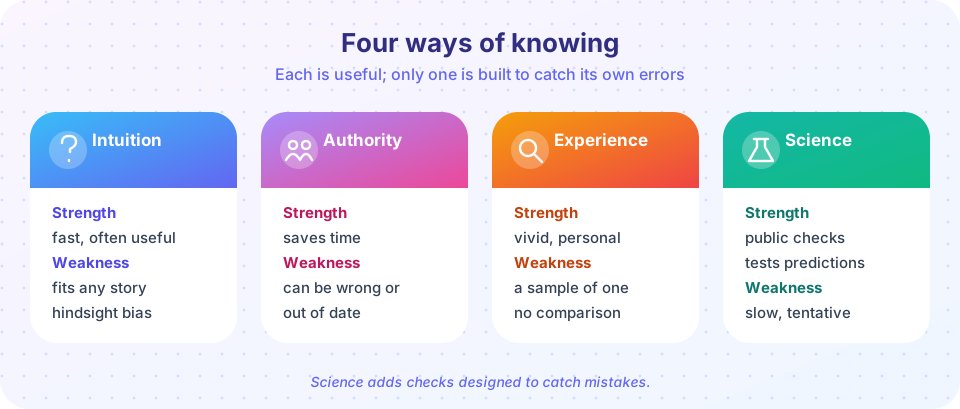
Four ways of knowing
Think about how you came to believe that "opposites attract" or that "you only use ten percent of your brain." Probably from one of four sources.
Intuition. It feels obvious. Intuition is fast and often useful, but it is shaped by what you have happened to notice.
Authority. A teacher, a book or an expert said so. Experts are often right, but they can also be out of date, and some are simply confident. The key question is what evidence the authority is relying on.
Personal experience. "It worked for me." Your own life is a sample of one, observed with no comparison and with your own expectations in mind.
The scientific method. Claims are turned into specific predictions, tested with carefully gathered observations, shared publicly, and revised when the evidence says so.
The first three are not worthless. Good scientific ideas often start with an intuition. The difference is that science adds checks designed to catch errors.
Why minds mislead themselves
Hindsight bias
In the 1970s, Baruch Fischhoff ran studies in which people were told how an event turned out and were then asked how likely they would have said it was beforehand. Those who knew the outcome tended to overestimate how predictable it had been. After the fact, everything seems to have been obvious.
This matters for psychology because many findings sound like common sense once you read them. If a result is described and you think "of course," try this test: would you have said "of course" about the opposite result too? Often you would. Intuition can explain any outcome, which means it predicts none.
Confirmation bias
Peter Wason's 1960 "2-4-6" task is a classic demonstration. People were told that the sequence 2, 4, 6 followed a rule the experimenter had in mind, and they had to discover the rule by proposing their own sequences and hearing yes or no. Many guessed "numbers increasing by two" and then tested only sequences like 8, 10, 12 that fit their guess. These all got a "yes," so they felt confirmed. But the real rule was much broader (any increasing sequence), so tests that could have shown the guess was too narrow, such as 1, 2, 3 or 5, 20, 100, were never tried.
The lesson is that finding examples that fit an idea is easy and proves little. Strong tests look for the result that would prove you wrong.
Seeing patterns in chance
People are very good at spotting patterns, including ones that are not there. Random sequences contain streaks, and streaks look meaningful. A fair coin tossed twenty times will often produce a run of four or five heads in a row, and many observers would call that suspicious.
What makes psychology scientific
Psychology is defined by its method, not by its subject matter. The scientific approach has four features.
- Empirical. Claims are tested against systematic observation.
- Systematic. Observations are planned and recorded, not just noticed.
- Public. Methods and results are shared so that others can inspect and repeat them.
- Self-correcting. When the evidence changes, the conclusions change. The field's own replication efforts are part of this (see chapter 7).
A famous example of why checks matter is Clever Hans, a horse in early-1900s Germany that seemed able to do arithmetic by tapping his hoof. In 1907, the psychologist Oskar Pfungst tested him under controlled conditions and found that Hans got the right answers only when the questioner knew the answer and could be seen. Hans was responding to tiny, unintentional changes in the questioner's posture. The horse was not doing sums, but he was an excellent reader of people. Pfungst's method, removing a possible cue and seeing if the effect disappeared, is the heart of experimental thinking.
Common misconceptions
"If it is not an experiment, it is not science." Careful observation, surveys and case studies are scientific too. They answer different questions from experiments.
"Science proves things." Science accumulates evidence that makes some explanations more or less plausible. In psychology especially, results are about tendencies in groups, not certainties about every individual.
"Common sense is enough." Common sense contains contradictions ("look before you leap" and "he who hesitates is lost"). Research tells you which holds, and under what conditions.
Try it
Press Run (or Ctrl + Enter) to see the result here.
Program input · what you'd type while the program runs
Type the answers before you press Run, one per line. Each time the program reads a line (with input()), it gets the next line from this box.
Check your understanding
Quick check · 5 questions
of 5 answered You scored / 5 · perfect!
-
1. Which feature best separates the scientific method from intuition?
Science is not error-free. Its strength is public, systematic checking and revision. -
2. A result sounds obvious after you read it, but you would also have found the opposite result obvious. This is typical of
Hindsight bias makes outcomes feel predictable after the fact, which is why intuition explains everything and predicts little. -
3. In Wason's 2-4-6 task, why did many people fail to find the rule?
Testing only cases that fit a guess always gives yes. Tests that could prove the guess wrong are far more informative. -
4. What did Oskar Pfungst show about Clever Hans?
Hans answered correctly only when the questioner knew the answer and was visible, so he was reading cues. -
5. Which statement about science is most accurate?
Scientific conclusions are tentative and based on accumulating evidence, and many designs besides experiments are scientific.
Summary
- Intuition, authority and personal experience are useful starting points but have known weaknesses.
- Hindsight bias, confirmation bias and pattern-seeking mislead everyone, including experts.
- Science is empirical, systematic, public and self-correcting.
- Clever Hans shows how removing a suspected cue can reveal the true explanation.
- Psychology is scientific because of its methods, not because it uses a laboratory.
Track your progress
Create a free account to tick off lessons and pick up where you left off on any device.
of Research Methods in Psychology lessons completed