


















Lesson 34 of 44 · Ethics and Replication
Chapter 7 Review: Ethics and Replication
Review the Belmont principles, informed consent, deception and debriefing, the replication crisis and open-science practices with a recap table and ten-question quiz.
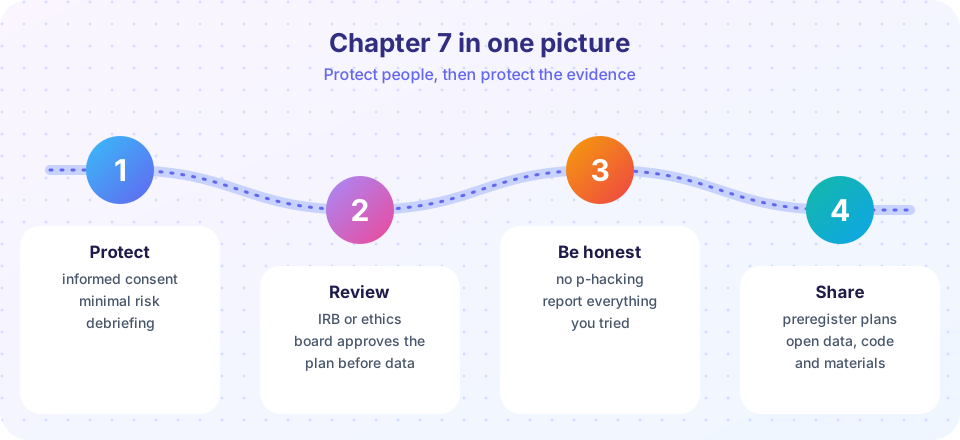
Protecting participants and protecting evidence are two halves of one commitment to honest research. This review ties them together and checks what you have retained.
Recap table
| Topic | What to remember | Lesson |
|---|---|---|
| Belmont principles | Respect for persons, beneficence, justice | Principles and cases |
| Informed consent | Plain language, voluntary, right to withdraw | Principles and cases |
| Deception | Last resort; justified; debriefed | Principles and cases |
| IRB | Independent review before data collection | Principles and cases |
| Privacy | Pseudonyms, separate keys, beware combinations | Principles and cases |
| p-hacking, HARKing | Flexible analysis and post-hoc stories inflate false positives | Replication and open science |
| Publication bias | Winners are published; nulls vanish | Replication and open science |
| Preregistration | Plan first; label the rest exploratory | Replication and open science |
| Open data and materials | Let others check and reuse | Replication and open science |
Connecting the two halves
Notice how often the same practice serves both goals. A clear preregistration protects readers from hidden flexibility, and it also protects participants, because an experiment designed with a justified sample size does not waste anyone's time or expose people to risk for a study that could never have answered its question. A study that is too small to detect anything is, in a sense, an ethical problem as well as a statistical one. Similarly, open data helps science but can threaten privacy unless the data are properly de-identified, so researchers need to hold both values at once.
Try it
A small planning helper that sorts study steps into "before data" and "after data" tasks. Add your own steps. It reinforces the key idea that protection of people and evidence happens mostly before data collection.
Press Run (or Ctrl + Enter) to see the console output here.
No output.
Check your understanding
Quick check · 10 questions
of 10 answered You scored / 10 · perfect!
-
1. Which is the best example of respecting persons?
Voluntary, informed participation is the core of respect for persons. -
2. Why is independent IRB review required?
An outside view guards against blind spots and conflicts of interest. -
3. A researcher analyses four outcomes and reports only the one with p < .05 as if it had been the plan. This is...
Selective reporting of flexible analyses inflates false positives. -
4. What problem does a registered report solve?
Because the study is accepted on the strength of its question and method, results can't influence publication. -
5. Which statement about Tuskegee is accurate?
It began in 1932 and ended in 1972; the Belmont Report followed in 1979. -
6. When is deception acceptable in psychology research?
The APA code allows it under tight conditions. -
7. A dataset contains age band, postcode and occupation but no names. The main privacy risk is...
Quasi-identifiers in combination can single out individuals. -
8. What happened to effect sizes in the Open Science Collaboration replications?
The average replication effect was about half the original. -
9. Which is an example of a conceptual replication?
Conceptual replications test the idea, not the exact procedure. -
10. Exploratory analysis in a preregistered study is...
Transparency is what matters.
Summary
- Ethics (Belmont principles, consent, deception rules, IRBs, privacy) protects participants.
- Replication practices (preregistration, registered reports, open data, large samples) protect the evidence.
- Many good practices serve both goals, and almost all of them happen before data are collected.
Track your progress
Create a free account to tick off lessons and pick up where you left off on any device.
of Research Methods in Psychology lessons completed